
You've completed an online BCA, or you're considering enrolling in one.
You understand that the degree covers computer applications, programming and technology-related subjects.
But there's a much more practical question.
What can you actually do with it?
Can you become a software developer?
Can you work in data analytics?
Will employers accept an online computing degree?
And what additional skills will you need before applying for jobs?
The answer is that an online BCA can provide a foundation for several technology-related career paths.
But the degree alone doesn't automatically make you ready for every technical role.
Understanding the gap between academic knowledge and workplace requirements is the most useful place to begin.
What Does an Online BCA Prepare You For?
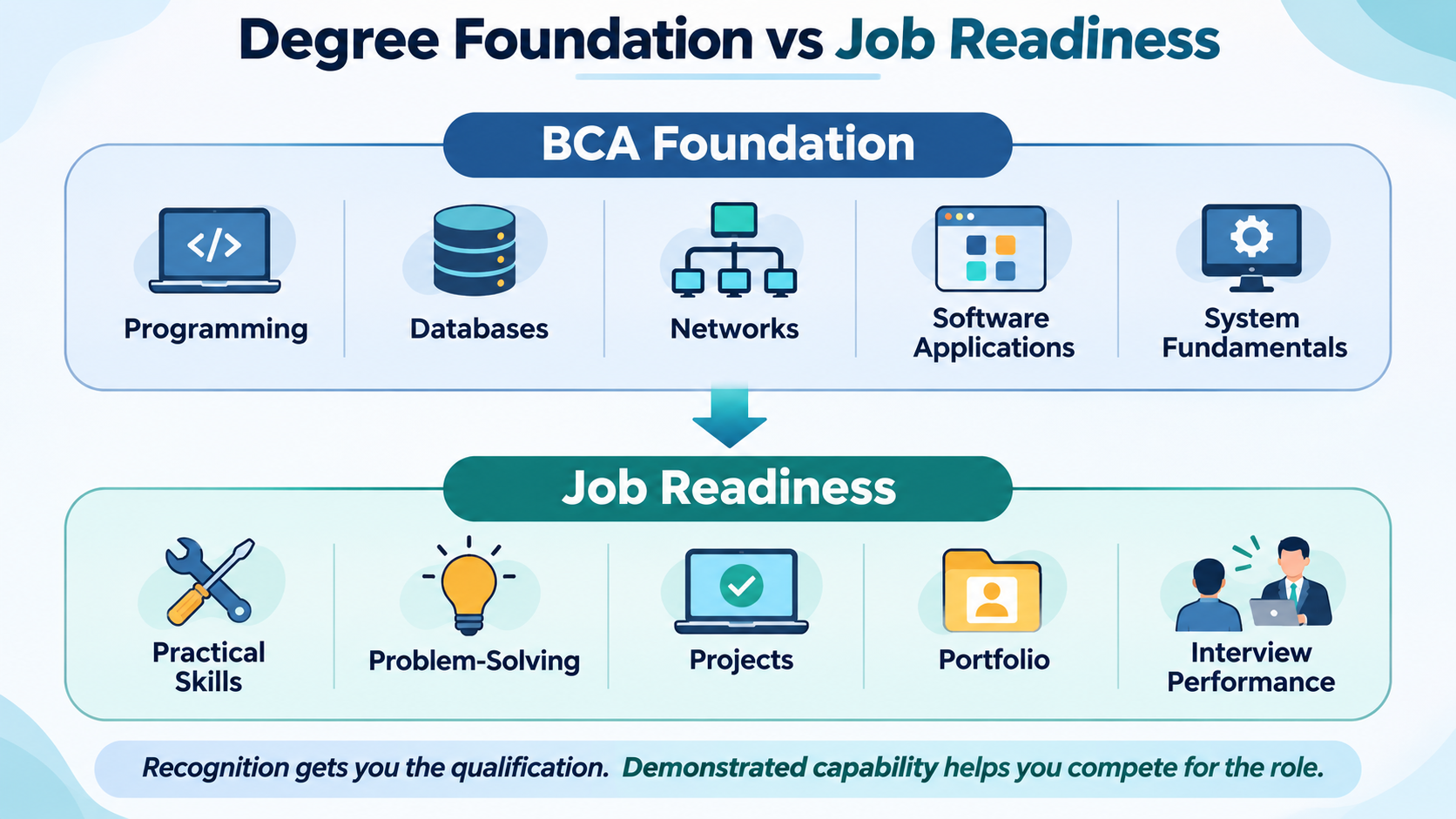
A Bachelor of Computer Applications generally introduces students to computing concepts such as programming, databases, software applications, computer networks and system fundamentals.
The exact curriculum depends on the university.
Some programmes may place greater emphasis on application development, while others include additional coursework in data analytics, cloud computing or emerging technologies.
An appropriately recognised online BCA provides a formal undergraduate qualification.
However, academic recognition and employment suitability are different questions.
Employers may evaluate your technical skills, ability to solve problems, project experience and performance in assessments or interviews.
For many technology roles, they want to understand whether you can actually use what you've studied.
That makes practical learning particularly important.
1. Software Development: Can You Build Applications?
Software development is one career direction a BCA graduate can explore.
Developers create, test and maintain software used by businesses and consumers.
Depending on the role, this could involve websites, mobile applications, enterprise software or backend systems.
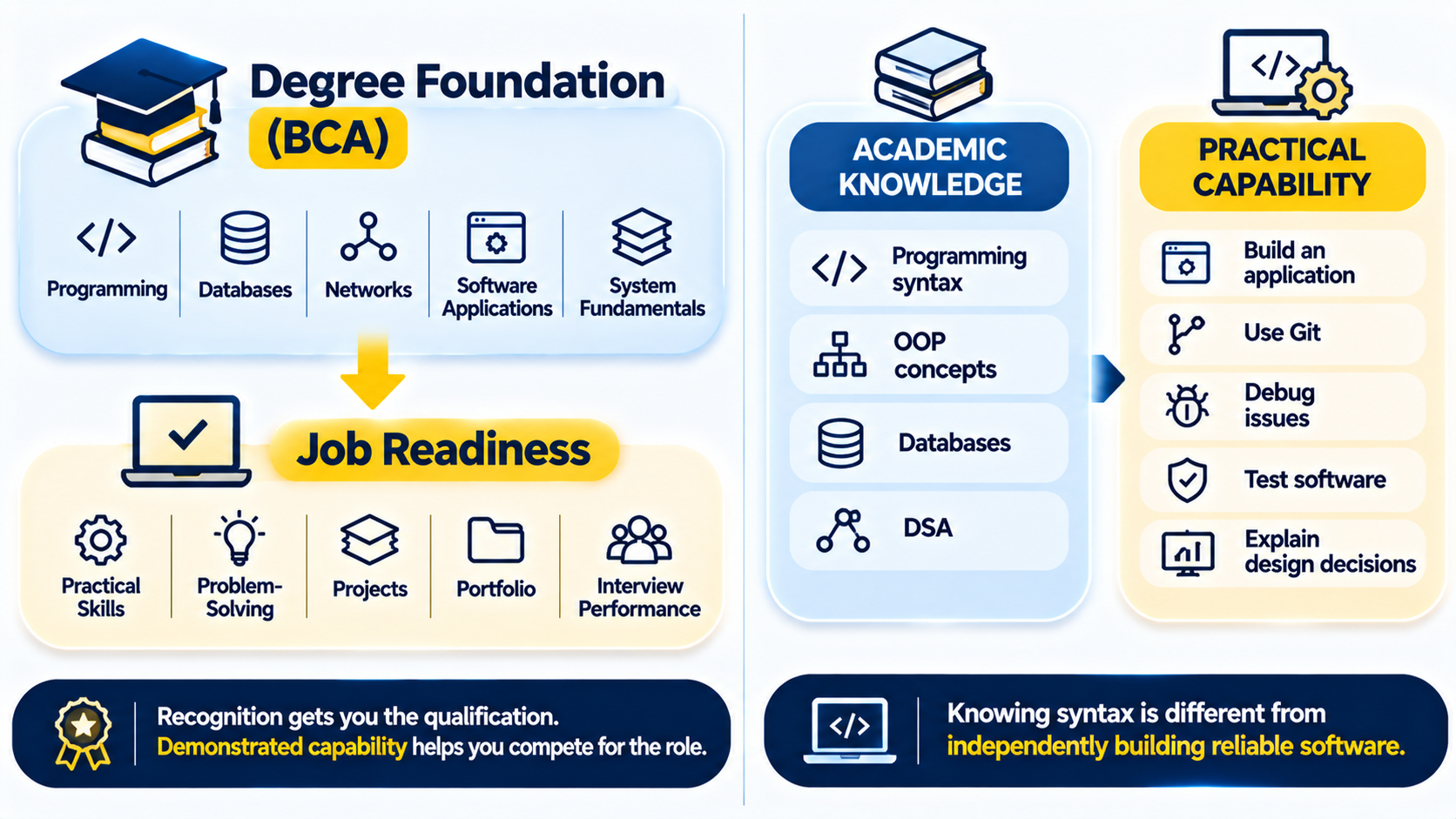
A BCA may introduce you to programming concepts, but employers can expect you to demonstrate them.
Useful areas to develop may include:
- Proficiency in a programming language such as Java or Python
- Data structures and algorithms
- Object-oriented programming
- Database fundamentals and SQL
- Version control using Git
- Debugging and software testing
The skill gap: Understanding programming syntax is different from independently developing reliable software.
A useful project could be a simple inventory management application.
Build a system where users can add products, update stock, search records and generate basic reports.
The project gives you an opportunity to apply programming, database and interface concepts together.
You should also be able to explain how the application works, what problems you encountered and how you solved them.
2. Data Analytics: Can You Turn Data Into Useful Answers?
Data analytics is another possible career direction.
A data analyst helps organisations understand information and identify patterns that support decisions.
For example, an e-commerce business may want to know which products sell best, which customers return and where sales are declining.
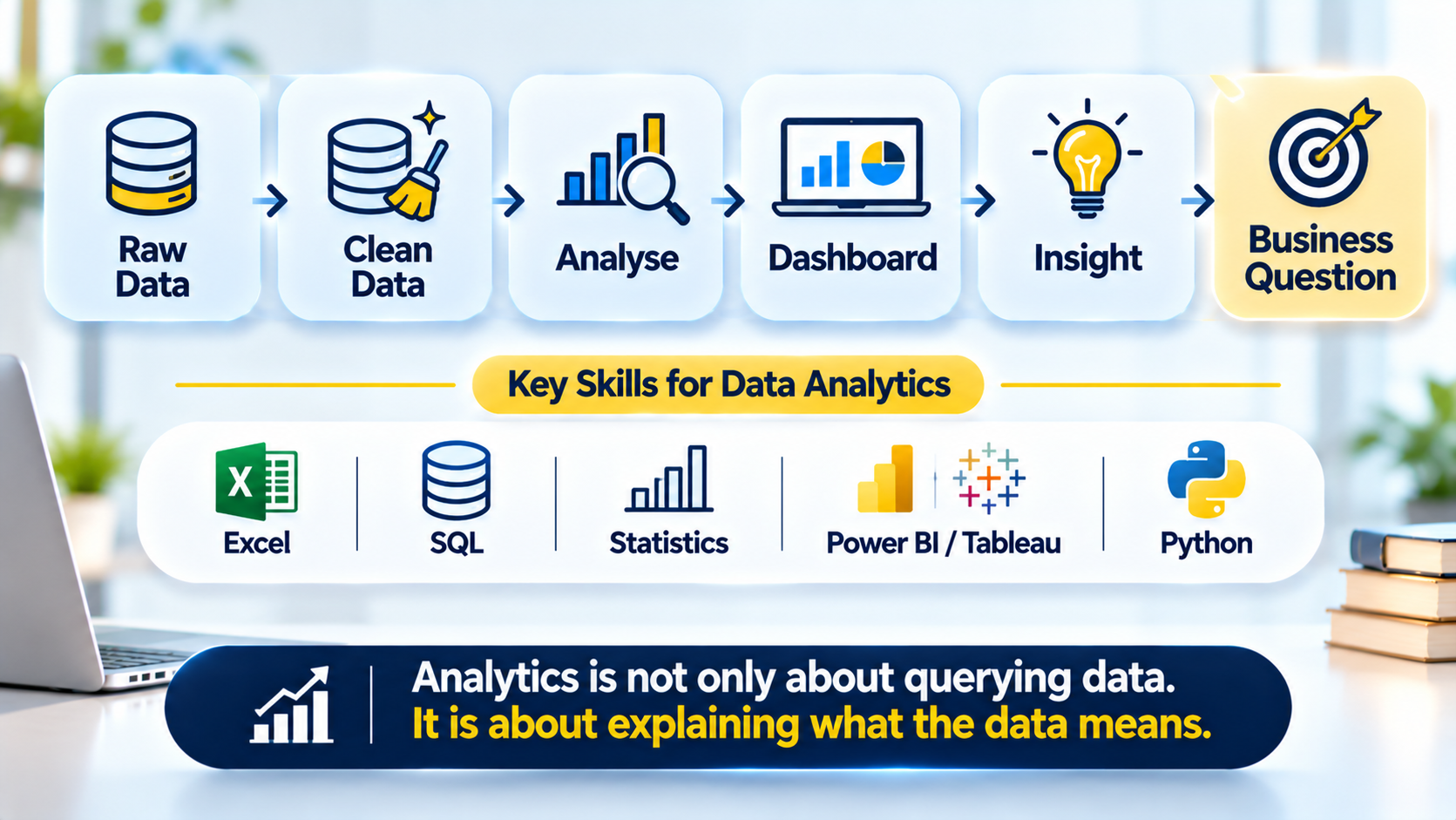
An analyst may organise data, calculate metrics, build dashboards and communicate findings.
For a BCA graduate, relevant additional skills may include:
- Excel or another spreadsheet tool
- SQL
- Basic statistics
- Power BI or Tableau
- Data cleaning and visualisation
- Python for data analysis, depending on the role
The skill gap: Knowing how to work with a database does not necessarily mean you can interpret business data.
Try analysing a publicly available sales dataset.
Identify the highest-performing products, changes in sales over time and possible reasons for declining performance.
Present your findings in a dashboard and explain what a business might investigate next.
A good analytics project should demonstrate both technical skills and reasoning.
3. Web Development: Can You Create a Working Website?
Web development involves building and maintaining websites and web applications.
Depending on the role, a developer may work on interfaces, backend functionality, databases or a combination of these.
A BCA can provide useful computing foundations, but web development requires familiarity with current development tools and practices.
You may need to learn HTML, CSS, JavaScript, an appropriate frontend framework, backend technologies and deployment basics.
The skill gap: Completing small programming exercises is different from creating an application that works across devices and handles real user interactions.
Build a portfolio website, an appointment booking application or a simple student management system.
Focus on functionality, accessibility, performance and clear documentation rather than adding unnecessary features.
4. Software Testing: Can You Identify Why Something Fails?
Not every computing career involves developing new applications.
Software testing and quality assurance focus on checking whether systems behave as expected.
Testers examine functionality, identify defects and help improve software reliability.
For someone who enjoys structured problem-solving and investigating errors, this can be an interesting pathway.
Relevant skills may include test-case design, defect reporting, software testing concepts, SQL, API testing and automation fundamentals.
The skill gap: Using an application and noticing an error is not the same as systematically evaluating software quality.
Try testing a simple web application.
Document the expected behaviour, create test scenarios, identify defects and explain how to reproduce them.
This can demonstrate attention to detail and an understanding of software quality processes.
5. Cloud and IT Support: Can You Understand How Systems Operate?
Some BCA graduates may be interested in IT operations, technical support, cloud services or infrastructure-related roles.
These positions can involve troubleshooting systems, managing user access, supporting networks or assisting with cloud-based environments.
Useful foundations may include computer networks, operating systems, Linux, cloud fundamentals, scripting and basic security practices.
The skill gap: Classroom knowledge of networks does not automatically prepare you to troubleshoot real infrastructure problems.
An introductory project might involve configuring a small cloud environment, documenting its architecture and explaining the basic security and access controls.
Start with fundamentals before pursuing specialised cloud engineering responsibilities.
6. Cybersecurity: Can You Identify and Understand Risks?
Cybersecurity is often presented as an attractive career option for computing graduates.
But the field involves much more than learning a few security tools.
Depending on the role, professionals may work on monitoring, vulnerability assessment, security operations, risk management or incident response.
A BCA graduate interested in cybersecurity should build strong foundations in networks, operating systems, programming and security concepts.
Practical training should take place in authorised environments, such as guided labs and controlled simulations.
The skill gap: Knowing security terminology is not the same as being able to analyse incidents or secure systems effectively.
Entry-level security support or trainee pathways may be possible, but more specialised roles require additional competence and experience.
Why Practical Projects Matter So Much
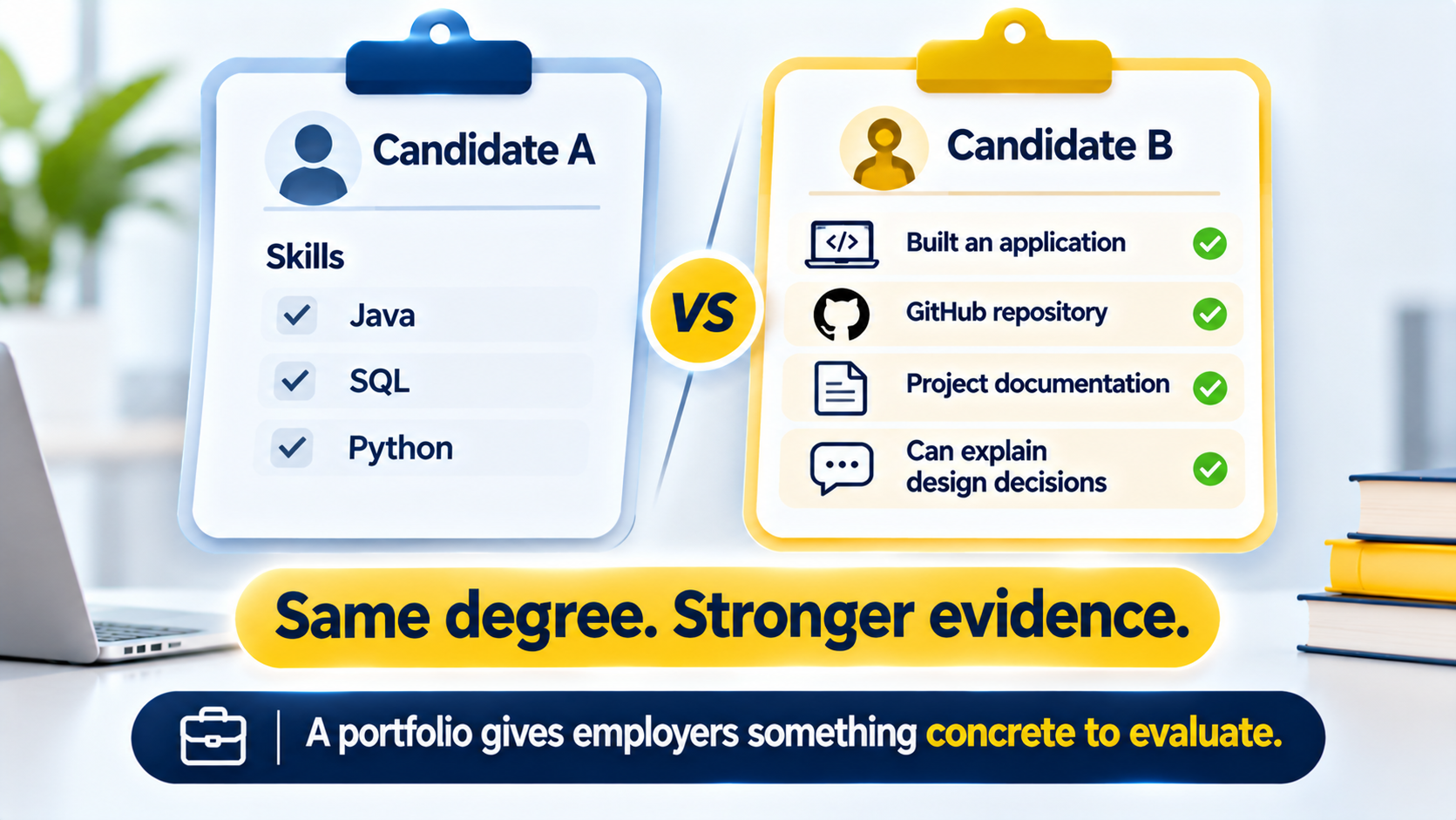
Imagine two candidates applying for the same junior software role.
Both have completed an online BCA.
Candidate A lists Java, SQL and Python on their résumé.
Candidate B has used those skills to develop a small application, maintains a GitHub repository and can explain the decisions behind the project.
The second candidate gives the interviewer more evidence to evaluate.
That doesn't guarantee selection.
But it makes the discussion more meaningful.
For online learners, creating this evidence can be particularly useful because practical exposure may need to be developed deliberately alongside academic study.
A portfolio with two or three well-executed projects can be more informative than a long list of unrelated course certificates.
Build Evidence, Not Just a Skills List
Choose a career direction, build 2–3 relevant projects and create proof of what you can actually do.
Compare ProgrammesHow Can You Build Experience While Studying Online?
One advantage of online education is that it may give you greater flexibility around where and when you study.
You can potentially use some of that flexibility to develop professional experience.
Depending on your schedule and opportunities, consider internships, freelance assignments, collaborative projects, coding competitions or contributions to open-source software.
The quality of the work matters more than simply being busy.
Try to gain experience that connects with the career you want.
If you're interested in data analytics, work on data projects.
If you want to become a developer, build software.
If infrastructure interests you, practise system administration in appropriate learning environments.
Make your projects increasingly relevant as your skills improve.
Should You Pursue an MCA After Online BCA?
A Master of Computer Applications can be one option for graduates who want further structured computing education.
Depending on the institution, an MCA may offer advanced subjects in software development, computing systems, databases, analytics or related areas.
It may be useful if your desired career requires deeper technical knowledge, a postgraduate qualification or additional academic preparation.
However, an MCA is not automatically necessary for every technology job.
If your immediate gap is practical programming experience, a focused project or internship could be more relevant.
If you're interested in further study, research or roles requiring postgraduate qualifications, an MCA may make more sense.
Evaluate the curriculum, admission eligibility and academic status of the programme before enrolling.
Are Online BCA Degrees Accepted by Employers?
An online BCA awarded through an appropriately recognised programme can be a valid undergraduate qualification.
UGC regulations provide for equivalence with corresponding conventional qualifications when the relevant conditions are met.
But individual employers may have different recruitment criteria.
Some may place particular emphasis on academic background or learning format. Others may focus more heavily on technical assessments, practical skills and experience.
That is why you should verify two things.
First, whether the university and programme meet the applicable recognition requirements.
Second, whether your qualifications and practical capabilities match the jobs you intend to pursue.
Neither question should replace the other.
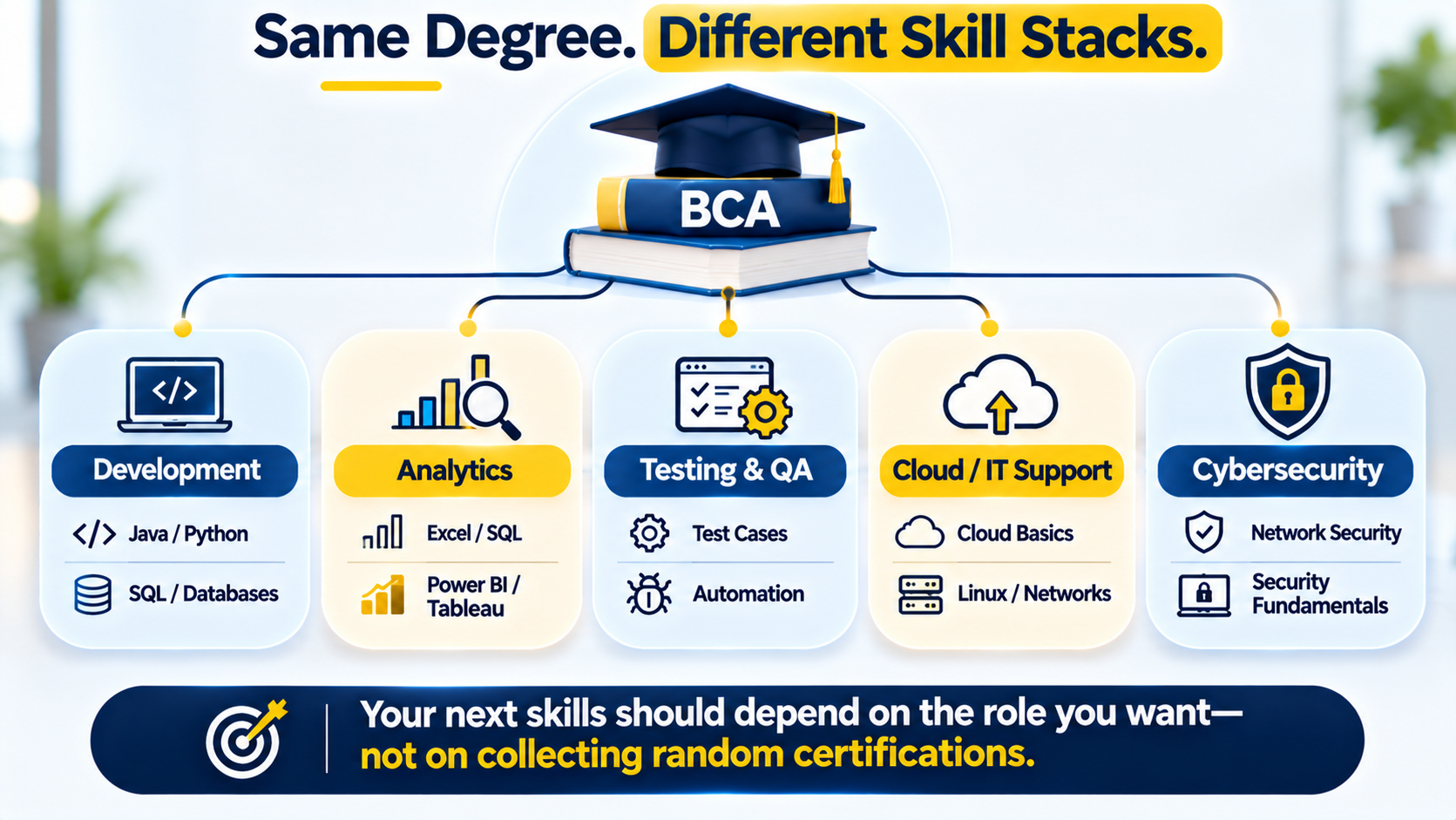
Create a Career Plan Before Collecting Certifications
A useful way to prepare for employment after an online BCA is to divide your development into three stages.
Stage 1: Choose a direction.
Explore software development, analytics, testing, infrastructure or another computing field.
Understand what professionals in that field do every day.
Stage 2: Identify your skill gaps.
Review entry-level job descriptions and compare their requirements with what you have already learnt.
Stage 3: Build evidence.
Complete relevant projects, seek practical exposure and prepare to explain your work during interviews.
This approach gives your learning a clear direction.
An online BCA can help you enter the world of computing.
But becoming employable involves turning that foundation into demonstrated capability.
For students exploring undergraduate computing programmes, Digivarsity provides access to learning pathways offered by partner institutions, which can be compared on curriculum, mode, eligibility and recognition.
The most useful question to ask before or after your degree is not simply:
"What jobs can I get with a BCA?"
Ask instead:
"What can I build, solve or demonstrate that makes me ready for the job I want?"
That's where meaningful career preparation begins.
Frequently Asked Questions
Can I get a software development job after an online BCA?
Yes, it is possible. However, opportunities depend on employer eligibility requirements, programming skills, projects, technical assessments and overall job readiness.
What are the best skills to learn after an online BCA?
The answer depends on your intended career. Software development may require programming, data structures and databases, while analytics may require Excel, SQL, statistics and visualisation tools.
Is an MCA necessary after completing an online BCA?
Not for every role. An MCA may be useful for advanced computing education or careers requiring postgraduate qualifications, but some graduates pursue employment directly by building relevant technical skills and experience.



Comments
Be the first to share your thoughts on this article.