
Five years into your career, something interesting often begins to happen.
You are no longer new to the workplace.
You understand how your function operates. You have probably handled difficult assignments, worked with different teams and developed a reasonable understanding of your industry.
But you may also be discovering that being good at your job and being ready to manage a business are not quite the same thing.
Perhaps you are moving towards a team leadership role.
Maybe your manager expects you to understand budgets, commercial decisions or business strategy.
Or perhaps you have reached a point where you want to move beyond your current specialisation.
That is when an Executive MBA can start looking attractive.
But is five years of experience the right time to pursue one?
The answer depends less on the number of years you have worked and more on the responsibilities you are preparing to take on.
Why Five Years Can Be an Important Career Stage
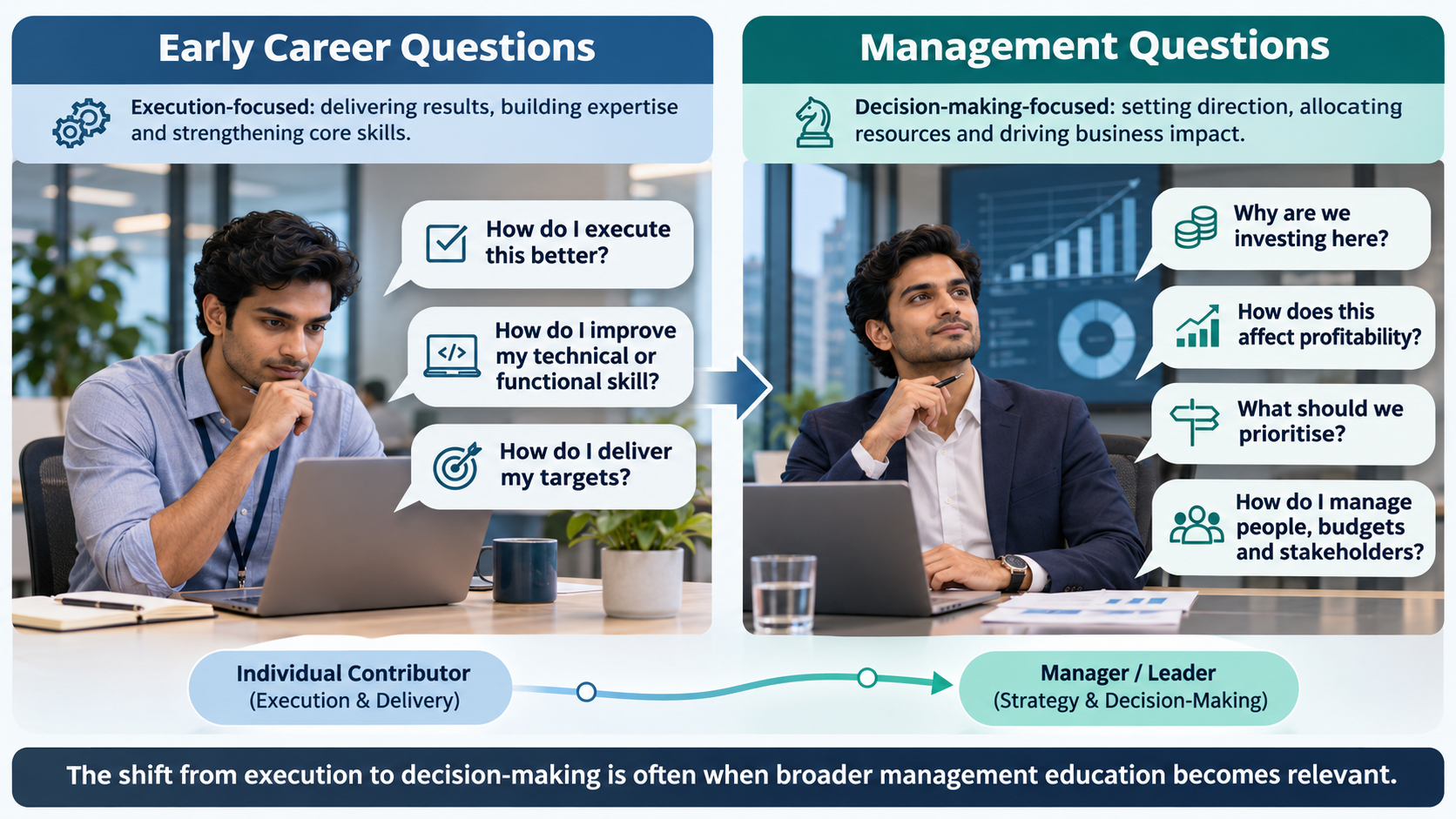
During the early part of a career, professional development often centres on becoming effective at a particular function.
A marketing professional learns campaigns, customers and performance metrics.
A software engineer develops technical expertise and solves increasingly complex problems.
A finance professional strengthens their understanding of reporting, analysis and financial processes.
As responsibilities increase, however, the questions begin to change.
Why is the business investing in this initiative?
How does our team's performance affect profitability?
What should we prioritise when resources are limited?
How do we manage people, budgets and stakeholders?
These questions require a broader understanding of how organisations work.
An Executive MBA may become relevant when your career begins shifting from functional execution towards management and cross-functional decision-making.
What Can an Executive MBA Add to Your Existing Experience?
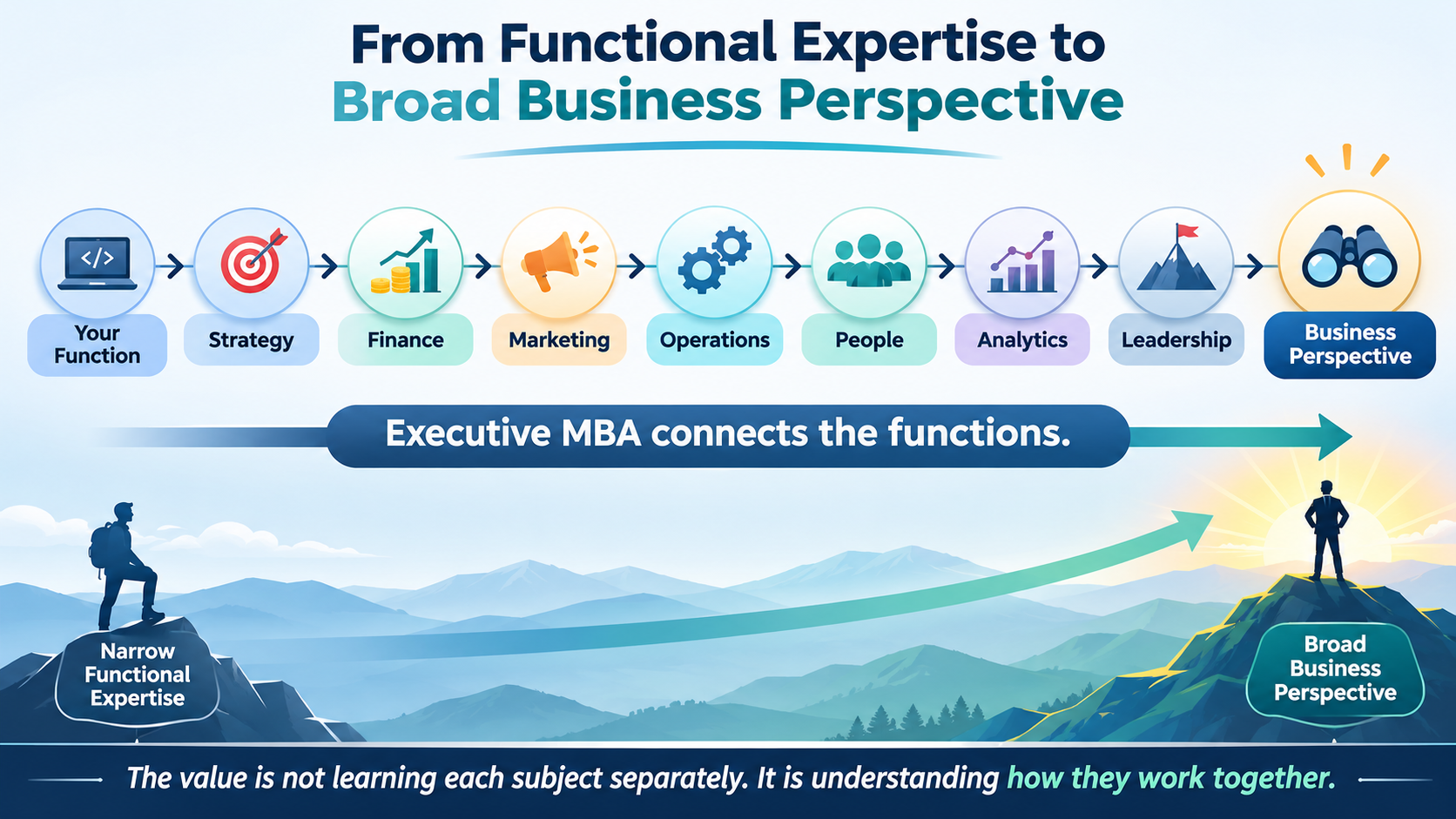
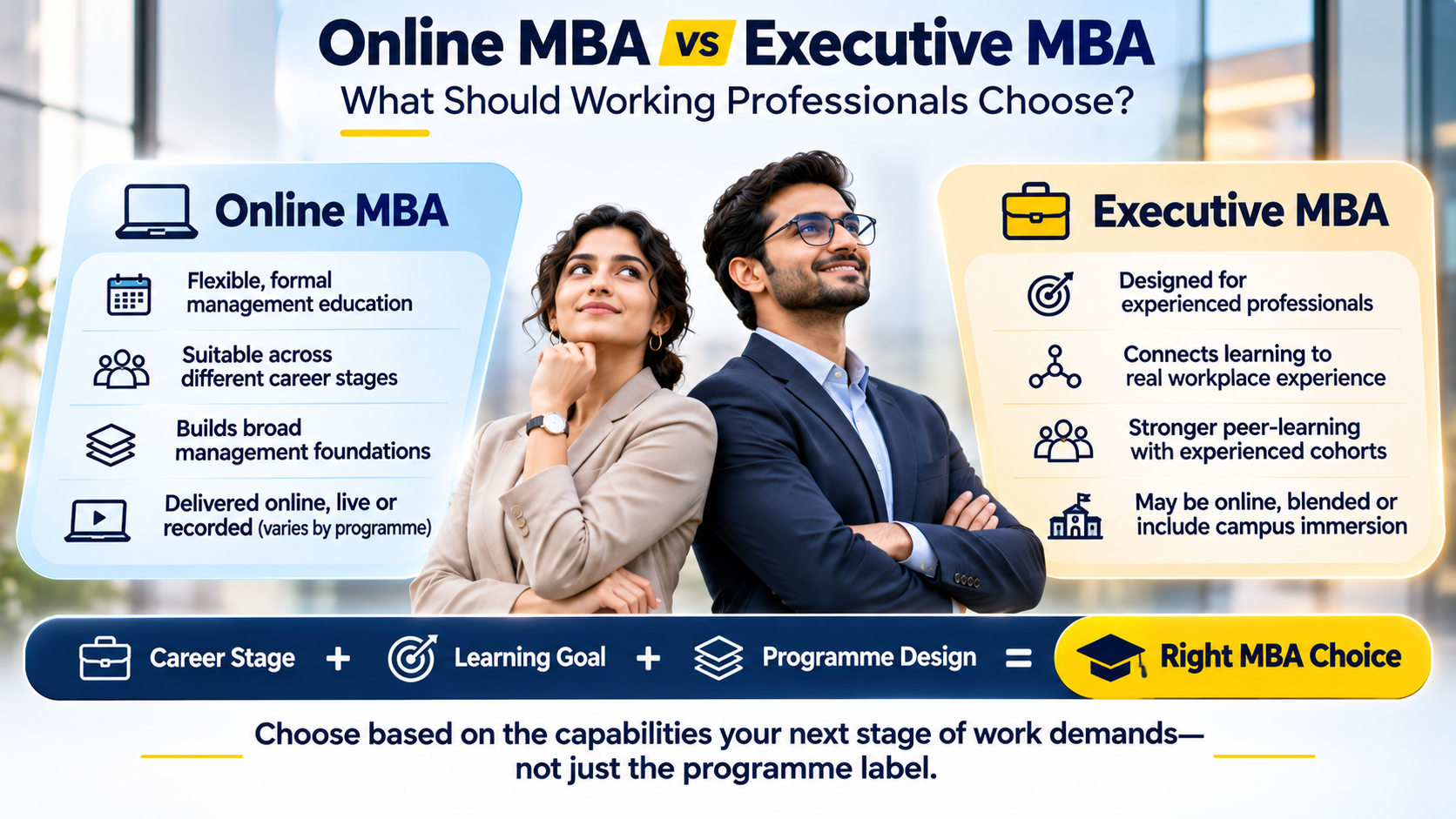
An Executive MBA generally aims to develop management and leadership capabilities among professionals who already have workplace experience.
Depending on the institution and programme, the curriculum may cover strategy, finance, marketing, operations, organisational behaviour, analytics and leadership.
The value is not simply learning these subjects individually.
It is understanding how they interact.
Consider a sales manager responsible for increasing revenue.
Strong sales skills can help them acquire customers and manage a team.
But larger business responsibilities may require them to understand profitability, pricing, working capital, resource allocation and organisational strategy.
An Executive MBA can provide structured opportunities to develop that wider perspective.
It can also expose learners to problems outside their own industries and functions.
That broader understanding becomes particularly useful when the next career step requires decisions affecting more than one department.
Ready to Build a Broader Business Perspective?
Explore Executive MBA Programmes.When an Executive MBA Makes Sense After Five Years
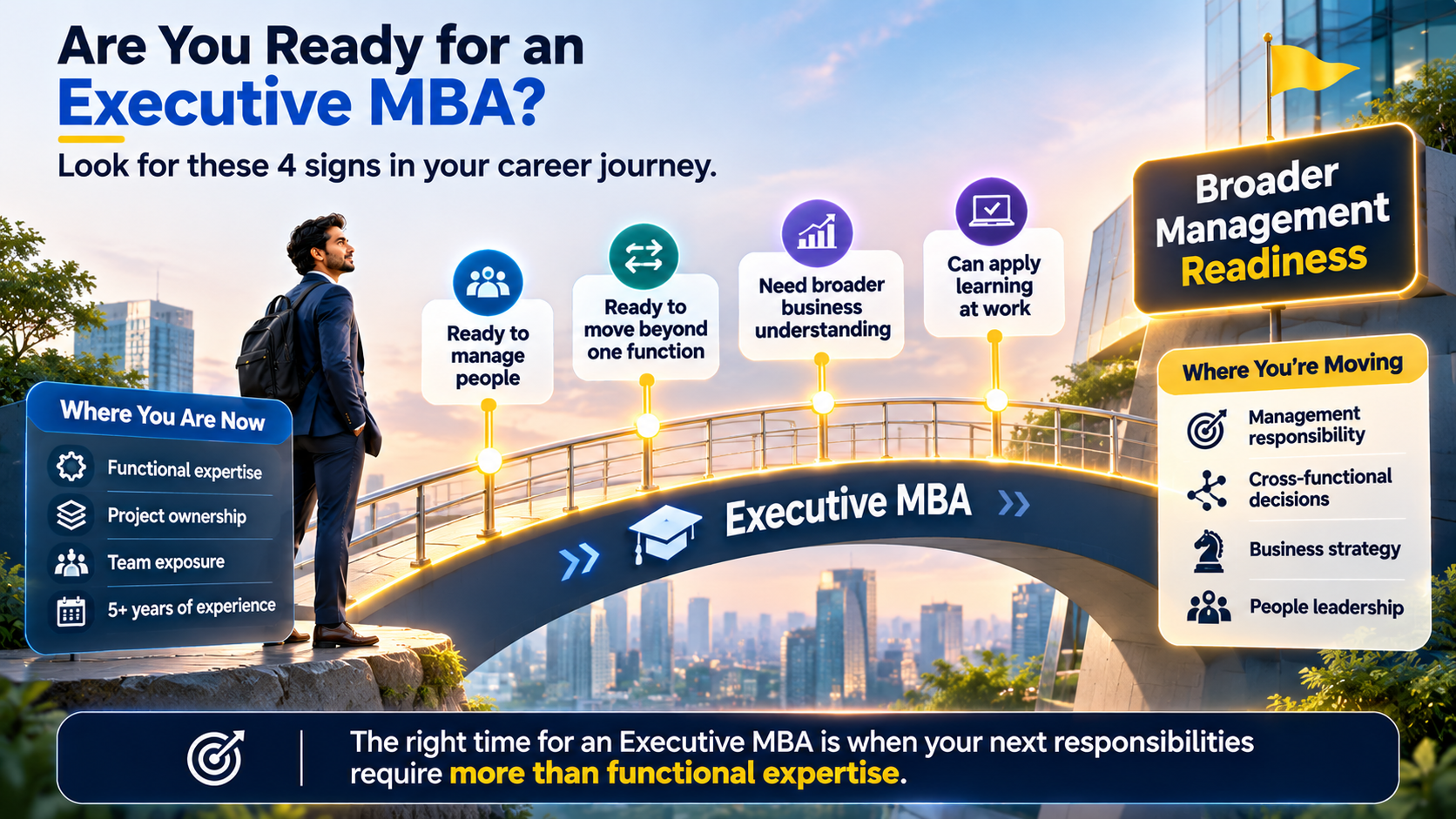
There are several situations where pursuing an Executive MBA could be worthwhile.
1. You Are Preparing for Your First Significant Management Role
You may already supervise colleagues or manage projects but have limited formal knowledge of management.
You need to understand performance, motivation, finance, operations and strategy.
An Executive MBA can help develop the management foundations required for broader responsibilities.
The important question is whether the programme supports the kind of leadership role you are realistically approaching.
2. You Want to Move Beyond Your Current Function
Suppose you have spent five years in software development but now want to explore product management or business leadership.
Your technical experience remains valuable.
However, your next role may also require customer understanding, commercial judgement, prioritisation and communication across functions.
A suitable management programme can help you broaden your perspective.
It will not automatically qualify you for a product leadership position, but it can strengthen relevant capabilities alongside your experience.
3. You Want to Understand How Businesses Make Decisions
Some professionals become highly capable specialists without receiving much exposure to the wider organisation.
They may understand what their department does but not how its work connects to financial performance, strategy or organisational priorities.
A management programme can help connect these different areas.
This may be useful even when you intend to remain in your current industry.
4. You Can Apply the Learning While Studying
This is an important advantage for working professionals.
If your role already involves budgets, stakeholders, projects or strategic decisions, you may be able to connect classroom learning directly with workplace challenges.
A discussion about pricing becomes more meaningful when you have seen customers negotiate.
A case study about team performance becomes easier to understand when you have experienced management problems yourself.
Professional experience gives academic concepts practical context.
When Five Years May Be Too Early for an Executive MBA
Five years of experience does not automatically make an Executive MBA the right investment.
You may be better served by another learning pathway if you are still uncertain about your intended career direction.
For example, suppose you work in technology and are considering an Executive MBA mainly because you feel your career has slowed down.
But the roles you actually want require stronger cloud architecture, cybersecurity or AI engineering capabilities.
In that case, a specialised technical programme may address your immediate needs more directly.
Similarly, if your primary objective is to improve one specific skill, an extensive management qualification may be unnecessary.
An Executive MBA makes more sense when broader management education is relevant to the responsibilities you want to pursue.
It should not become a default solution to every career problem.
The Peer Group Matters More Than You Might Think
Management learning is not limited to faculty lectures and textbooks.
Your classmates can become an important part of the experience.
Imagine discussing a supply chain challenge with someone from manufacturing, a finance professional, a consultant and a technology manager.
Each may approach the same problem differently.
Those conversations can reveal perspectives that are difficult to gain when your professional experience is concentrated in one function.
Before choosing a programme, examine the profile of its participants.
What experience levels does it attract? Which industries are represented? How much interaction does the format allow?
A strong peer-learning environment can make the experience richer, but networking benefits also depend on how actively you participate.
Understand the Financial and Professional Commitment
An Executive MBA can represent a substantial investment.
Beyond tuition fees, consider travel, campus immersion, study materials where applicable, financing costs and the time required for classes and assignments.
For someone with five years of experience, that investment may compete with other priorities.
So avoid judging the return only through a projected salary increase.
Think about several possible outcomes.
Could the programme help you manage more complex responsibilities?
Might it strengthen capabilities relevant to a planned role transition?
Could the knowledge improve your effectiveness in your current organisation?
Will you be able to apply what you learn?
These are useful questions, but the outcomes are not guaranteed.
The value of the qualification will depend partly on the opportunities available to you and how you use your new capabilities.
Five Questions to Ask Before Enrolling
Before making a decision, answer these questions.
- What is my intended next role? Define the responsibilities you want, not simply the title.
- What management skills am I currently missing? Identify gaps in areas such as finance, strategy, leadership or business decision-making.
- Does the programme address those gaps? Examine the curriculum, assessments, applied projects and learning format.
- Is the cohort right for my experience level? Look for a learning environment where you can contribute and benefit from peer discussions.
- Can I justify the full investment? Consider whether the timing, cost and workload fit your current circumstances.
If your answers are clear, you have a stronger reason to pursue an Executive MBA.
If they remain uncertain, it may be worth gaining more exposure to management responsibilities before committing.
Five Years Is a Reference Point, Not a Rule
Different Executive MBA programmes have different admission requirements and learning objectives.
Some welcome professionals with approximately three years of experience. Others are designed for substantially more experienced managers and business leaders.
The Executive MBA from IIM Bodh Gaya, for example, specifies a minimum of three years of full-time work experience after graduation. That eligibility requirement does not mean the programme is automatically right for everyone who qualifies.
You should also verify whether the programme awards a formal MBA degree or a different executive education credential, since programme titles and qualifications vary across institutions.
The most useful question is not:
"Have I worked long enough to do an Executive MBA?"
It is:
"Have I reached a point where broader management education will help me handle the responsibilities I want next?"
Five years can be an appropriate time to pursue an Executive MBA.
But readiness is better measured by career direction, learning needs and opportunity for application than by experience alone.
Is an Executive MBA the Right Next Move?
Explore Executive MBA and management programmes based on your experience, next role and learning goals.
Compare ProgrammesFrequently Asked Questions
Is five years of experience enough for an Executive MBA?
It can be. Some Executive MBA programmes accept professionals with three or more years of experience, while others require substantially more. Eligibility and suitability depend on the specific programme.
Will an Executive MBA help me get promoted?
It may strengthen your management capabilities and professional profile, but it does not guarantee promotion. Career progression also depends on experience, performance, organisational opportunities and the ability to apply what you learn.
Should I pursue an Executive MBA or a specialised certification after five years?
Choose based on your career objective. An Executive MBA may be more relevant for broader management and leadership development, while a specialised certification may be better when you need expertise in a particular subject or technology.


Comments
Be the first to share your thoughts on this article.