
You've completed your BCom, or you're approaching your final semester.
Now comes a familiar question.
Should you pursue an MBA or continue studying commerce through an MCom?
Both are postgraduate qualifications. Both can help you build on what you've already studied. And both may open up new academic and professional opportunities.
But they don't prepare you for exactly the same kind of work.
An MBA generally takes you towards broader business management, while an MCom allows you to study commerce, accounting, finance and related disciplines in greater depth.
The better choice isn't necessarily the degree with the more impressive reputation.
It's the one that fits the career you're trying to build.
First, Understand What Each Degree Is Designed to Do
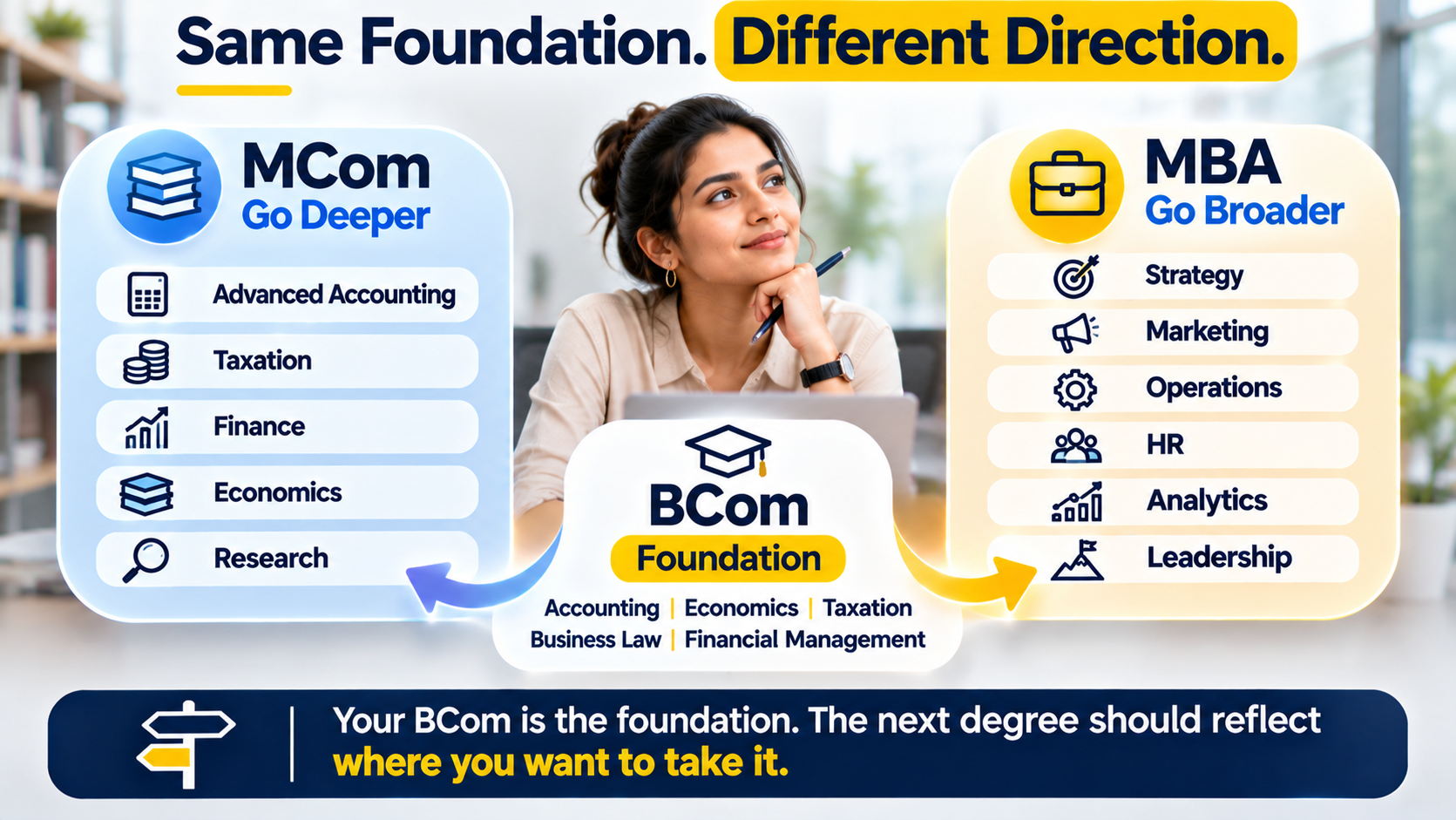
A Bachelor of Commerce provides a foundation in subjects such as accounting, economics, taxation, business law and financial management.
After graduation, you have two broad directions to consider.
You can deepen your understanding of commerce-related subjects.
Or you can broaden your education to understand how different business functions work together.
This is the fundamental difference between an MCom and an MBA.
An MCom builds on your commerce foundation.
Depending on the university, you may study advanced accounting, financial management, taxation, economics, research methods and other commerce-related subjects.
An MBA introduces a broader management perspective.
You may study marketing, operations, finance, human resources, strategy, business analytics and organisational behaviour.
Both can include finance and business-related subjects.
The difference lies in their overall emphasis, not in one degree teaching finance and the other ignoring it.
When Does an MCom Make More Sense?
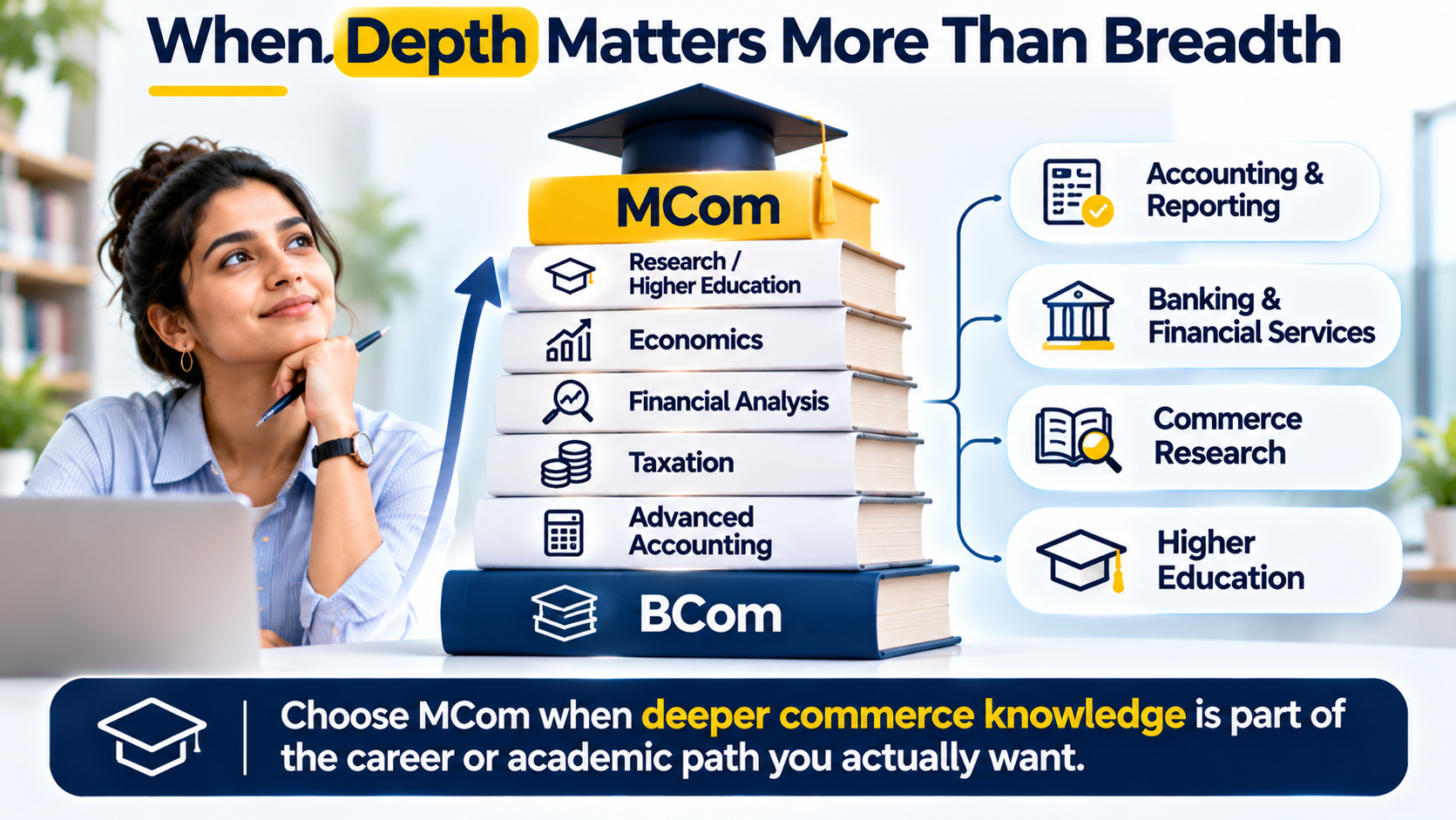
Suppose you enjoyed financial accounting, taxation and economics during your BCom.
You want to develop deeper knowledge in these areas, perhaps with the intention of pursuing a commerce-related career, further research or teaching.
An MCom may provide a suitable academic pathway.
It can be particularly relevant when your interests include:
- Accounting and financial reporting
- Taxation and commerce
- Banking and financial services
- Economics and financial analysis
- Academic research and higher education
For example, someone interested in teaching commerce at the college level may choose an MCom before pursuing the additional eligibility requirements applicable to academic positions, such as UGC-NET where required.
Similarly, a graduate interested in accounting and taxation may value the subject depth offered by an MCom.
However, the degree does not automatically qualify you as a Chartered Accountant, Cost Accountant or another regulated professional.
Those qualifications follow their own professional requirements.
An MCom is most useful when its subject matter connects with the work or further education you intend to pursue.
When Does an MBA After BCom Make More Sense?
Imagine you've completed a BCom and started working in a finance department.
You understand accounting and reporting, but over time, you become interested in how the organisation makes bigger decisions.
How does the business decide which markets to enter?
Why does one product receive more investment than another?
How are teams, budgets and operations managed?
These questions go beyond individual commerce subjects.
An MBA can help you develop a wider understanding of how businesses function.
It may be particularly relevant if you want to explore careers in:
- Marketing and business development
- Operations and supply chain management
- Business analytics and consulting
- Human resources and organisational management
- General management
- Corporate finance and related business functions
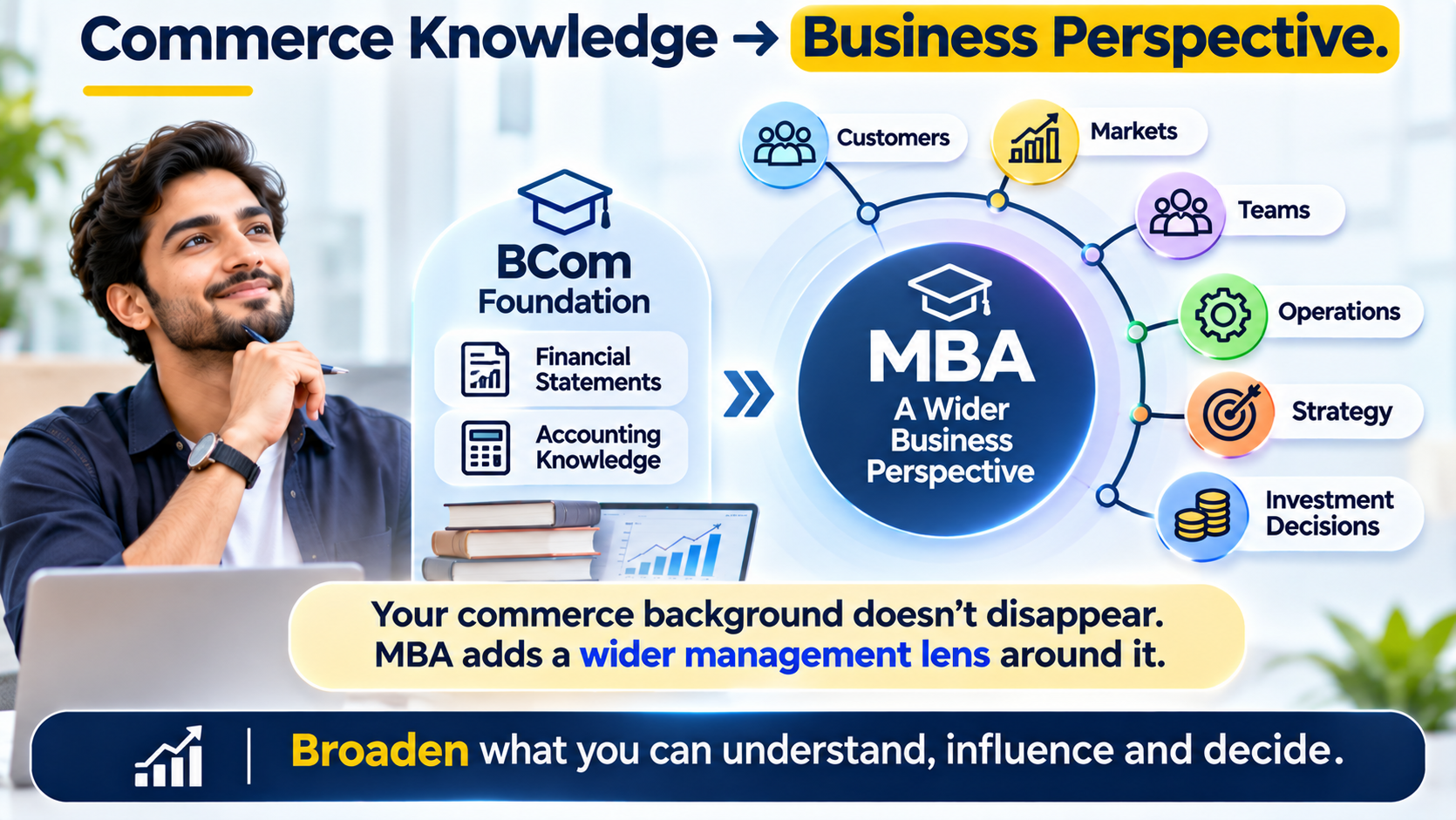
You don't necessarily need to abandon your commerce background.
In fact, it can become an advantage.
A BCom graduate who understands financial statements may find that knowledge useful when studying business strategy, pricing or investment decisions.
The MBA adds a broader management perspective to your existing foundation.
But the qualification alone does not guarantee a management position. Your practical skills, internships, projects and experience remain important.
MBA vs MCom: What Are the Main Differences?
|
These are general distinctions. Individual universities may offer specialised curricula that overlap considerably.
What If You Want a Career in Finance?
This is where many BCom graduates become confused.
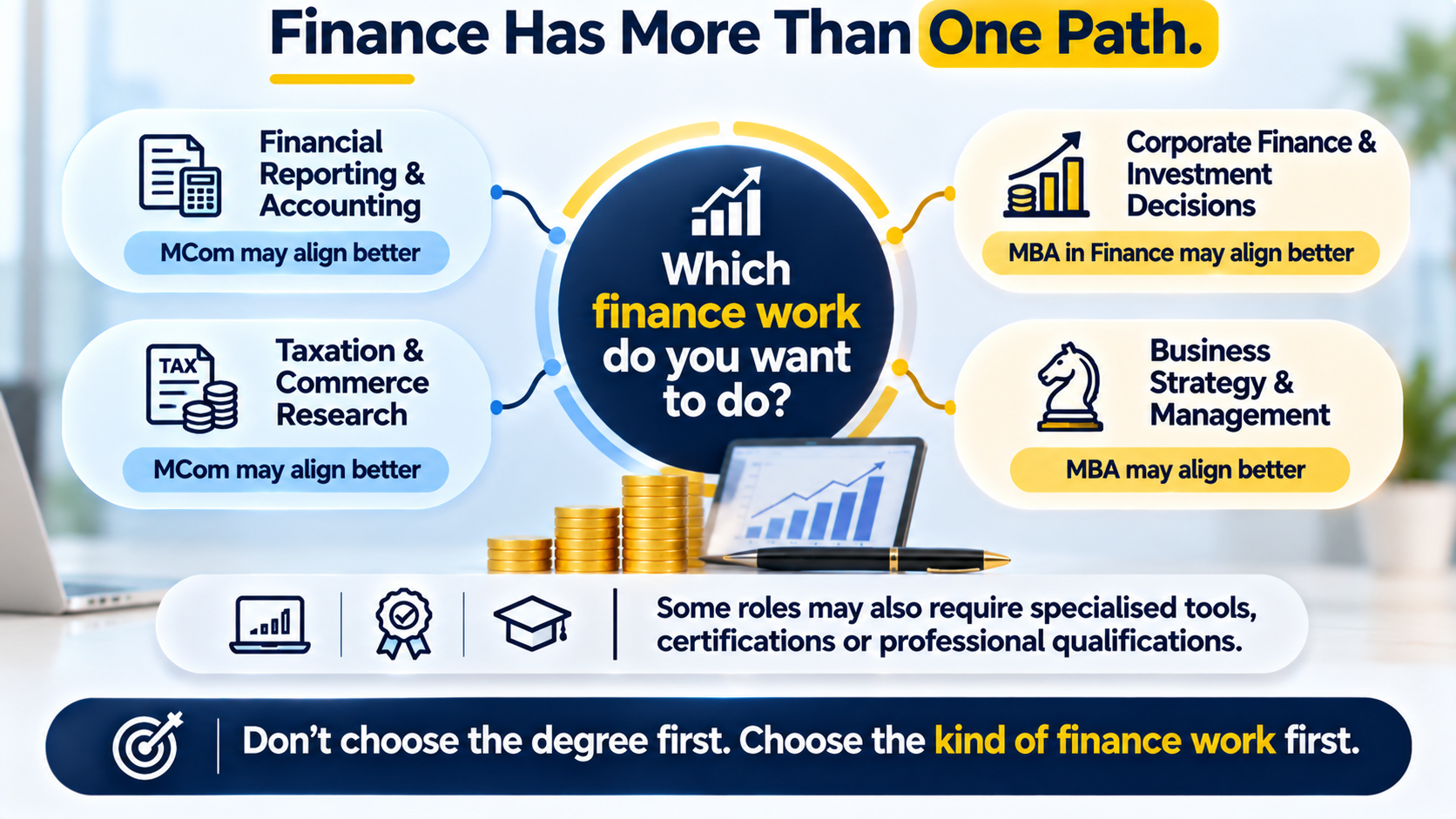
An MBA in Finance and an MCom can both be relevant to financial careers.
The difference is the kind of financial work you want to prepare for.
Suppose you're interested in financial reporting, accounting practices, taxation or commerce research.
An MCom may offer greater alignment with those interests, depending on its curriculum.
Now suppose you're interested in financial decision-making within a business, corporate finance, business strategy or management responsibilities.
An MBA in Finance may offer a more suitable combination of finance and management education.
But don't rely on the degree title alone.
Look at the subjects, practical assignments, analytical tools and types of roles you're targeting.
Some finance roles may also require specialised certifications, professional qualifications or substantial technical knowledge beyond either degree.
Interested in Finance but Not Sure Which Route Fits?
Compare programmes by curriculum, practical exposure and the type of finance work they prepare you for.
Explore MBA Finance ProgrammesShould You Start Working Before Pursuing an MBA?
Not necessarily, but work experience can change how you approach management education.
A fresh BCom graduate can pursue an MBA if they meet the programme's eligibility requirements.
However, someone who has worked for two or three years may bring a different perspective to discussions about customers, budgets, teams and business operations.
Neither route is automatically better.
If you're considering an MBA immediately after graduation, look closely at opportunities for practical learning, internships, projects and employer interaction.
If you're already employed, consider whether the programme can help you develop capabilities relevant to your current responsibilities or intended next role.
An MBA should have a clear purpose beyond adding another qualification to your résumé.
Can You Pursue an MBA or MCom Online?
Both qualifications may be available through recognised online programmes.
For graduates who are already working, online education can make it easier to continue studying while managing professional commitments.
However, flexibility is only one factor.
Before enrolling, verify that the university and the specific programme are appropriately recognised or entitled for the relevant academic session.
The University Grants Commission states that degrees awarded through recognised online programmes, in conformity with applicable regulations, are equivalent to their corresponding conventional qualifications.
This does not mean every online programme is automatically recognised.
Check the programme's recognition status through the official UGC Distance Education Bureau portal before making an admission decision.
The Three-Question Career Test
Before choosing an MBA or MCom, answer these questions.
- Which subjects do I genuinely want to study further?
If you're interested in commerce, accounting and financial concepts in greater depth, an MCom may be a natural direction.
If you want to understand how organisations are managed, an MBA may be more suitable.
- What kind of work do I want to do?
Don't stop at job titles.
Look at actual job descriptions. Understand what professionals in those roles do every day and which qualifications they require.
- What additional skills will I need?
An MBA student interested in analytics may need Excel, SQL or data visualisation.
An MCom student interested in finance may benefit from financial modelling, accounting software or taxation tools.
The degree provides structured education.
Your practical capabilities help you use that education professionally.
Choose Your Career Direction Before Your Degree
An MBA and an MCom are not simply two different ways of continuing education after BCom.
They represent different approaches to professional development.
An MCom may be a stronger fit when you want to deepen your expertise in commerce-related subjects.
An MBA may make more sense when you want to develop broader management knowledge and explore business functions beyond your undergraduate specialisation.
Neither qualification is automatically superior.
The right decision comes from understanding what you want to study, which career you want to enter and what that career actually requires.
If you're comparing postgraduate options, you can explore management and commerce programmes offered by partner universities through Digivarsity, paying attention to curriculum, recognition, delivery format and eligibility.
Don't choose the next degree simply because it is the expected step after graduation.
Choose it because you understand where you want that degree to take you.
Frequently Asked Questions
Is an MBA better than an MCom after BCom?
Neither is universally better. An MBA may suit graduates interested in management and broader business functions, while an MCom may be more relevant for advanced commerce, accounting, finance and academic interests.
Can I pursue an MBA immediately after BCom?
Yes. Many MBA programmes accept graduates without prior work experience, subject to their admission requirements. Some executive management programmes, however, require professional experience.
Is an MCom useful for a career in banking or finance?
It can be. An MCom develops commerce and financial knowledge, but eligibility for particular banking or finance roles may also depend on recruitment examinations, technical skills, professional qualifications and experience.



Comments
Be the first to share your thoughts on this article.