
You want to pursue an MBA without leaving your job.
You start researching programmes and quickly encounter two popular options.
Online MBA.
Executive MBA.
Both promise opportunities to develop management knowledge. Both may appeal to working professionals. And depending on the institution, both may offer flexible learning schedules.
So which one should you choose?
Before comparing fees, rankings or course durations, there is an important distinction to understand.
An online MBA describes how a programme is delivered. An Executive MBA generally describes whom a programme is designed for.
They are not necessarily opposite categories.
In fact, an Executive MBA may itself be delivered online or through a combination of online classes and campus learning.
Understanding that difference makes the choice much clearer.
What Is an Online MBA?
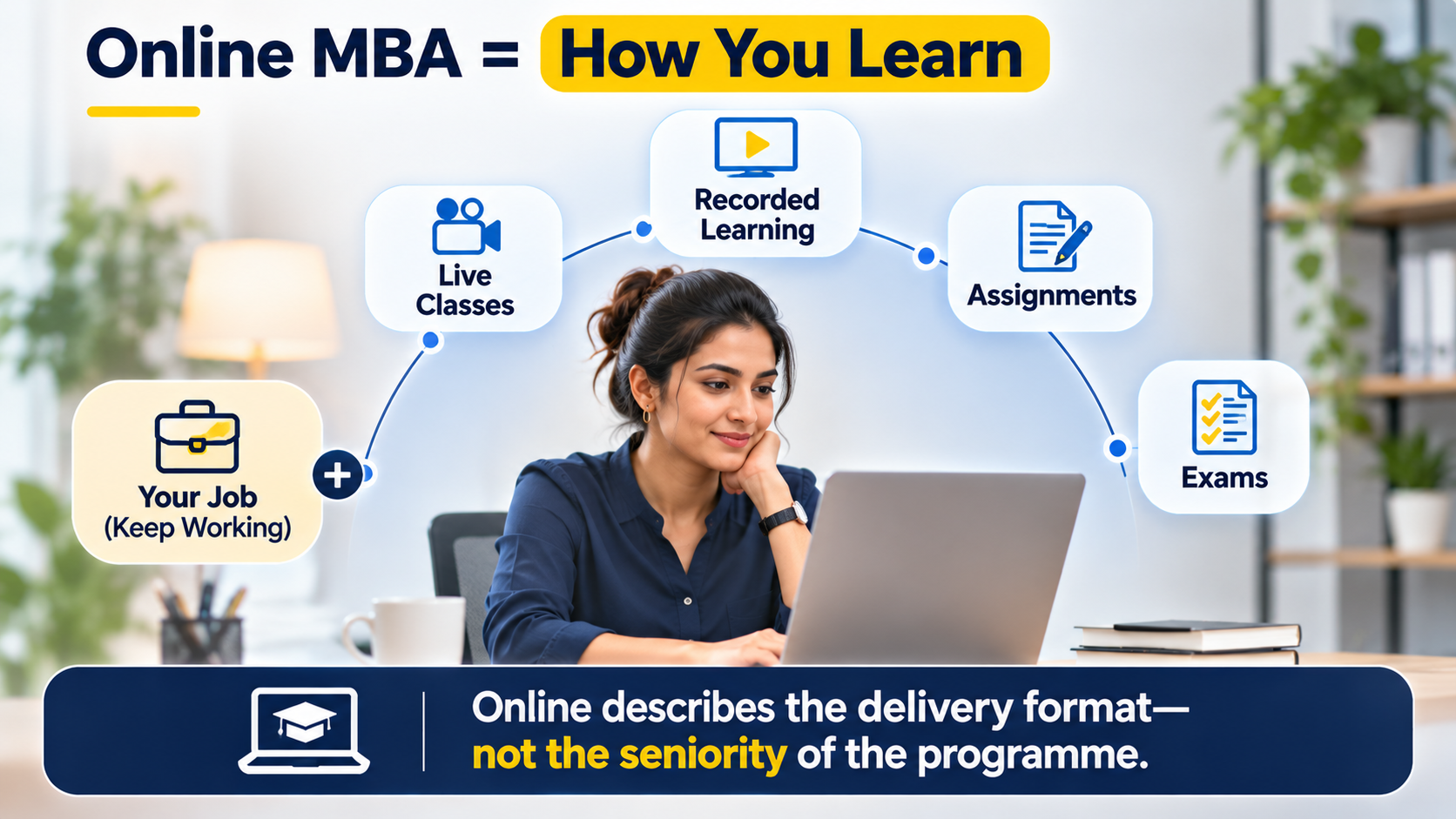
An online MBA is a management degree programme delivered primarily through online learning.
Depending on the institution, the experience may include live classes, recorded lectures, digital study materials, group assignments, online assessments and interactive discussions.
The attraction for working professionals is flexibility.
You can continue employment while pursuing formal management education without following the same daily campus schedule as a residential student.
A typical MBA curriculum covers subjects such as finance, marketing, operations, human resource management, organisational behaviour, economics and strategy.
Some programmes also offer specialisations in areas such as business analytics, finance, HR or marketing.
However, online MBAs can differ substantially in their teaching approach, faculty interaction, assessment methods and industry exposure.
The term "online" tells you how the programme is delivered, not necessarily how advanced or professionally relevant it is.
What Is an Executive MBA?

An Executive MBA, often called an EMBA, is generally developed for professionals who already have meaningful work experience.
The learning approach typically draws on situations encountered by working managers and executives.
Instead of discussing business concepts only as academic subjects, students may be encouraged to connect them with challenges from their organisations.
A discussion about business strategy may involve participants who have managed budgets, customers, teams or large projects.
A leadership case may become more meaningful when learners have already experienced the difficulties of managing people.
Executive MBA programmes may include live online teaching, weekend classes, in-person sessions, campus immersions, projects and peer discussions.
The exact format varies.
Importantly, the Executive MBA label does not by itself establish the academic status of the qualification. Verify the precise award and the institution's authority to confer it.
Online MBA vs Executive MBA: What Are the Main Differences?
|
Factor |
Online MBA |
Executive MBA |
|
Primary distinction |
Mode of delivery |
Intended professional audience |
|
Typical learners |
Graduates and working professionals at various career stages |
Professionals with established work experience |
|
Learning approach |
Structured management education delivered online |
Management learning often connected to participants' workplace experience |
|
Classes |
Online, live or recorded depending on the programme |
Online, classroom, blended or campus-based depending on the programme |
|
Work experience |
Requirements vary; some admit fresh graduates |
Usually requires meaningful professional experience |
|
Peer interaction |
Depends on programme design and cohort |
Often a significant element of the learning experience |
|
Qualification |
Formal MBA degree when appropriately awarded |
Verify the exact degree or other credential awarded |
These are general differences, not rules that apply to every institution.
A particularly important point is that an online Executive MBA can fit into both categories.
For example, the Executive MBA offered by IIM Bodh Gaya combines online learning with campus immersions and is designed for experienced working professionals.
It illustrates why learning format and programme audience should be evaluated separately.
When an Online MBA May Make More Sense
You Are Early in Your Career
Suppose you have two years of experience in sales and want to strengthen your understanding of business management.
You may not yet have extensive exposure to budgets, organisational strategy or large teams.
A suitable online MBA can help build foundational management knowledge while allowing you to continue working.
The priority would be finding a rigorous programme with relevant subjects, meaningful assessments and a format you can manage.
You Want a Formal Management Qualification
Some professionals pursue an MBA because a degree is relevant to their academic or career plans.
If that is your primary objective, establish exactly which qualification the programme awards.
A recognised online MBA degree may be an appropriate route, provided the specific programme meets the applicable regulatory requirements.
In India, the University Grants Commission states that degrees from appropriately recognised online programmes, offered in accordance with its regulations, are to be treated as equivalent to corresponding conventional awards.
However, students must verify the institution, programme and relevant admission session through the appropriate official sources.
You Need Flexibility Around Work
Online learning can be valuable when professional or personal responsibilities make regular campus attendance difficult.
But flexibility should not be confused with reduced academic effort.
You still need time for classes, assignments, examinations and independent learning.
Before enrolling, understand whether sessions are live or recorded, whether attendance is mandatory and how examinations are conducted.
The most useful schedule is one you can sustain throughout the programme.
When an Executive MBA May Make More Sense
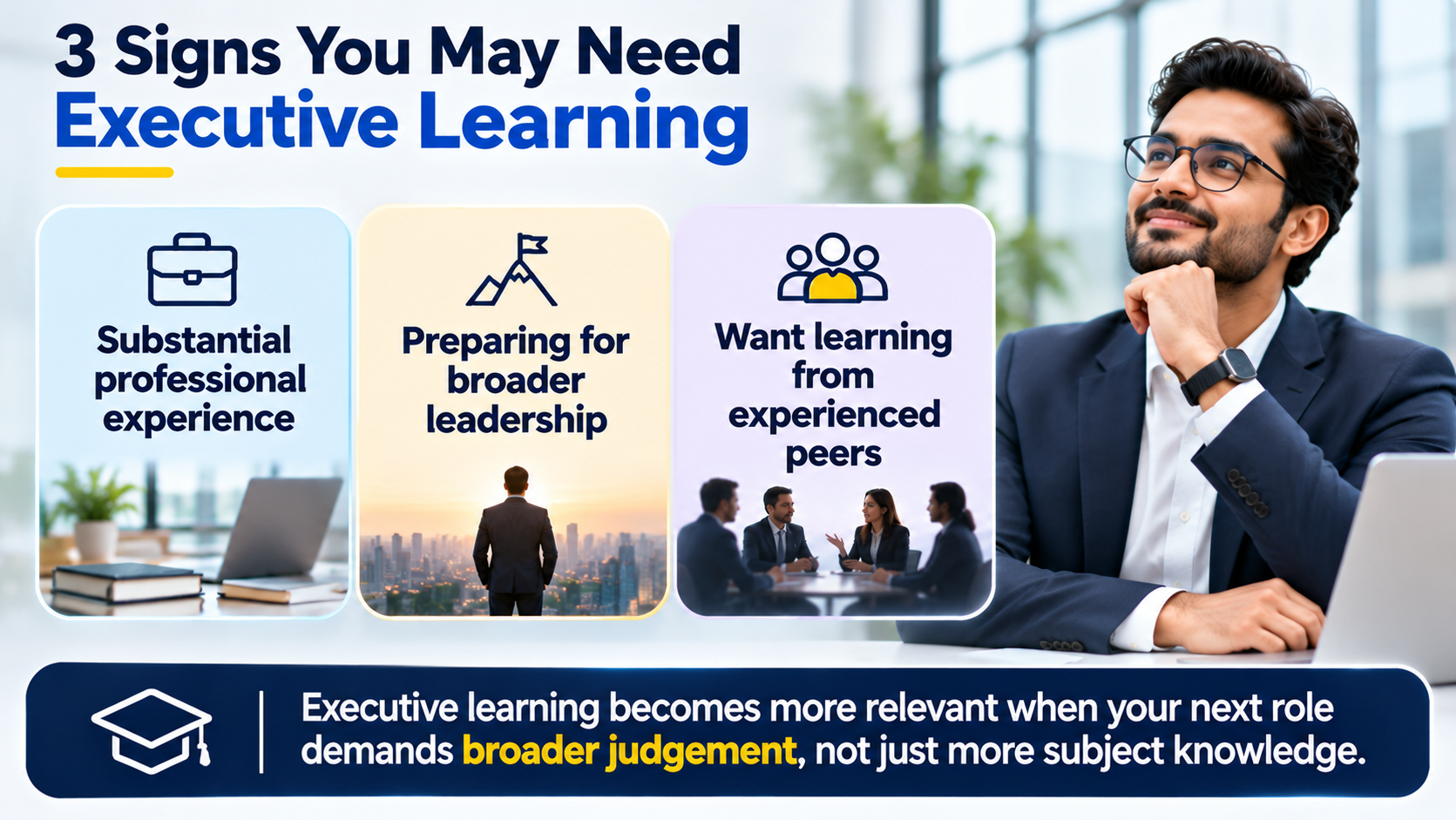
You Already Have Substantial Professional Experience
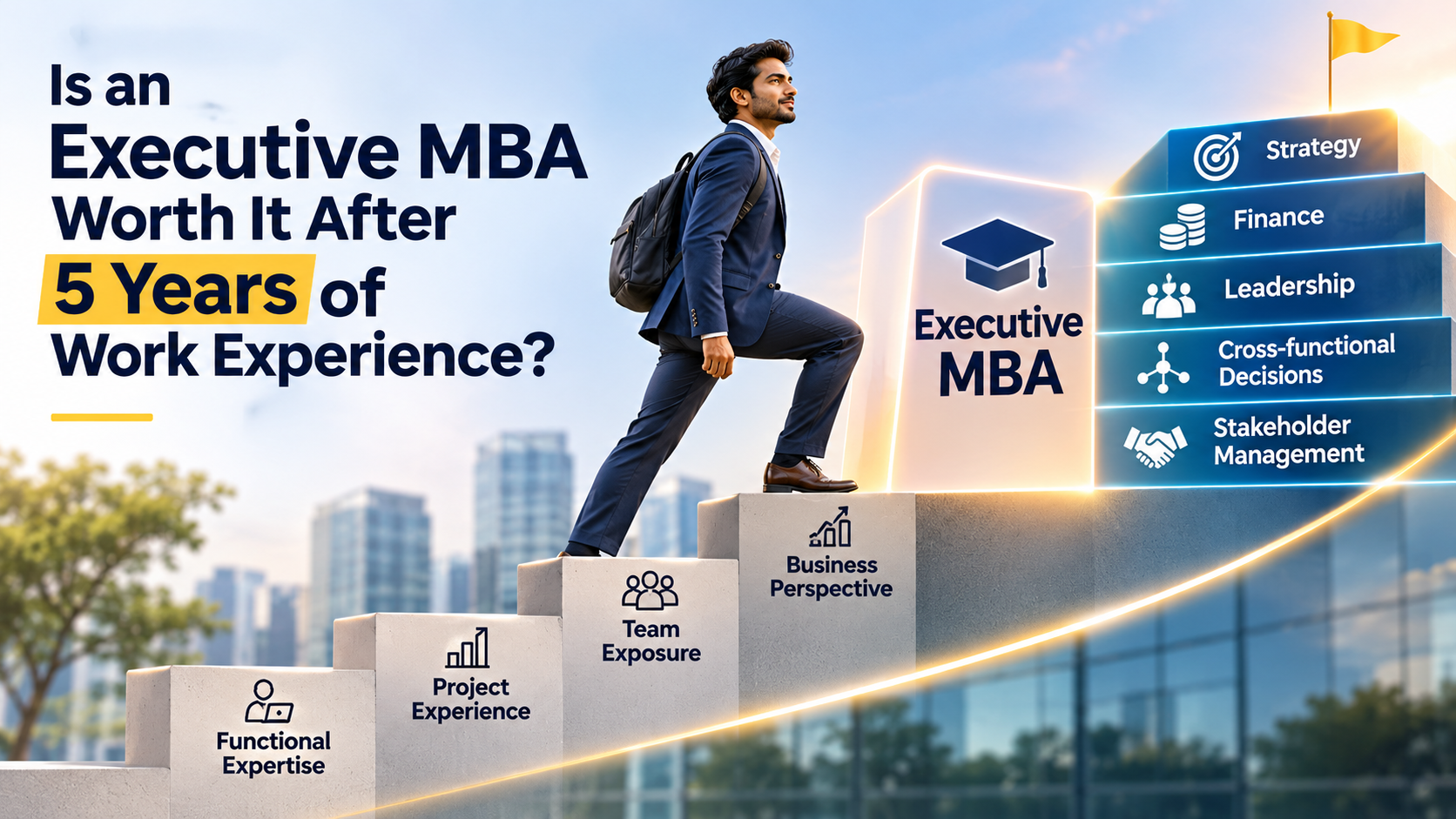
Suppose you have spent eight years in operations and are preparing to take responsibility for multiple teams.
You understand operational execution but want a stronger grasp of strategy, finance, organisational leadership and business decision-making.
An Executive MBA designed for experienced professionals may provide an appropriate learning environment.
The curriculum can be valuable because you already have practical situations against which to evaluate management concepts.
You Want to Move Into Broader Leadership Responsibilities
Some career transitions involve a change in the nature of work.
Moving from a functional specialist role towards general management requires more than additional subject knowledge.
You may need to make trade-offs between competing priorities, manage budgets, communicate across departments and lead people through uncertainty.
An Executive MBA can help develop a broader management perspective when its curriculum and learning approach address these responsibilities.
You Value Learning From Other Experienced Professionals
A significant part of executive management education can come from interaction with peers.
Consider a classroom discussion about entering a new market.
A finance professional may examine investment risk.
A marketer may focus on customer behaviour.
An operations manager may identify delivery constraints.
An entrepreneur may approach the question from the perspective of business survival.
These perspectives can help participants understand the same problem more comprehensively.
The quality of this experience depends on cohort composition, opportunities for interaction and the participant's own engagement.
Don't Choose Based Only on the Institute's Name
Institutional reputation matters, but it should not replace a careful evaluation of programme suitability.
Before enrolling, investigate the following.
The qualification: Is it an MBA degree, a diploma, a certificate or another award? Who issues it?
The curriculum: Does it develop general management fundamentals, specialised expertise or advanced leadership capabilities?
The learner profile: Are participants typically early-career professionals, experienced managers or senior executives?
The delivery model: How many hours are live? Are campus visits mandatory? How are examinations conducted?
The complete cost: What are the tuition fees, additional charges, travel costs and financing commitments?
The learning outcomes: What knowledge and capabilities should you realistically develop?
Institutional reputation can influence how a qualification is perceived. But the experience becomes more valuable when the programme is aligned with your professional needs.
Which MBA Is Right for Your Career Stage?
Consider three different professionals.
A graduate with one year of experience
They want to understand business functions more comprehensively while continuing employment.
A suitable online MBA may provide structured management education without requiring extensive prior management exposure.
A specialist with seven years of experience
They are preparing for cross-functional management responsibilities.
An Executive MBA may be more relevant if it offers advanced management learning, a suitable peer group and opportunities to apply concepts at work.
An entrepreneur with ten years of experience
They want to strengthen financial management, strategy and organisational leadership while running their business.
An Executive MBA could offer a useful combination of academic learning and experienced peer perspectives.
These examples illustrate potential fit, not automatic eligibility.
The actual decision must be based on the requirements and outcomes of a particular programme.
The Best MBA Is the One You Can Use
An MBA is a significant commitment of time, effort and money.
Whether you choose an online MBA or an Executive MBA, the qualification alone cannot guarantee a leadership role, salary increase or career transition.
Consider what you want to achieve over the next three to five years.
Do you need a formal management foundation?
Are you preparing for broader organisational responsibilities?
Would you benefit more from studying alongside experienced managers?
How much flexibility do you need, and what learning format works best for you?
Your answers should guide the choice.
You can explore management education pathways through Digivarsity, comparing programmes on curriculum, eligibility, delivery format and the specific qualification awarded.
Do not choose an MBA simply because it is online, labelled executive or offered by a recognised institution.
Choose the programme that develops the capabilities your next stage of work demands.
Frequently Asked Questions
Is an Executive MBA better than an online MBA?
Not necessarily. An Executive MBA may be more suitable for professionals seeking experience-based management learning, while an online MBA may suit those seeking flexible formal management education. The choice depends on career stage, curriculum and programme design.
Can I pursue an Executive MBA online while working?
Yes. Some Executive MBA programmes offer live online sessions or blended formats with campus immersion. Attendance, work experience requirements and academic commitments vary by institution.
Are online MBA degrees valid in India?
Online MBA degrees awarded by appropriately authorised institutions through programmes meeting the applicable regulatory requirements can be valid qualifications. Students should verify the specific programme and admission session through official sources such as UGC-DEB, where applicable.


Comments
Be the first to share your thoughts on this article.