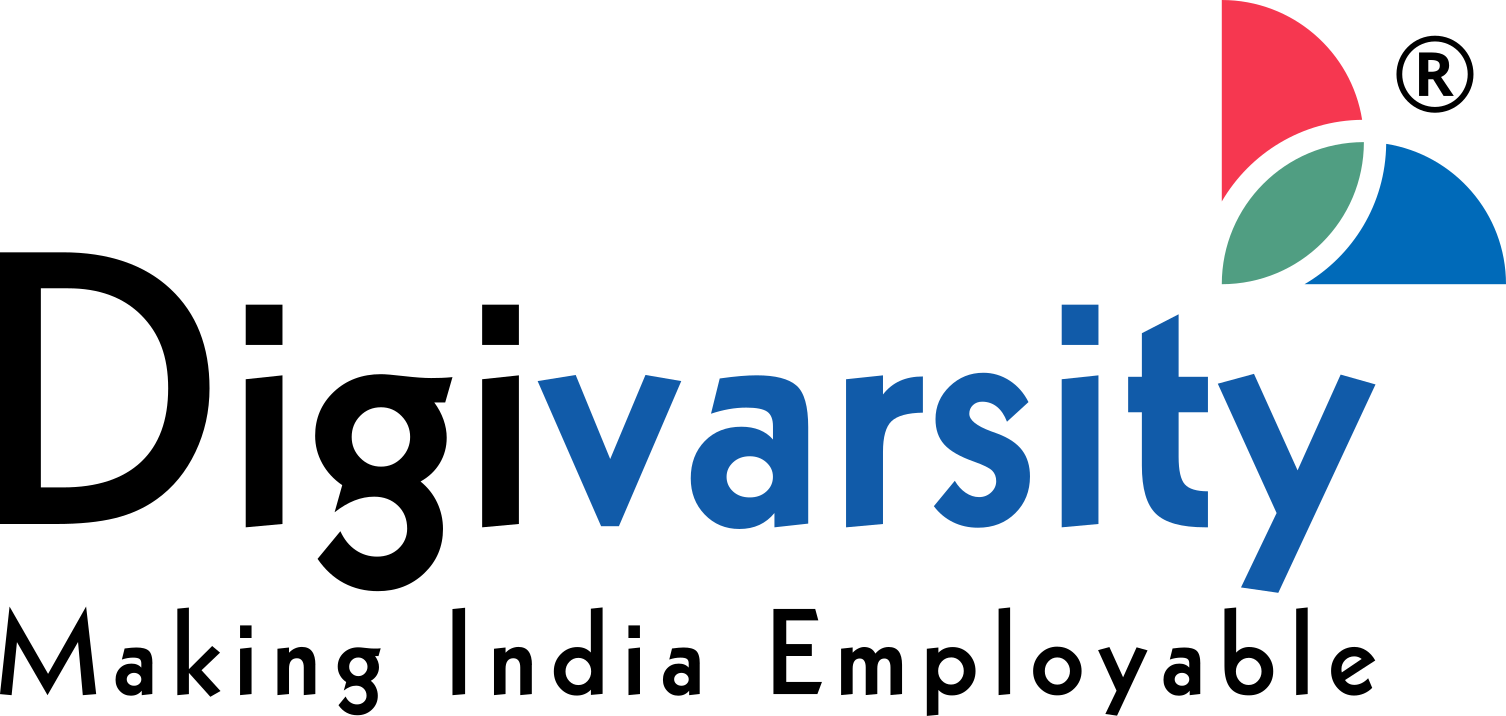
Your organisation has invested in new technology.
There is a cloud platform, an analytics dashboard, perhaps a customer management system and now a growing collection of AI tools.
Yet employees still depend on spreadsheets. Teams continue working in silos. Decisions take too long, and customers experience the same delays.
The technology has changed.
The way the business operates hasn't changed nearly enough.
This is where understanding the difference between digital transformation and artificial intelligence becomes important.
For business leaders deciding what to learn next, a digital transformation course and an AI course can appear similar. Both discuss technology, innovation and the future of business.
But they develop different capabilities.
And choosing between them requires understanding the problems you are responsible for solving.
Digital Transformation Is Bigger Than Introducing Technology
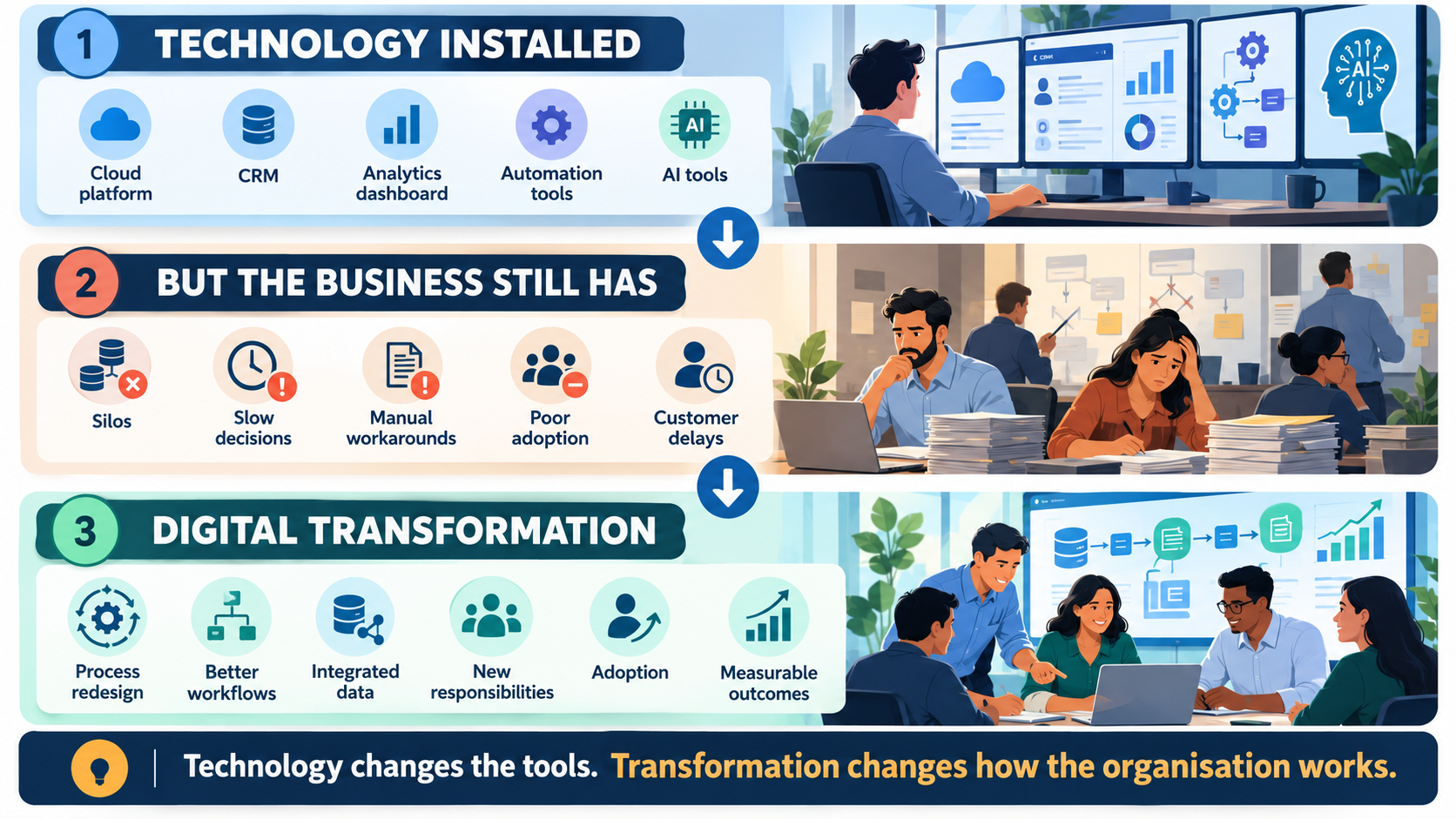
Digital transformation is the process of using digital technologies to fundamentally improve how an organisation operates, delivers value and competes.
It is not simply replacing paperwork with software.
Consider a traditional insurance company introducing a digital claims platform.
The technology may allow customers to submit claims online. But making the process work better could require changes to documentation, approval workflows, employee responsibilities, customer communication and performance measurement.
Simply purchasing the platform does not accomplish all of that.
Someone needs to understand how the new system changes the entire process.
This is where digital transformation leadership becomes important.
It brings together technology, strategy, processes, people and organisational change.
What Does a Digital Transformation Course Teach?
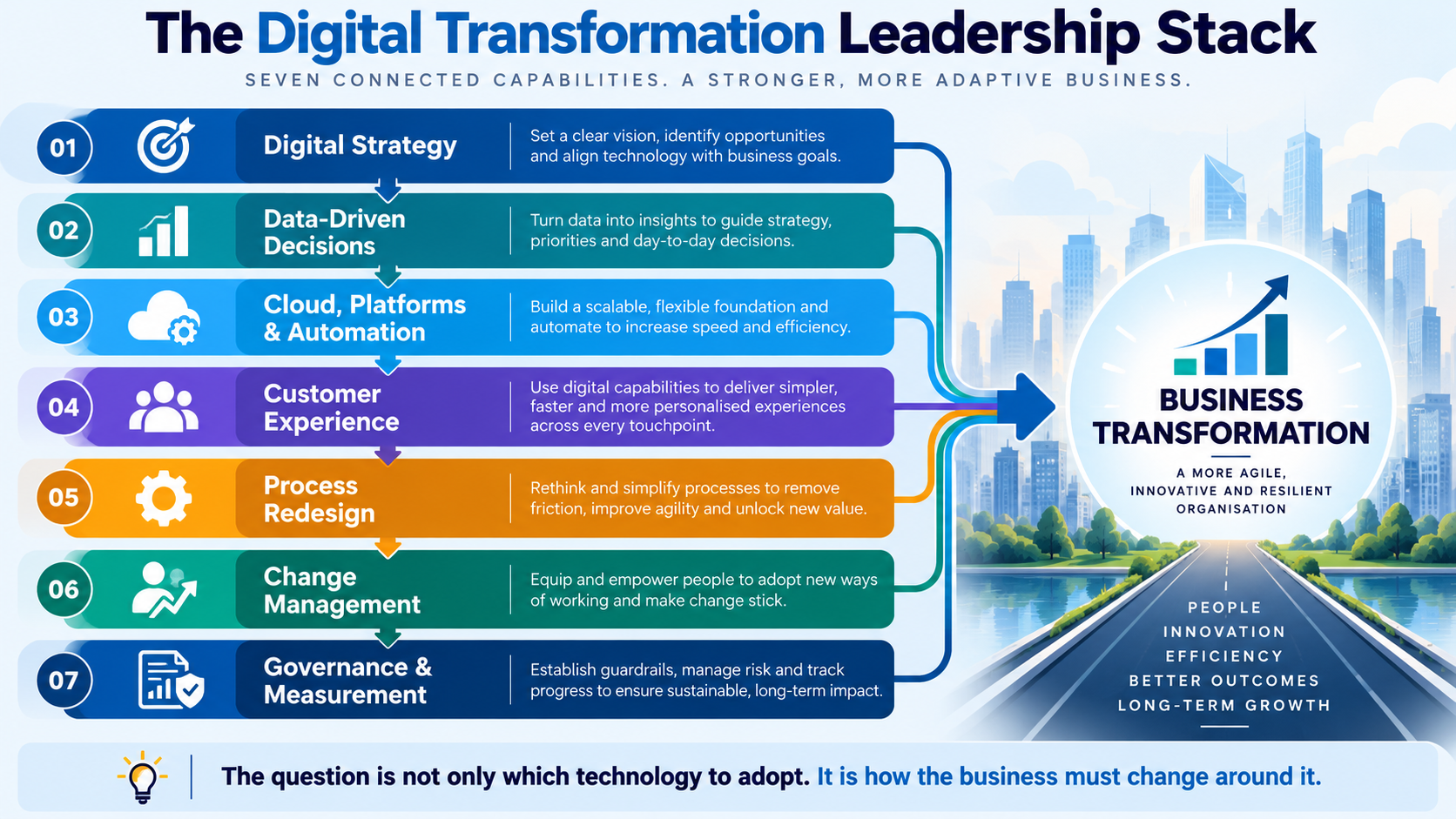
A well-designed digital transformation programme helps professionals understand how businesses can use technology to improve their operating models and strategic capabilities.
Depending on the curriculum, it may cover:
- Digital strategy and business model innovation
- Data-driven decision-making
- Digital platforms, cloud technologies and automation
- Customer experience and operational redesign
- Technology investment and implementation
- Change management and organisational adoption
- Digital governance and performance measurement
The central question is not just which technology an organisation should use.
It is how the organisation needs to change to create value from that technology.
Imagine a retail business struggling with inventory visibility across its stores.
A digital transformation initiative might involve integrating inventory systems, improving data availability, redesigning replenishment processes and changing how store managers make decisions.
Different technologies may support the initiative.
But successful execution requires coordination across several functions.
That is the perspective digital transformation programmes aim to develop.
How Is an AI Course Different?
An AI course concentrates more specifically on understanding, evaluating, developing or applying artificial intelligence.
Its content can vary substantially depending on whether it is designed for business leaders or technical specialists.
A business-oriented AI course may focus on identifying opportunities for predictive analytics, automation and generative AI.
A technical AI course may go deeper into machine learning algorithms, model development, programming, data preparation and deployment.
For example, a logistics company may want to use AI to predict delivery delays.
An AI-focused programme could help a professional understand how predictive models work, what data they require, how their performance is measured and what limitations they may have.
The learning is centred on AI capability.
A digital transformation programme would examine how those predictions could be integrated into logistics operations, employee workflows, customer communication and management decisions.
Both approaches are useful.
They operate at different levels of the business problem.
The Difference: Improving a Model vs Improving a Business Process
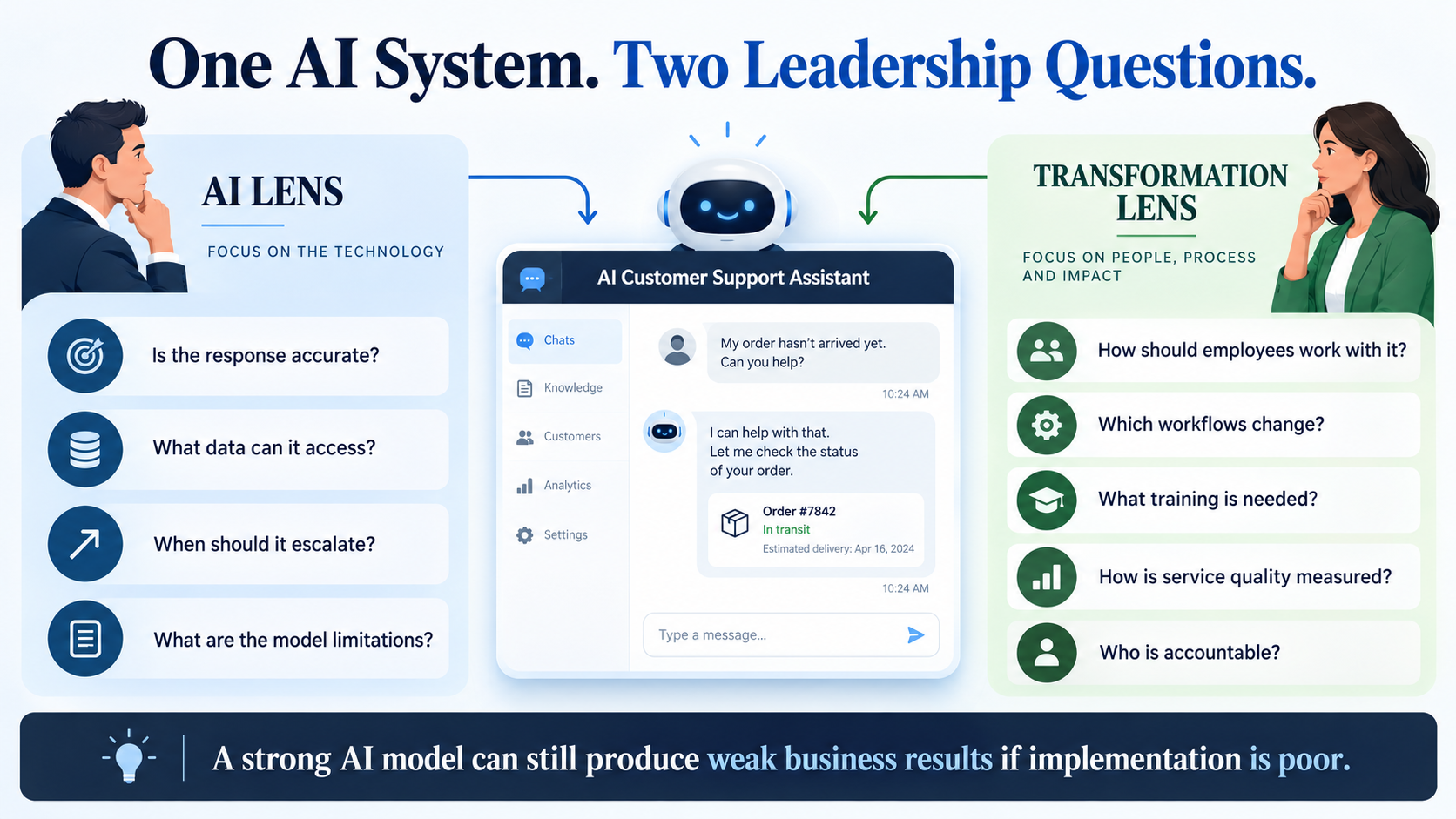
Suppose a bank introduces an AI-powered customer support assistant.
The AI system can answer routine questions, identify customer intent and route more complex queries to employees.
From an AI perspective, important questions include:
How accurate are the responses? What information can the model access? How does it handle sensitive customer data? When should it escalate to a human employee?
From a digital transformation perspective, additional questions emerge.
How should customer service teams work alongside the system? Which processes need redesigning? What training will employees require? How will service quality be measured? Who will be accountable when the technology fails?
A technically capable AI system can still deliver disappointing business results if implementation is poorly managed.
Likewise, a digital transformation initiative may underperform if its leaders do not understand the capabilities and limitations of the technology involved.
This is why business leaders increasingly need elements of both.
Is Your Challenge AI—or the Change Around It?
If the problem is redesigning processes, adoption and business performance, build transformation capability.
Explore Executive ProgrammesWhich Course Should You Choose Based on Your Role?
If You Lead Business Strategy or Organisational Change
A digital transformation course may be particularly relevant.
Your responsibility extends beyond understanding one technology.
You may be deciding how to modernise operations, improve customer experiences, allocate investments or introduce new ways of working.
You need a broader understanding of technology-enabled business change.
If You Manage Analytics, Automation or AI Initiatives
An AI-focused course may be more immediately useful.
You may need to understand AI use cases, model performance, data requirements, governance and implementation risks in greater depth.
Your role requires informed decisions about AI itself.
If You Lead a Functional Business Team
You may need a combination.
Consider a marketing leader.
They might need AI knowledge to evaluate predictive customer analytics and generative AI applications.
But they also need digital transformation skills to redesign campaign workflows, integrate platforms, manage agencies and change how the team operates.
The right balance depends on whether their biggest challenge is understanding AI or leading broader operational change.
Five Capabilities Business Leaders Should Develop
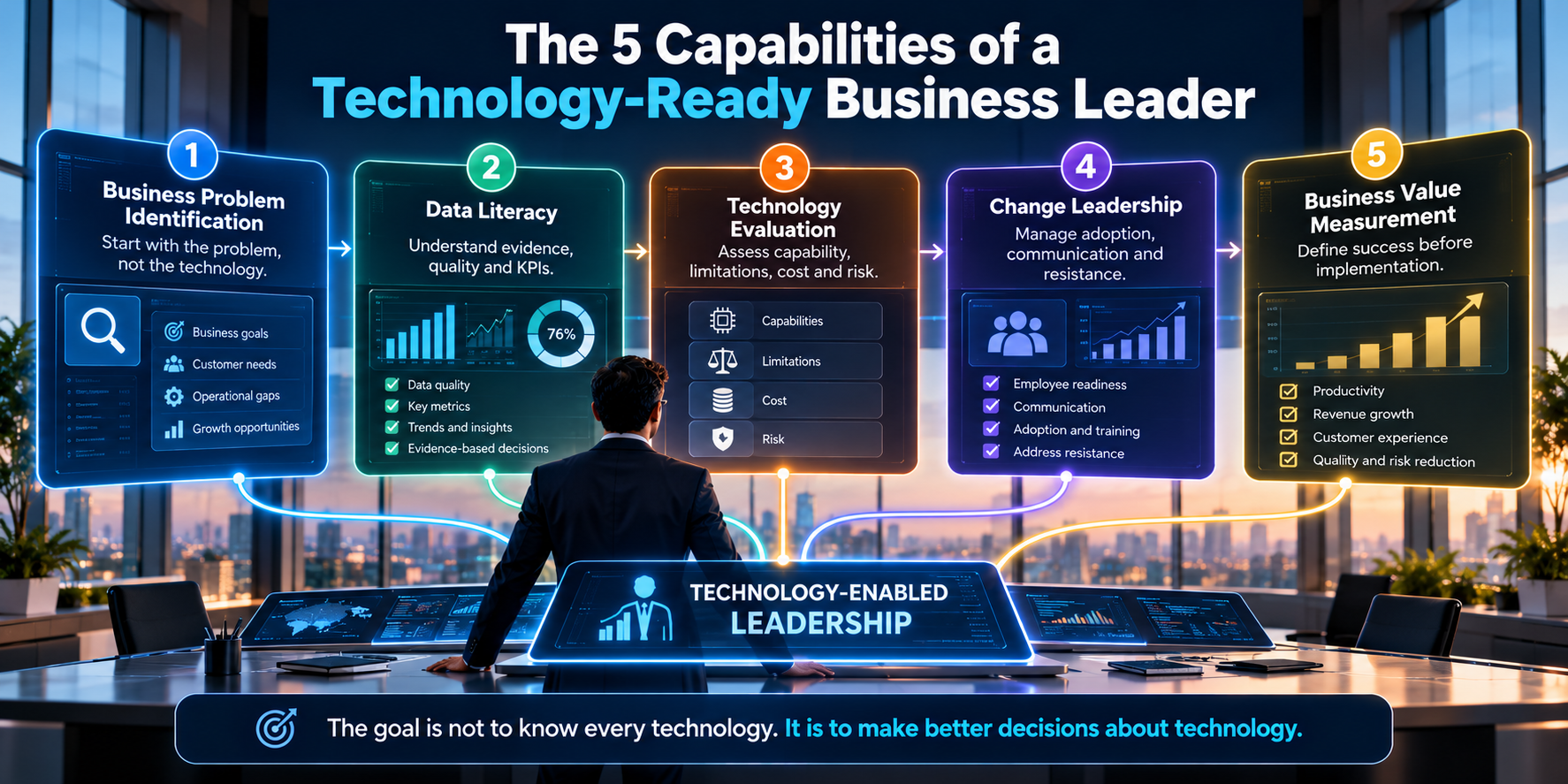
Regardless of the programme chosen, several capabilities are becoming valuable for technology-related leadership.
- Business problem identification
Start with the problem that matters to the organisation. Avoid adopting technology simply because competitors are using it.
- Data literacy
Understand data quality, basic analytics, performance indicators and how evidence supports decisions.
- Technology evaluation
Develop enough knowledge to assess a proposed solution's capabilities, limitations, costs and risks.
- Change leadership
Learn how to communicate change, manage resistance, redesign responsibilities and encourage adoption across teams.
- Business value measurement
Establish what success should look like before implementation. This may involve productivity, customer satisfaction, cost, quality, revenue or risk reduction.
These capabilities help connect technology investment to organisational outcomes.
What If Your Organisation Needs Both?
Increasingly, the two areas overlap.
A manufacturer introducing AI-based quality inspection is not only implementing an AI model. It may also need to redesign inspection workflows, train employees and connect production data across systems.
A financial services organisation using AI for risk analysis must consider not only predictive performance but also governance, accountability and integration with existing decision processes.
For professionals responsible for such initiatives, a programme combining digital transformation and AI may be more useful than treating the subjects separately.
The Executive Certificate Program on Digital Transformation and AI from IIM Mumbai, available through Digivarsity, is an example of a pathway that brings business transformation and emerging AI applications together.
The important consideration remains whether the curriculum addresses your actual responsibilities.
Choose Based on the Change You Need to Lead
Before enrolling in either programme, think about an important challenge in your organisation.
Is the problem that you do not understand how AI could improve a specific task or decision?
Or is it that your organisation struggles to turn technology investments into better processes, stronger performance and lasting change?
The first may point towards deeper AI education.
The second may require broader digital transformation capabilities.
And if you are responsible for both technology decisions and organisational implementation, an integrated learning approach may be appropriate.
The most effective business leaders do not need to become experts in every technology.
They need to understand enough to make informed decisions, work with specialists and lead change that creates measurable value.
Frequently Asked Questions
What is the difference between a digital transformation course and an AI course?
A digital transformation course typically focuses on using technologies to improve business strategy, processes and organisational performance. An AI course focuses more specifically on understanding, evaluating or developing artificial intelligence applications.
Do business leaders need technical AI skills?
They generally benefit from enough AI knowledge to assess opportunities, limitations and risks. The level of programming or model-development expertise required depends on their responsibilities.
Can I study digital transformation and AI together?
Yes. Some executive programmes integrate digital strategy, AI applications, change management and practical business projects. Such programmes may be relevant for professionals leading technology-enabled business initiatives.



Comments
Be the first to share your thoughts on this article.