
You've completed Class 12 and decided to explore an online undergraduate degree.
You want flexibility, a recognised qualification and opportunities to build your career while studying.
Two options keep appearing.
Online BBA.
Online BCom.
Both involve business-related subjects. Both can be useful for careers in the corporate world. And both can provide a foundation for further education.
So why choose one over the other?
The real difference is not the learning mode.
It's the kind of business knowledge you want to develop.
A BBA generally focuses more broadly on business administration and management, while a BCom places greater emphasis on commerce, accounting, finance and related subjects.
Understanding this distinction can help you make a much more informed choice.
What Will You Actually Study in an Online BBA?
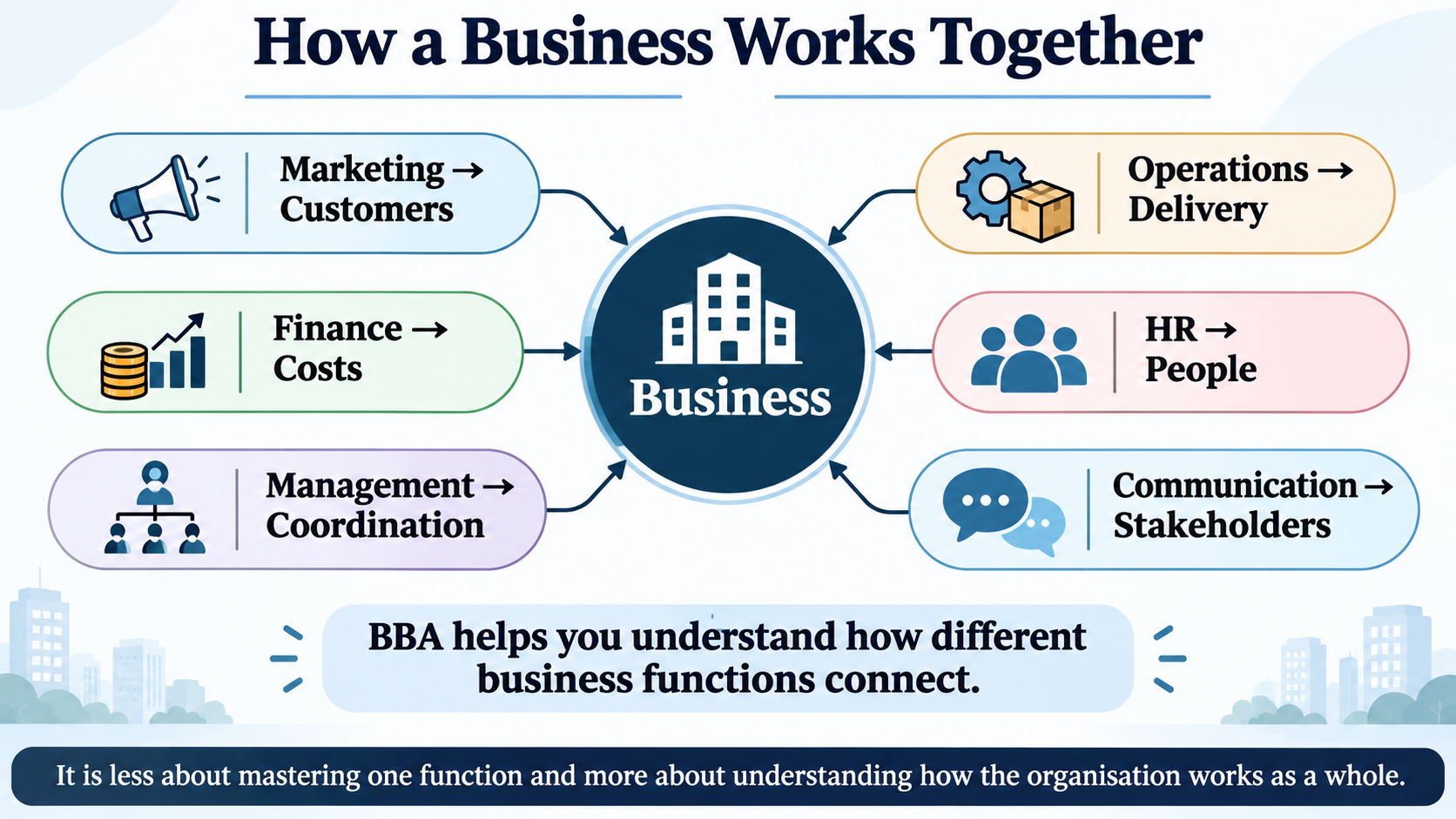
A Bachelor of Business Administration introduces students to the different functions involved in running an organisation.
You may study marketing, management, accounting fundamentals, economics, human resources, organisational behaviour, operations and business communication.
The objective is to help you understand how these functions work together.
Imagine a company launching a new product.
Someone needs to understand customer demand.
Someone has to plan the marketing.
Others must manage costs, operations, supply chains and employees.
A BBA introduces you to several parts of that process.
This can make it relevant for students interested in business management, marketing, operations, sales, entrepreneurship or related fields.
However, a BBA does not automatically prepare you to manage a company.
Leadership and management capabilities also develop through experience, responsibility and practical problem-solving.
What Will You Study in an Online BCom?
A Bachelor of Commerce generally provides a stronger foundation in commerce-related disciplines.
Depending on the university and specialisation, subjects may include financial accounting, corporate accounting, business law, taxation, economics, auditing and financial management.
The emphasis is often on understanding how financial and commercial activities are recorded, analysed and managed.
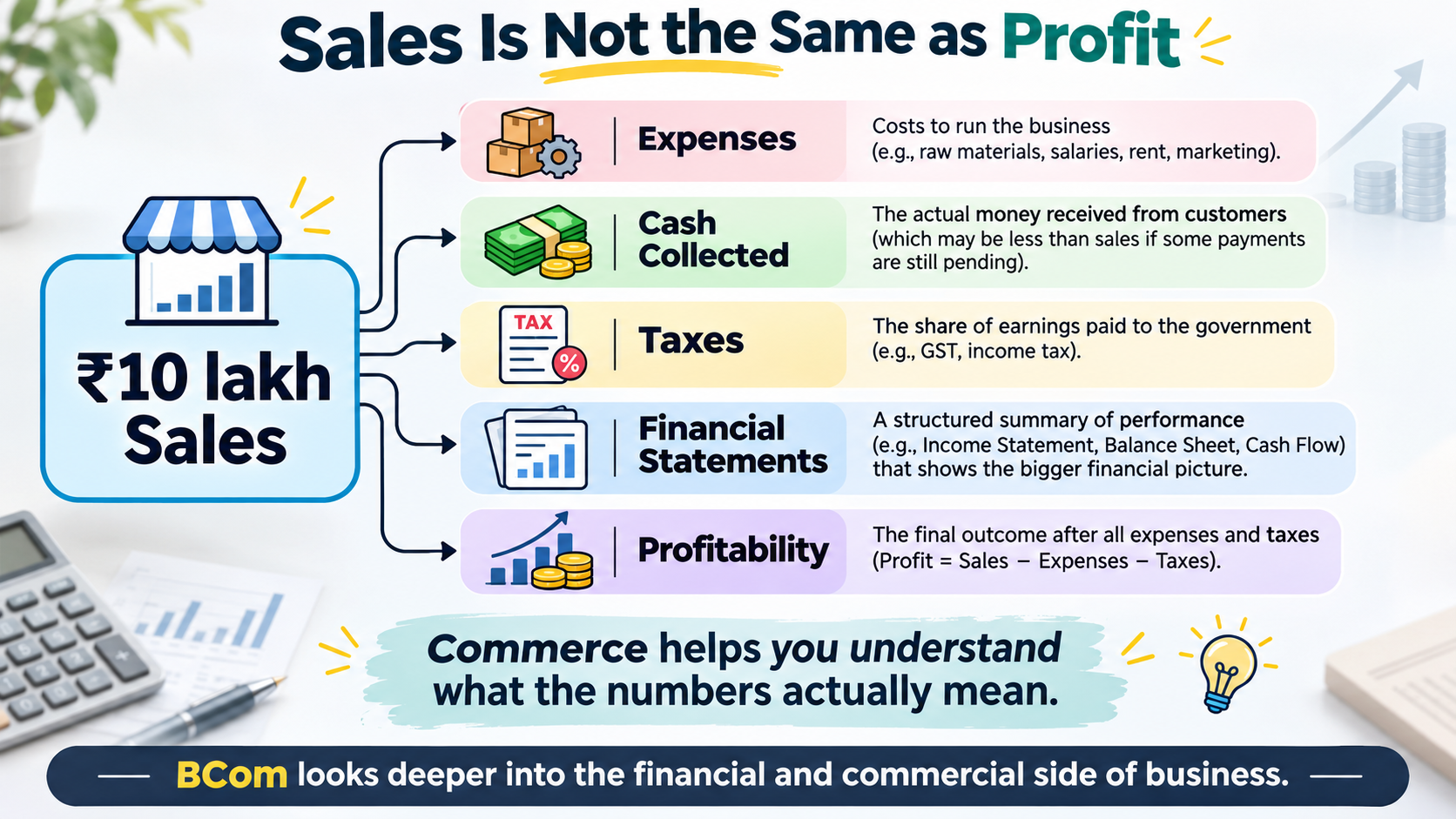
Consider a business that generates ₹10 lakh in sales.
That number alone doesn't tell you whether the business is profitable.
What were its expenses?
How much money was actually collected?
What are its tax obligations?
How should the transactions appear in financial statements?
Commerce education helps students understand questions like these.
An online BCom may be especially relevant if you enjoy accounting, finance, economics or other subjects involving the financial and commercial side of business.
Online BBA vs Online BCom: The Key Differences
|
The table describes common curriculum patterns rather than fixed rules.
Some BBA programmes have substantial finance content, while certain BCom programmes include management, analytics or specialised business subjects.
Always compare the actual syllabuses.
Think About the Work, Not Just the Degree Title
Suppose two students have completed Class 12.
One enjoys organising school events, coordinating teams and developing ideas for selling products.
The other enjoys accountancy, economics and understanding how businesses manage money.
The first student may find a BBA more aligned with their interests.
The second may prefer BCom.
But the decision shouldn't be based only on school subjects.
Try understanding what different professionals actually do.
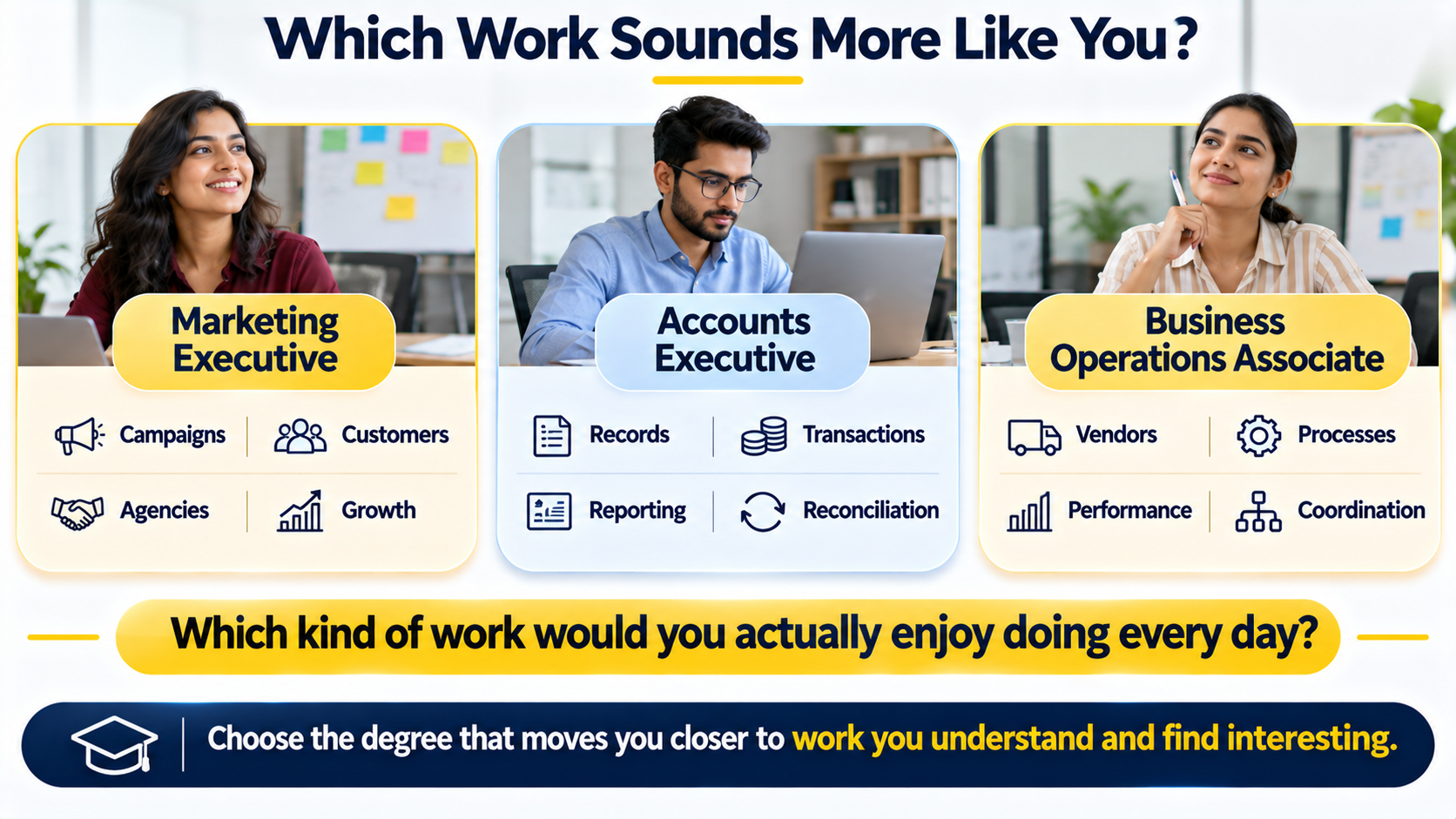
A marketing executive may analyse campaign performance, coordinate with agencies and work on customer acquisition.
An accounts executive may reconcile financial records, process transactions and support reporting.
A business operations associate may coordinate vendors, track performance and improve processes.
These are different kinds of work, even though all three roles exist within businesses.
Your undergraduate degree should help you move towards the type of work you find interesting.
Does an Online Degree Affect Career Opportunities?
A common concern is whether employers will accept an online BBA or online BCom.
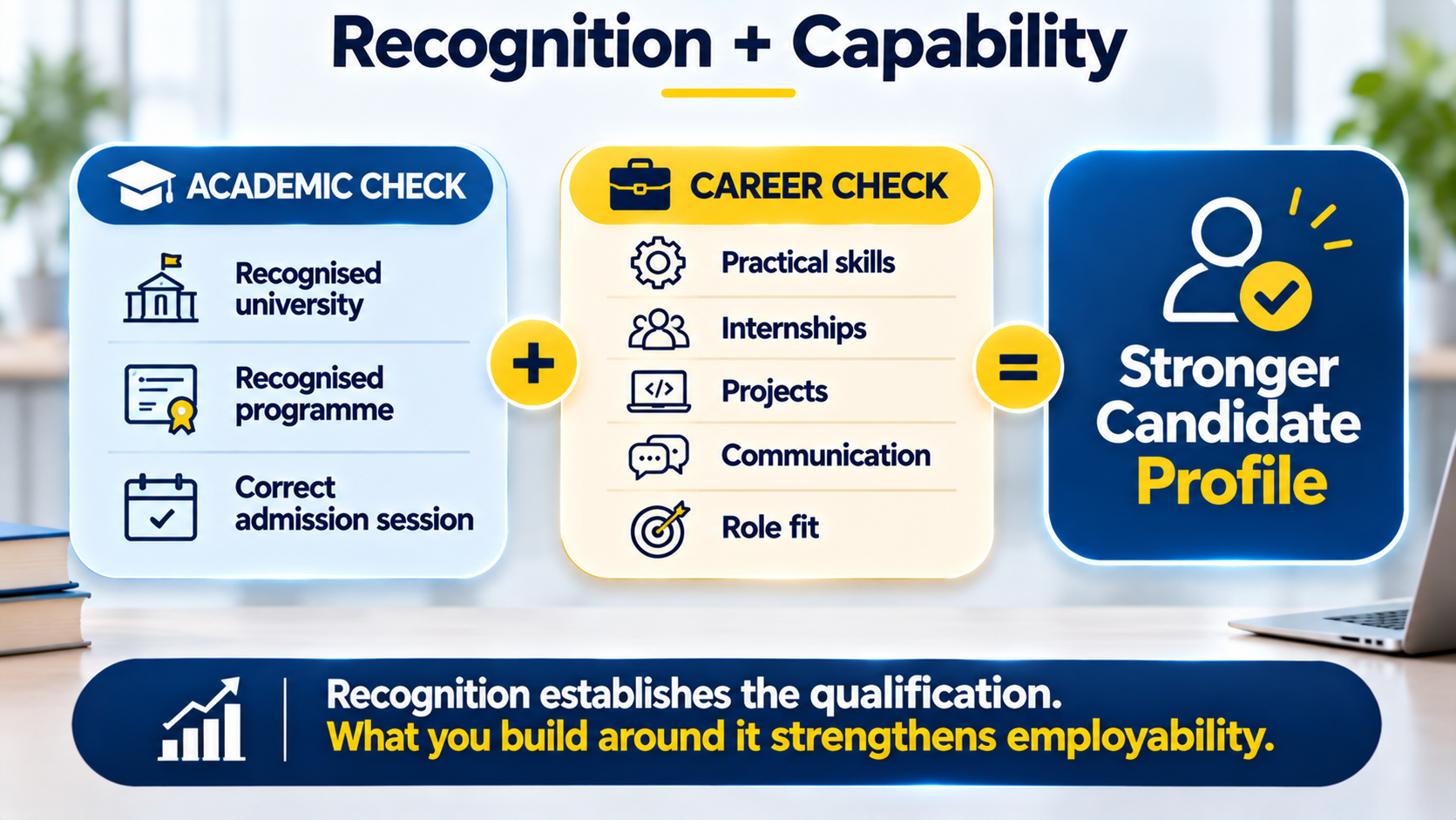
The first consideration is academic recognition.
UGC regulations provide for equivalence between appropriately recognised online degrees and their corresponding conventional qualifications.
However, recognition is not the same as guaranteed employment.
Employers may also evaluate your academic performance, communication, practical skills, work experience and suitability for a particular role.
Online learning can provide flexibility.
What you do with that flexibility can make a significant difference.
For example, a student pursuing an online BBA could work on a small marketing project, complete an internship or gain exposure to business operations.
An online BCom student could practise spreadsheet analysis, work with accounting software or undertake finance-related projects.
In both cases, practical experience can strengthen the academic foundation.
What Skills Should You Build Alongside the Degree?
Your degree subjects matter, but they should not become the only things you learn.
For an online BBA student interested in marketing, useful additional capabilities might include digital advertising, customer research, presentation skills and analytics.
For someone interested in operations, Excel, process mapping and project coordination may be relevant.
An online BCom student interested in accounting could build proficiency in spreadsheets, accounting software and financial reporting.
Someone interested in financial analysis may need stronger quantitative and analytical skills.
The key is to choose skills based on the work you want to do.
Don't complete unrelated certifications simply because they are popular.
What About MBA, MCom and Other Postgraduate Options?
Your undergraduate degree does not necessarily determine your entire career.
A BBA graduate may pursue an MBA or another eligible postgraduate qualification.
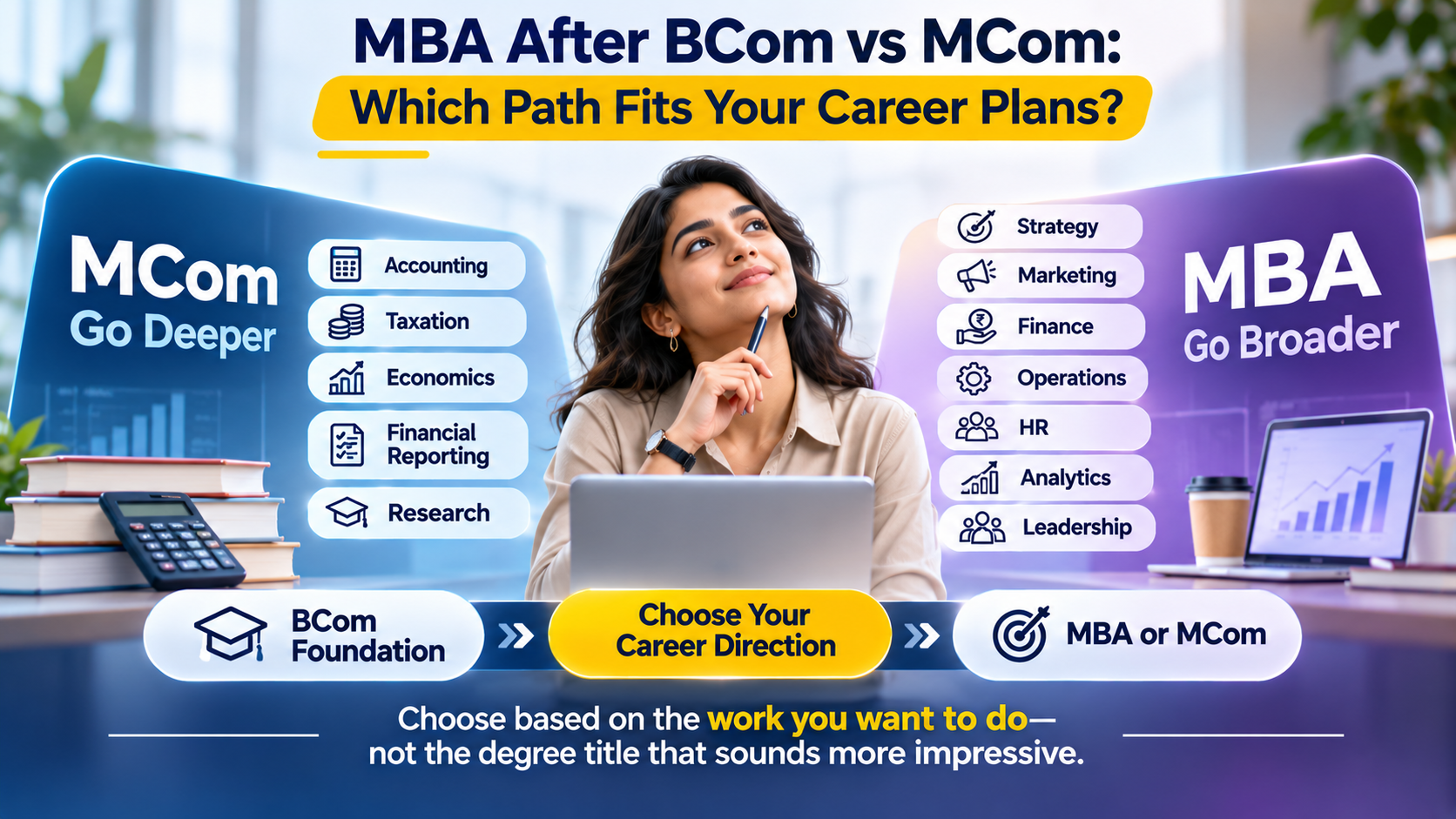
A BCom graduate may choose an MCom, MBA or a different postgraduate pathway, depending on eligibility.
The decision should reflect how your interests develop over time.
For example, a BCom student might become interested in marketing through an internship and later pursue management education.
A BBA student might discover an interest in finance and develop additional accounting or analytical capabilities.
Your first degree creates a foundation.
It does not permanently restrict you to one type of work.
Five Things to Check Before Choosing an Online Programme
Before enrolling, compare the following:
- Recognition: Is the specific online programme recognised or entitled for your admission session?
- Curriculum: Do the subjects match your interests and intended career direction?
- Learning experience: Are classes live, recorded or a combination? What faculty interaction and academic support are available?
- Assessments: How are assignments and examinations conducted?
- Practical opportunities: Can you realistically undertake internships, projects or work experience alongside your studies?
Also check the total programme cost, duration and degree-awarding university.
These factors are more important than choosing a programme based only on an attractive advertisement.
So, Online BBA or Online BCom?
Choose an online BBA if you're particularly interested in understanding how businesses operate, how teams work and how different functions contribute to business performance.
Choose an online BCom if you're more interested in accounting, finance, economics and the commercial foundations of organisations.
And if you're still unsure, don't rush.
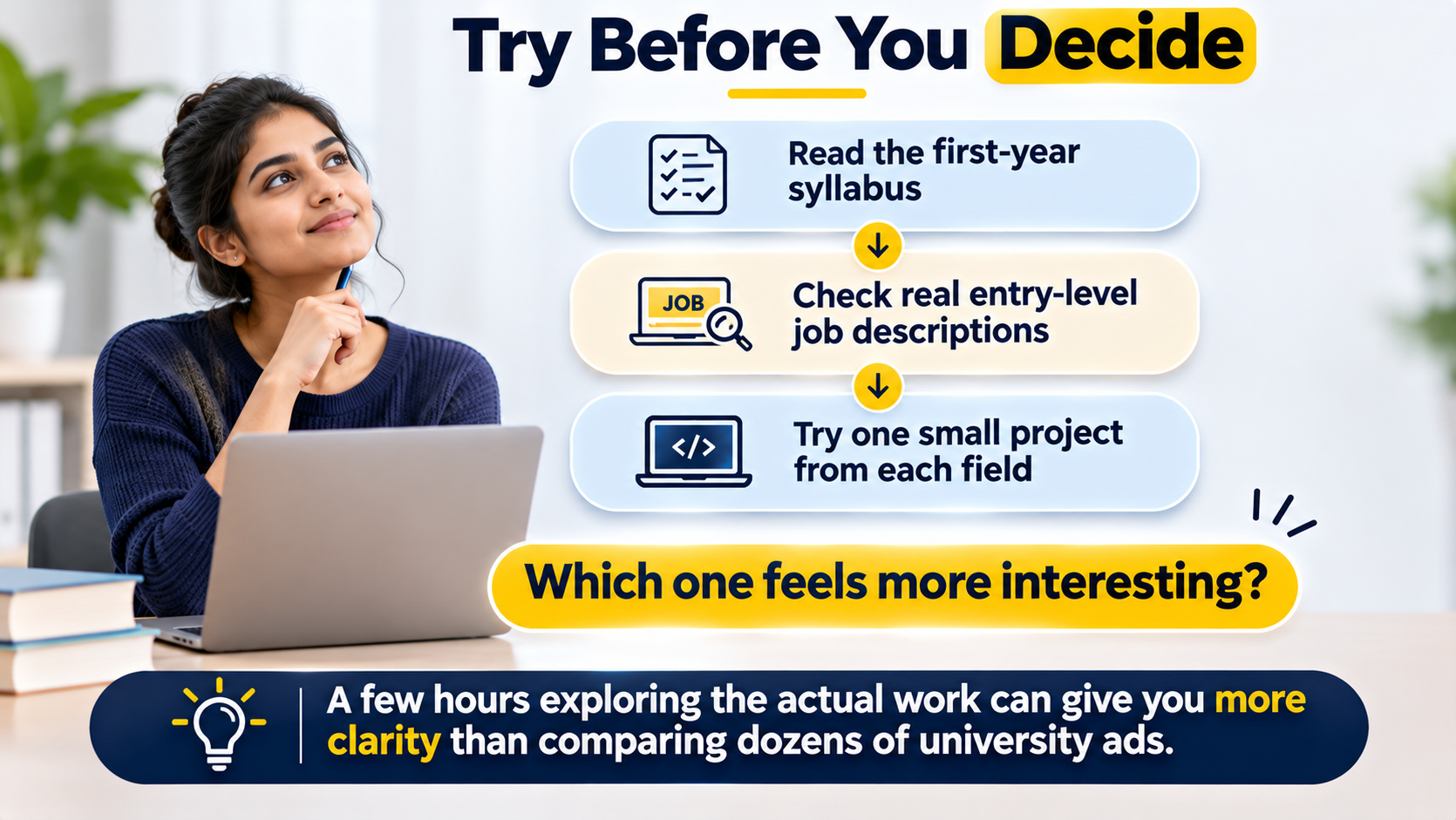
Read the first-year syllabus of both programmes.
Explore relevant entry-level job descriptions.
Try a small project connected with each field.
Sometimes spending a few hours understanding the work can give you more clarity than comparing dozens of university advertisements.
You can explore undergraduate programmes from partner universities on Digivarsity, and compare their curriculum, recognition and learning formats before making a decision.
Your degree should be the beginning of a career you understand, not simply the next qualification you're expected to complete.
Choose Your Undergraduate Path With Clarity
Compare online BBA and BCom programmes by curriculum, recognition, learning format, practical opportunities and eligibility.
Compare ProgrammesFrequently Asked Questions
Which is better for finance careers: online BBA or online BCom?
An online BCom often provides more specialised exposure to accounting and commerce subjects. However, a BBA with relevant finance coursework can also support finance-related career pathways. Compare the curriculum and the requirements of your target roles.
Can I pursue an MBA after an online BCom?
Yes, a recognised online BCom degree can provide an eligible undergraduate qualification for MBA applications, subject to the admission requirements of the institution concerned.
Are online BBA and online BCom degrees recognised in India?
They can be, provided they are awarded by appropriately authorised institutions through programmes that meet applicable UGC regulations. Verify the specific programme's status for your admission session through UGC-DEB.


Comments
Be the first to share your thoughts on this article.