
You want to work in technology.
Maybe you're interested in software development, artificial intelligence, cybersecurity or building applications.
You start researching undergraduate programmes and discover two familiar options.
BCA.
BTech in Computer Science.
Both involve programming. Both introduce students to computing concepts. And graduates from both pathways may pursue careers in the technology industry.
So why do they exist as separate degrees?
More importantly, does choosing one over the other make a significant difference to your career?
The answer lies in understanding their academic approach, depth of technical education, eligibility requirements and the kinds of roles you want to pursue.
What Is the Difference Between BCA and BTech in Computer Science?
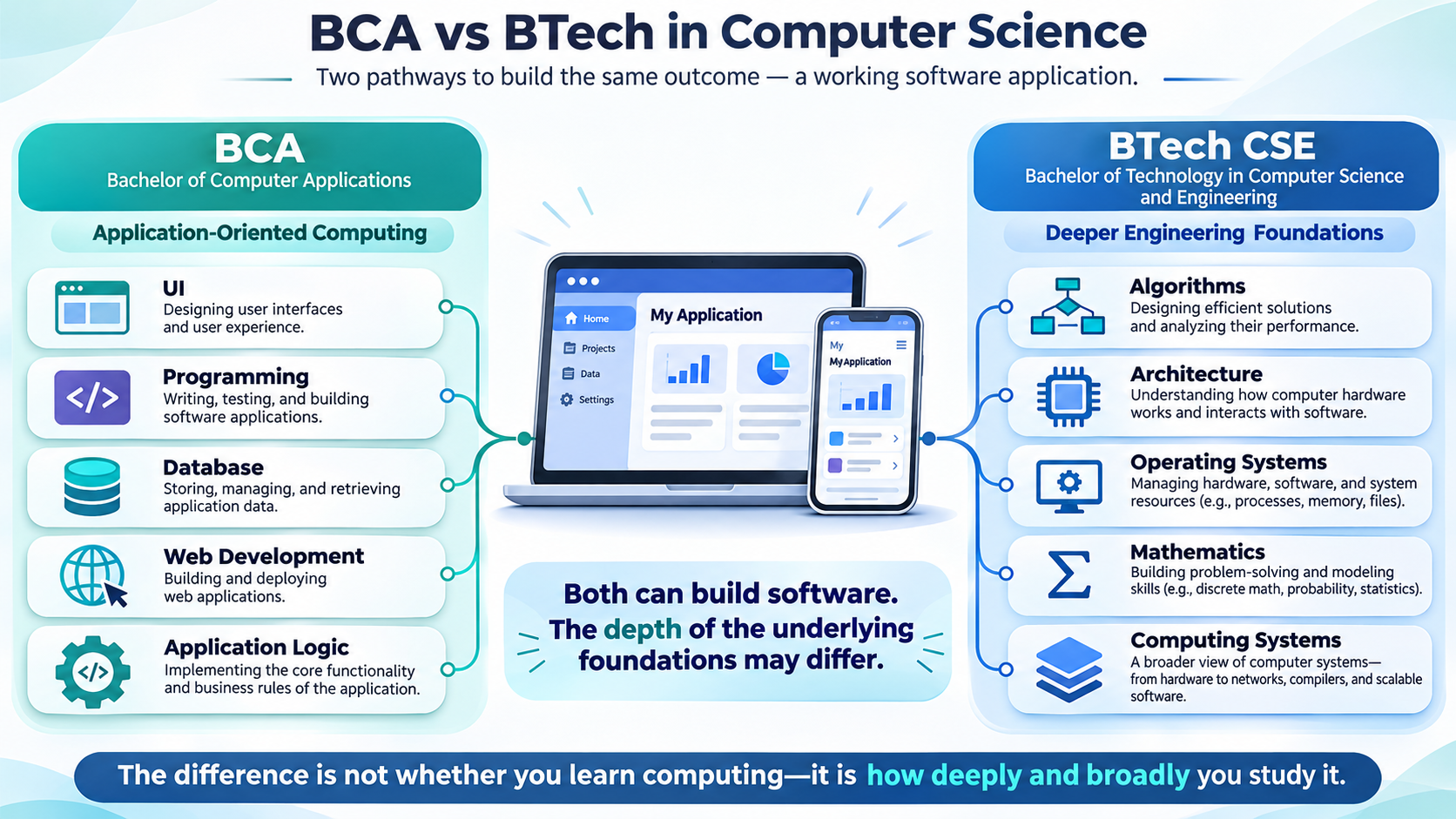
A Bachelor of Computer Applications (BCA) generally focuses on computing concepts and their application in software and information technology.
Students may study programming, databases, web development, operating systems, networks and software engineering fundamentals.
A Bachelor of Technology in Computer Science and Engineering (BTech CSE) is an engineering degree.
It generally includes a broader engineering and mathematical foundation alongside computer science subjects such as algorithms, computing systems, software development, networks and computer architecture.
The two programmes overlap considerably in some areas.
Students from both backgrounds may learn programming languages, database management and software development concepts.
But the level of depth, academic structure and practical requirements can differ.
A BTech CSE programme typically places greater emphasis on engineering foundations and the underlying principles of computing systems.
A BCA programme often concentrates more directly on computer applications and software-related learning.
However, the precise difference depends on the university's curriculum.
BCA vs BTech CSE: A Quick Comparison
|
These are general distinctions, not a ranking of degree quality.
A rigorous BCA programme with meaningful practical learning may prepare students well for certain computing careers.
Similarly, the value of a BTech depends on the quality of teaching, curriculum, practical exposure and opportunities to apply knowledge.
How Is the Learning Experience Different?
Imagine you're building a web application.
You need to create a user interface, store information, process requests and make the application function correctly.
A BCA student may learn the programming, database and application-development concepts required to build such a system.
A BTech CSE student may study many of the same concepts while also exploring computing architecture, algorithms, mathematical foundations and broader engineering principles.
Both pathways can contribute to software development capability.
But their emphasis and depth may differ.
This can become important when you move towards more specialised technical responsibilities.
For example, developing advanced machine learning systems may require substantial mathematics, statistics and programming knowledge.
Working on low-level systems, embedded computing or advanced infrastructure may require deeper understanding of architecture, operating systems and engineering principles.
A BTech CSE programme often provides more structured exposure to those foundations.
But a BCA graduate can also develop advanced technical capabilities through additional study, projects and experience.
The degree influences your starting point. It does not define your ultimate technical limit.
Can BCA and BTech Graduates Apply for the Same Jobs?
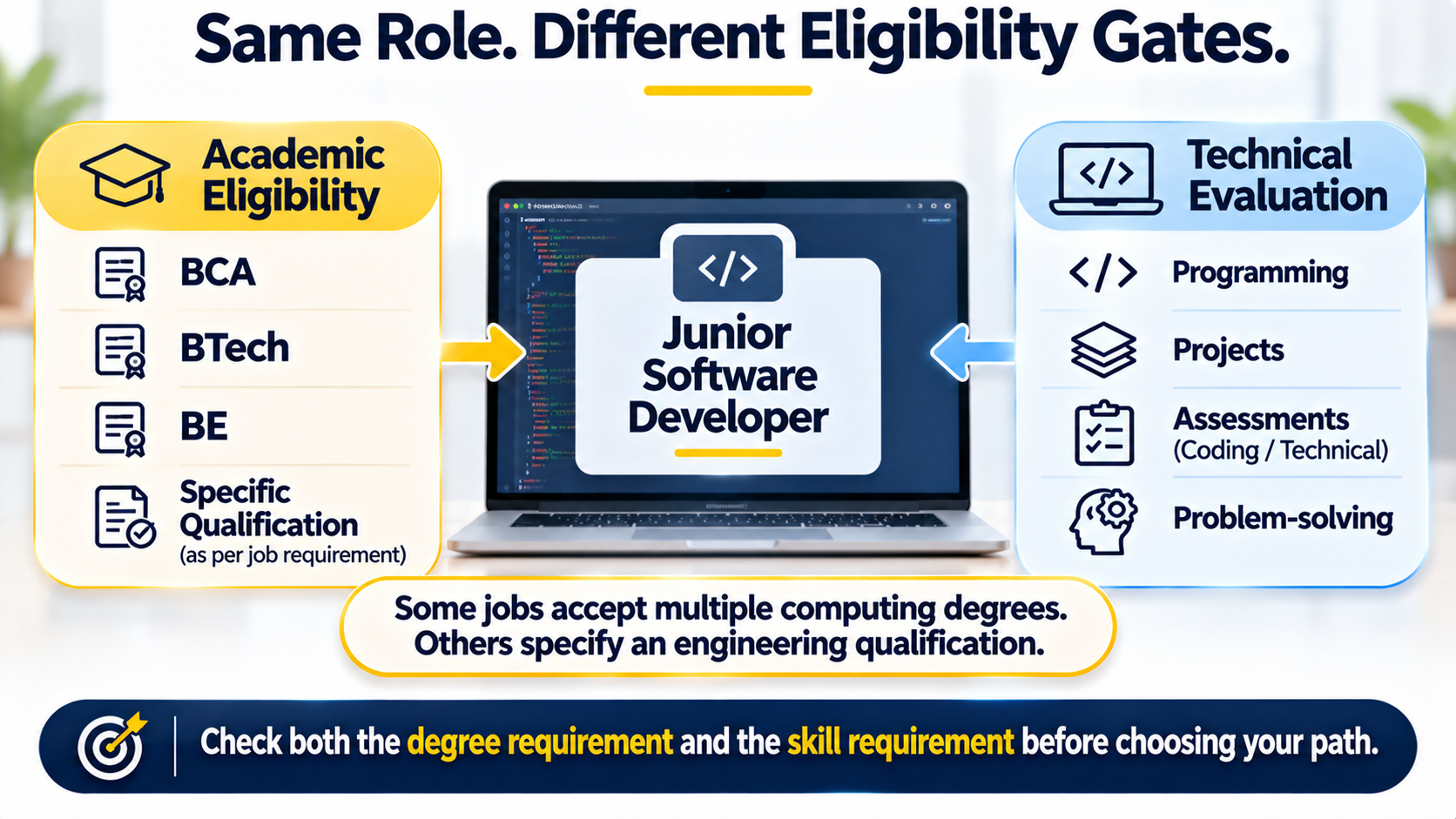
In many cases, yes.
Both may explore opportunities in software development, web development, testing, IT services, technical support and related areas.
However, employer requirements vary considerably.
Some organisations recruit graduates from several computing disciplines and evaluate them through technical assessments.
Others explicitly require a BTech, BE or another particular qualification.
That distinction matters.
For example, a company hiring a junior web developer may consider applicants who can demonstrate relevant programming skills and project work.
Another organisation recruiting for an engineering position may specify a BTech CSE or equivalent qualification as an eligibility condition.
Neither recruitment approach applies universally.
If you already know the type of role you want, examine actual job descriptions before choosing your degree.
Look at both the required academic qualifications and the technical skills employers repeatedly mention.
Is BTech Always Better for Software Development?
Not necessarily.
A BTech CSE may provide a broader technical foundation, but completing the degree does not automatically make someone a strong software developer.
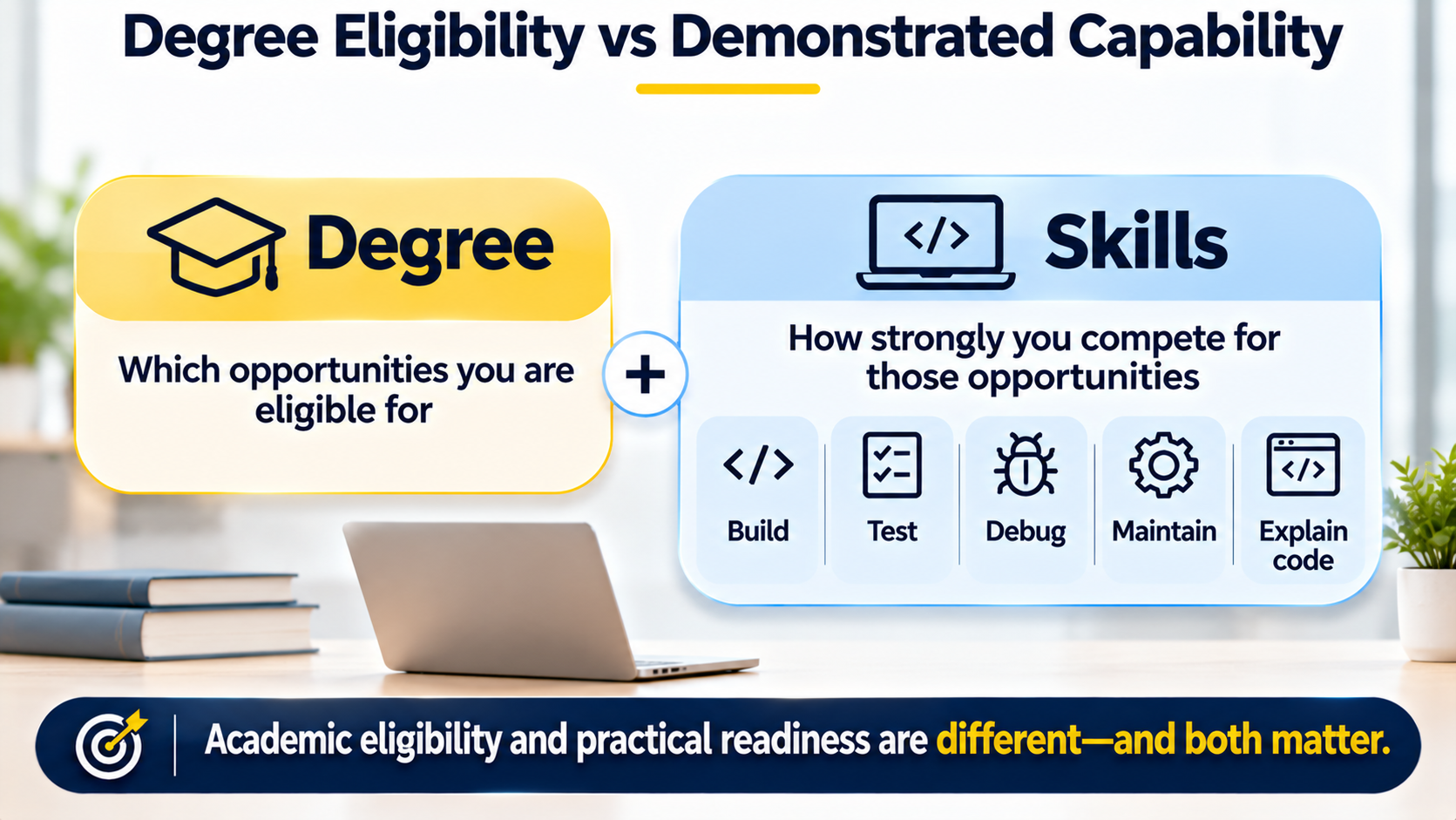
Software development requires the ability to design, write, test, debug and maintain programs.
Those abilities improve through sustained practice.
Consider two graduates.
One has a BTech CSE but limited experience building independent projects.
The other has a BCA, has developed several applications, understands databases and programming fundamentals, and can explain their code confidently.
Depending on the employer and role, the second candidate may demonstrate stronger practical readiness.
But this does not eliminate formal eligibility requirements where they apply.
A useful way to think about it is:
Your degree influences the opportunities for which you are academically eligible. Your demonstrated skills influence how well you compete within those opportunities.
Both matter.
Don’t Compare Degrees in Isolation
Compare the actual curriculum, projects and eligibility requirements against the roles you want to enter.
Compare ProgrammesWhat If You Want to Work in Artificial Intelligence?
AI is one area where the distinction between general programming skills and deeper technical foundations becomes particularly important.
Using AI tools to build simple applications is different from developing and evaluating machine learning models.
More specialised AI work may require:
- Mathematics and linear algebra
- Probability and statistics
- Programming and algorithms
- Data structures
- Machine learning principles
- Model evaluation and optimisation
- Software engineering and computing infrastructure
A BTech CSE programme may offer more systematic exposure to several of these areas.
However, not every BTech programme provides the same AI specialisation.
Similarly, a BCA student may develop relevant capabilities through additional coursework, mathematical preparation, technical projects and further education.
If AI is your intended direction, compare the actual curriculum rather than assuming that either degree guarantees AI expertise.
Does BCA Offer a Faster Route Into Technology?
Because many BCA programmes follow a three-year structure, they may allow students to complete undergraduate education sooner than a conventional four-year BTech.
However, some universities also offer four-year BCA or honours pathways.
Completing a shorter degree does not automatically mean becoming job-ready sooner.
You may still need time to develop programming proficiency, complete projects, gain experience or prepare for further study.
Likewise, the additional year of a BTech should not be judged only by duration.
Its value depends on the technical depth, engineering curriculum and practical opportunities it provides.
Compare the complete learning experience.
The question is not simply how quickly you can graduate.
It is what knowledge and capabilities you will have developed by graduation.
What About Online BCA and Online BTech?
This is an important distinction for students considering flexible higher education.
BCA programmes may be offered online by appropriately recognised or entitled institutions, subject to the applicable regulations.
However, engineering disciplines are currently included among the programmes prohibited through online and open and distance learning modes under UGC's framework.
This means students should not assume that an advertised fully online BTech CSE is a recognised route to an engineering degree.
Verify the precise programme, delivery mode and regulatory status through official sources.
For a learner who needs flexibility because of employment, location or personal responsibilities, a recognised online BCA may be an option worth examining.
But online education still requires consistent effort.
Programming skills cannot be developed simply by watching lectures.
Students need to write code, solve problems, complete projects and test their understanding.
The quality of independent practice becomes especially important.
What Can You Study After BCA or BTech?
Both degrees can support further education, although postgraduate eligibility requirements differ.
A BCA graduate may consider an MCA or other eligible postgraduate programmes in computing or related subjects.
A BTech CSE graduate may explore MTech, MS or other advanced technical and management qualifications, depending on the programme and institution.
Some students may enter employment after graduation and pursue specialised learning later.
Others may benefit from further academic study before entering their preferred roles.
The decision should depend on what your intended career requires.
For example, someone interested in software development may prioritise technical projects and practical experience.
Someone interested in advanced computing research may need stronger mathematical foundations and formal postgraduate preparation.
Choose the next qualification because it addresses a specific gap, not simply because it is the conventional step after graduation.
How Should You Decide Between BCA and BTech?
Before making a decision, consider three things.
1. Your Academic Interests
Do you particularly enjoy mathematics, science and understanding how complex technical systems work?
A BTech CSE may be worth exploring.
Are you primarily interested in computing applications, programming and developing software?
A BCA may also provide a relevant starting point.
Neither choice removes the need for logical reasoning or continuous technical learning.
2. Your Intended Career
Explore the requirements of the roles you're interested in.
Some software-related positions may be accessible through either pathway.
Other roles may specifically require an engineering qualification or deeper technical preparation.
Don't rely only on broad claims about which degree has better career opportunities.
Look at the work and its actual requirements.
3. Your Learning Opportunities
Compare the universities and programmes available to you.
Consider curriculum quality, laboratories, project work, academic support, fees, programme recognition and industry exposure.
A degree should be evaluated through the learning it provides, not just its name.
The Better Degree Is the One That Fits Your Technical Direction
BCA and BTech CSE are both potential starting points for a career in technology.
A BCA may be appropriate for students seeking a computing-focused undergraduate education with substantial application-oriented learning.
A BTech CSE may be more suitable for those who want a broader engineering education and stronger foundations across computer science and related technical disciplines.
Neither degree replaces the need to develop practical capabilities.
And neither guarantees that you'll secure a particular job.
If you're exploring recognised undergraduate computing pathways, Digivarsity can help you discover programmes from partner institutions and compare their learning formats, curriculum and eligibility.
Before selecting a degree, ask yourself:
"What kind of technology problems do I want to understand and solve?"
Then find the programme that gives you the most relevant foundation to begin solving them.
Because your first technology degree is not the finish line.
It's where you start building the knowledge and skills your career will depend on.
Frequently Asked Questions
Is BCA equivalent to BTech in Computer Science?
No. BCA and BTech CSE are different undergraduate qualifications. They overlap in computing subjects but differ in academic structure, engineering emphasis and certain eligibility requirements.
Can BCA graduates become software engineers?
Yes, BCA graduates may enter software development roles when they meet employer requirements and demonstrate suitable technical capabilities. Some positions, however, specifically require an engineering degree.
Can I pursue BTech Computer Science completely online in India?
Under the current UGC online and ODL regulatory framework, engineering disciplines are generally prohibited through these modes. Students should verify any claimed exception or specially approved arrangement directly with the relevant regulatory authority before enrolling.




Comments
Be the first to share your thoughts on this article.