
You're finishing Class 12, and two very different career paths seem interesting.
One involves business.
Understanding customers, managing teams, developing products and helping organisations grow.
The other involves technology.
Building applications, working with data, solving programming problems and understanding how digital systems operate.
That often leads students to two undergraduate options.
BBA or BCA.
Both can lead to interesting careers. Both can provide opportunities for further education. And both require more than simply completing a degree to become job-ready.
But they develop different foundations.
The question isn't which course has more scope.
It's what kind of work you actually want to learn to do.
What Is the Difference Between BBA and BCA?
A Bachelor of Business Administration (BBA) focuses on business and management-related subjects.
Students generally study areas such as marketing, finance fundamentals, human resources, operations, organisational behaviour and business communication.
A Bachelor of Computer Applications (BCA) focuses on computing and software-related subjects.
Depending on the university, students may learn programming, databases, computer networks, operating systems, software development and other computer application concepts.
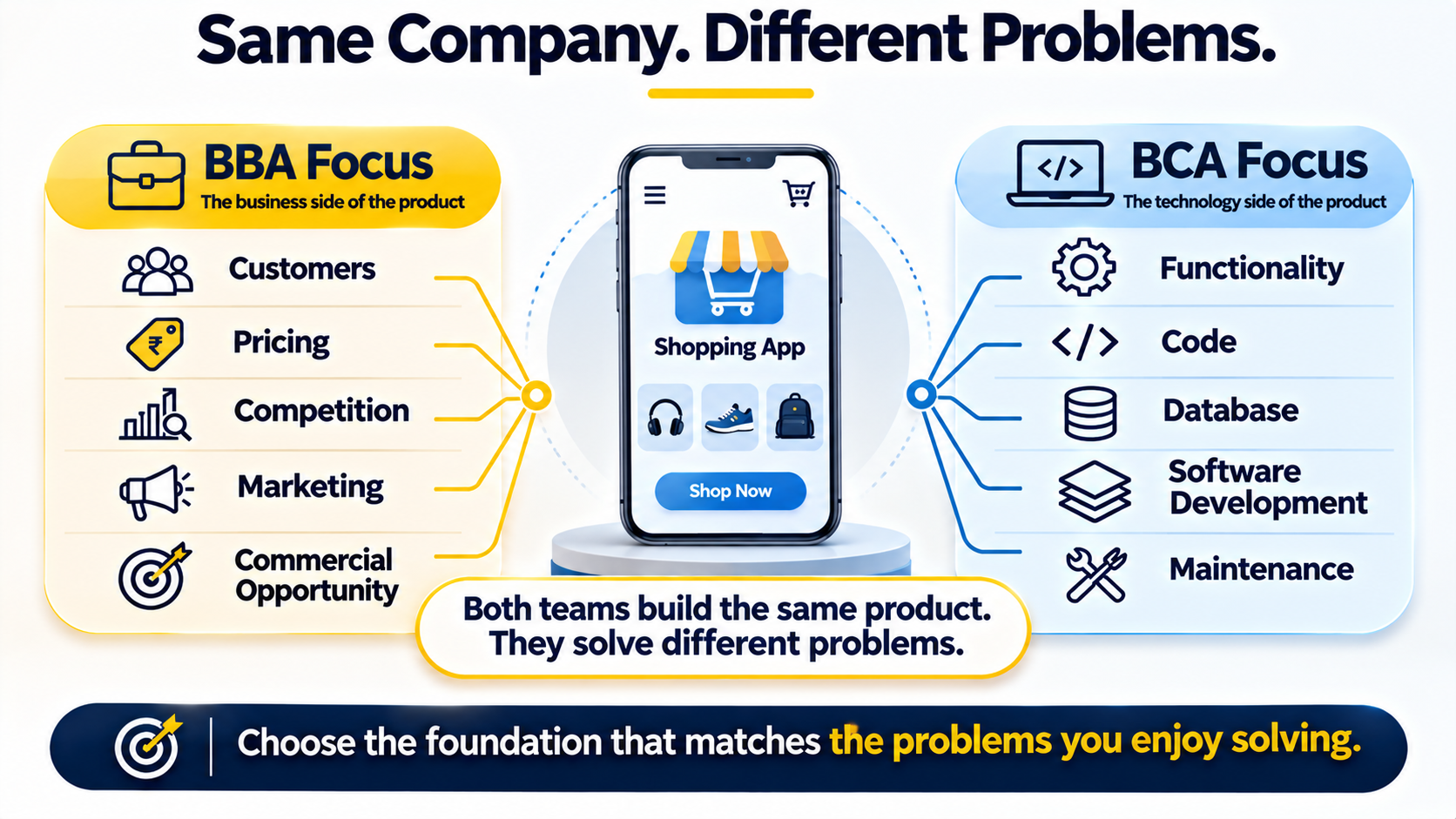
A simple way to understand the difference is to imagine a company developing a mobile application.
The business team needs to understand customers, pricing, competition, marketing and commercial opportunities.
The technology team needs to understand how the application should function, how its data will be managed and how the software will be developed and maintained.
Both contribute to the success of the product.
But the knowledge required for their responsibilities is different.
What Will You Learn in a BBA?
A BBA introduces you to the different functions involved in operating a business.
You may study why customers choose certain products, how companies manage employees, how business decisions affect profitability and how organisations plan their activities.
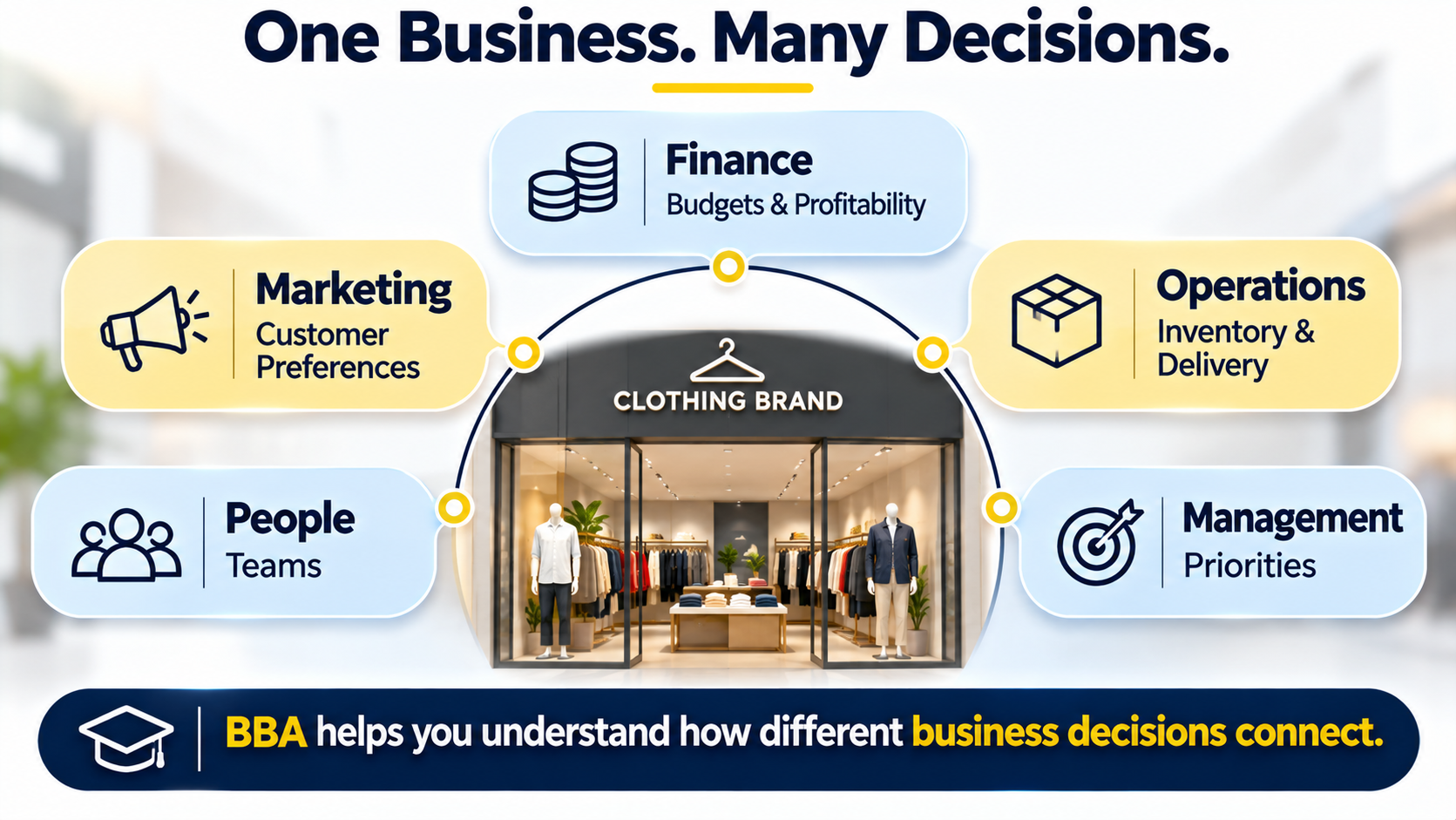
For example, imagine a clothing brand wants to attract more customers.
A marketing team might research customer preferences, analyse competitors, decide how to position the brand and plan promotional activities.
A finance team might assess budgets and profitability.
An operations team might work on inventory availability and delivery.
A BBA can help you understand how such activities connect.
It may be suitable if you enjoy communication, business problem-solving, economics, organising activities or understanding how organisations work.
However, studying management does not mean you will immediately enter a management position.
Professional responsibility usually develops through practical experience and demonstrated capability.
What Will You Learn in a BCA?
A BCA helps students develop foundational knowledge of computing and software applications.
Depending on the curriculum, you may learn programming languages, data structures, databases, web technologies, computer networks and software engineering concepts.
Consider the same clothing company.
It needs an online store.
Someone must develop the website, manage product information, connect payment systems, maintain databases and ensure the application works correctly.
A computing education provides relevant foundations for understanding these tasks.
But studying programming concepts and writing production-quality software are not the same thing.
Students also need practice through coding exercises, projects, debugging and exposure to real development workflows.
A BCA may be more suitable if you enjoy logical reasoning, technology, structured problem-solving and learning how software systems work.
BBA vs BCA: Which Career Paths Can You Explore?
|
BBA-related pathways |
BCA-related pathways |
|
Marketing and sales |
Software development |
|
Business operations |
Web and application development |
|
Human resources |
Software testing and quality assurance |
|
Business development |
Database and technical support |
|
Customer success |
Data analysis |
|
Management-related roles |
Cloud and IT support |
These are potential career directions, not guaranteed jobs after graduation.
Most roles require specific technical, analytical or professional skills in addition to a degree.
For example, a BCA graduate interested in software development needs to demonstrate programming ability.
A BBA graduate interested in marketing needs to understand campaigns, customers and performance measurement.
The degree gives you the foundation. Your skills and experience determine how well you can apply it.
What If You Like Both Business and Technology?
This is more common than you might think.
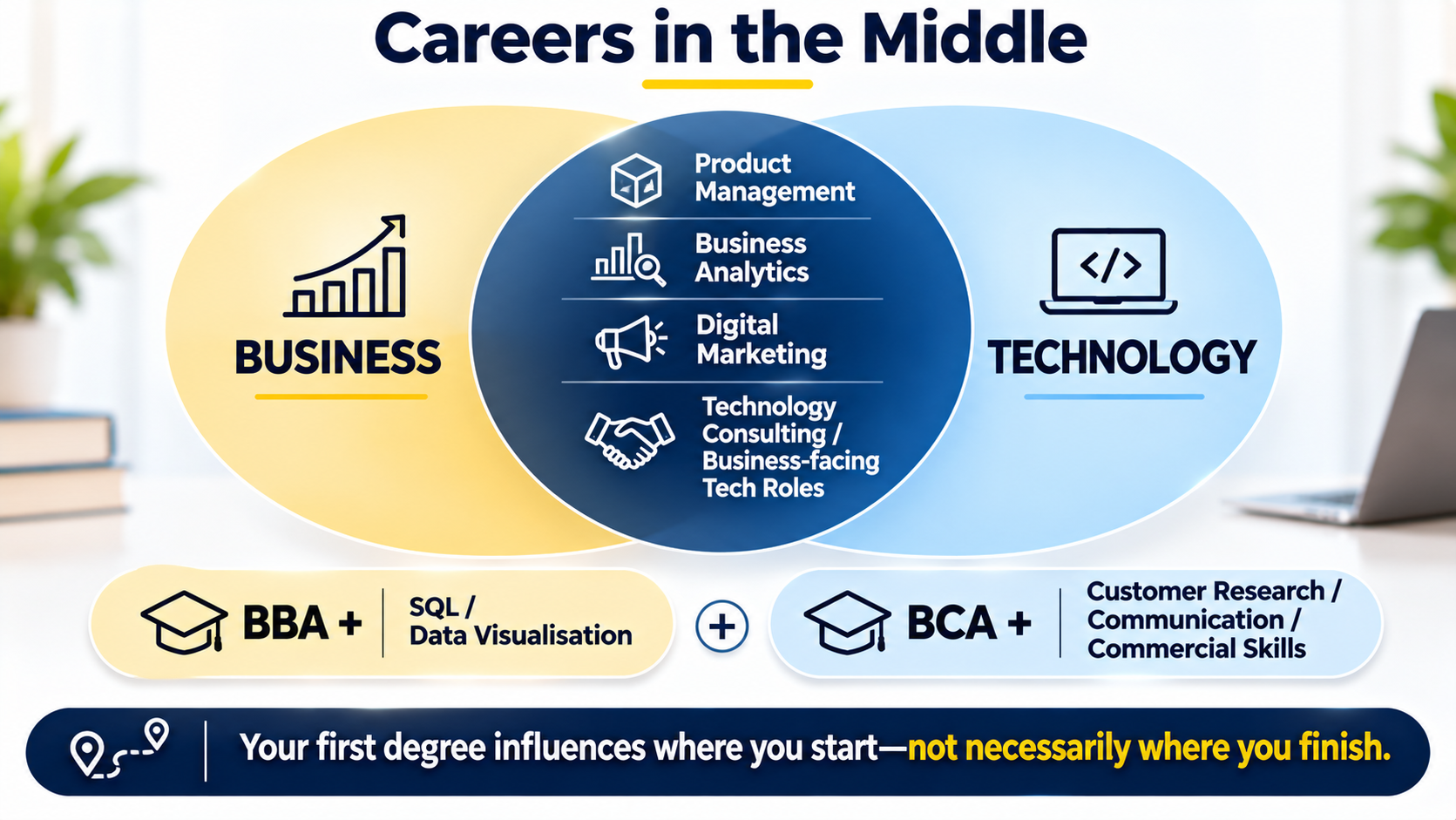
Many modern careers sit between the two fields.
Consider product management.
A product professional needs to understand customer problems, business priorities and how technology can help solve them.
Or consider business analytics.
The role combines business understanding with data interpretation and analytical tools.
Digital marketing also involves both business concepts and technology platforms.
So choosing BBA doesn't mean you can never work with technology.
And choosing BCA doesn't mean you cannot move towards business-related responsibilities later.
However, the route into these roles will differ.
A BBA student interested in business analytics may need to learn Excel, SQL and data visualisation.
A BCA student interested in product management may need to develop customer research, communication and commercial skills.
Your undergraduate background influences where you start, but it doesn't necessarily decide where you finish.
Interested in Both?
Some careers combine business understanding with technology capability. Compare programme curricula before deciding which foundation gives you the stronger starting point.
Compare BBA & BCAIs Mathematics Important for BCA?
You don't need to be a mathematical genius to begin learning programming.
However, logical reasoning and quantitative thinking can be important in computing.
Subjects such as algorithms, data structures, statistics and certain areas of computer science rely on mathematical concepts.
More advanced fields, including machine learning, may require stronger mathematics.
BCA eligibility rules vary across institutions.
Some programmes accept Class 12 students from different streams, while others specify mathematics, computer science or other subject requirements.
Before applying, check the university's current eligibility criteria rather than assuming that all BCA programmes follow the same rules.
The same applies to BBA admissions, where requirements can also differ by institution.
How Can You Test Your Interest Before Choosing?
Instead of trying to predict your entire career at 17 or 18, run two small experiments.
Experiment 1: Explore business.
Choose a product you use regularly.
Try answering these questions.
Who buys it? Who are its competitors? Why might customers choose it? How could the company attract more buyers?
You could even develop a simple marketing plan.
Notice whether you enjoy thinking about customers, pricing and business decisions.
Experiment 2: Explore technology.
Try an introductory programming course.
Build a simple webpage, calculator or small application.
Learn how variables, conditions and basic programming logic work.
Notice whether you enjoy solving errors and understanding how the code behaves.
Neither experiment will tell you everything about the degree.
But both can help you distinguish genuine interest from an attractive idea of a career.
What About Further Education?
A BBA graduate may pursue an MBA or other eligible postgraduate programmes to develop management or specialised business capabilities.
A BCA graduate may pursue an MCA or another suitable postgraduate pathway, depending on eligibility and career goals.
Students may also develop specialised capabilities through certifications, practical projects and workplace experience.
For technology careers, areas such as cloud computing, cybersecurity, software development and data analytics may become relevant.
For business careers, marketing analytics, finance, operations and management-related specialisations may be useful.
The right postgraduate qualification should be chosen based on the role you eventually want, rather than simply continuing with the most familiar subject.
Don't Let Salary Comparisons Make the Decision
It's tempting to search for average BBA and BCA salaries and choose whichever appears higher.
But salary figures can hide important differences.
A software developer, marketing executive, business analyst and IT support professional perform very different work.
Their salaries may vary based on the employer, location, skill level, responsibilities and experience.
A degree title alone tells you very little about what you will eventually earn.
You may be better served by identifying the kind of work you can imagine learning, practising and improving at over several years.
Business or Technology? Start With Your Curiosity
Choose BBA if you are more interested in how businesses operate, understand customers, manage resources and make commercial decisions.
Choose BCA if you are more interested in computing, programming, software applications and technology-related problem-solving.
And if you're interested in both, explore careers that combine business and technology before deciding which foundation suits you better.
You can compare BBA and BCA programmes offered by partner universities through Digivarsity, including their curriculum, eligibility and learning formats.
The goal isn't to identify the degree everyone says has the brightest future.
It's to understand what you want to learn and what kind of problems you'd like to solve.
Because choosing between BBA and BCA is not simply choosing between two degrees.
It's choosing where you want your professional learning to begin.
Frequently Asked Questions
Which is better after Class 12: BBA or BCA?
BBA may suit students interested in business, management and commercial functions. BCA may suit students interested in programming, software and computing. Neither is universally better.
Can commerce students pursue BCA after Class 12?
Some universities admit students from commerce and other streams, while others require specific subjects such as mathematics or computer science. Check the eligibility criteria of the particular BCA programme.
Can BCA graduates work in business roles?
Yes. BCA graduates may explore business-facing technology roles and develop additional skills in analytics, product management or business operations. Eligibility and suitability depend on the role and the candidate's capabilities.


Comments
Be the first to share your thoughts on this article.