If you are in college right now, you have probably heard two completely different pieces of career advice.
“Your degree is what gets you a good job.”
And then:
“Degrees don’t matter anymore. Companies only care about skills.”
So, which one is actually true in 2026?
The short answer: employers increasingly want both — and they want proof that you can use what you know.
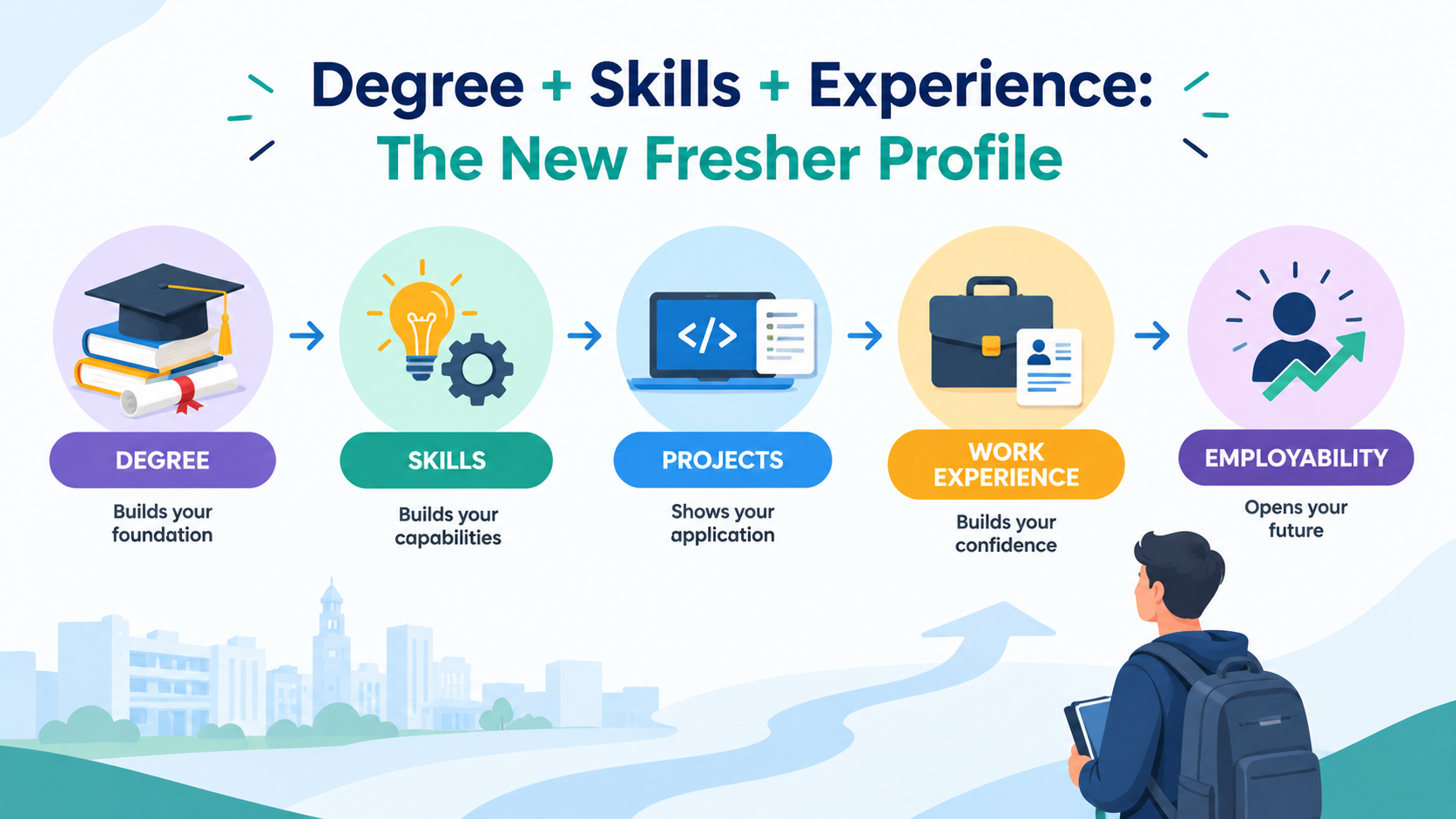
A degree can give you the foundation. Skills show what you can do. Projects, internships and real work exposure prove that you can apply those skills.
That last part is becoming increasingly important.
TeamLease EdTech's Career Outlook Report for July–December 2026 found that 75% of surveyed employers intend to hire freshers, up from 73% in the first half of the year. But employers are also becoming more selective about candidates' readiness to contribute at work.
Do Employers Still Care About Degrees?
Yes.
A degree still matters for many entry-level jobs, postgraduate programmes and professional career paths. It gives you structured knowledge and a recognised qualification.
But a degree alone does not tell an employer how well you can solve a problem, use technology, work with a team or handle a real task.
Think about two candidates applying for the same marketing role.
Both have a BBA.
Candidate A lists the degree and a few certifications.
Candidate B has the same degree, but has also run a digital campaign for a college event, analysed the results and can explain what worked and what didn’t.
Same qualification. Very different hiring conversation.
That is what skills-first hiring really means. It doesn’t necessarily mean “degree-free.” It means employers are increasingly looking beyond the degree.
Why Skills Matter More Than Ever
There is good news for freshers.
TeamLease EdTech’s Career Outlook Report for July–December 2026 found that 75% of surveyed employers intend to hire freshers, up from 73% in the first half of 2026. The study covered 1,097 companies across India.
But there is another side to the story.
Employers are also becoming more selective. Practical skills, AI fluency, applied problem-solving and hands-on project experience are becoming increasingly important.
In simple terms:
Companies are hiring freshers. But they are becoming clearer about which freshers they want.
LinkedIn’s Skills on the Rise 2026 research shows the same shift. In India, fast-growing skills include areas such as prompt engineering, LLMOps and data storytelling, alongside stakeholder management, collaboration and leadership.
So, it isn’t about choosing between technical skills and human skills.
You need a mix of both.
What Skills Should a Fresher Build in 2026?
There is no single list that works for everyone.
The skills you need should depend on the career you want.
Interested in technology? AI, cloud, cybersecurity, data and software skills may matter.
Interested in marketing? Think digital advertising, analytics, content, consumer understanding and AI tools.
Interested in finance? Financial modelling, data analysis, Excel, business intelligence and AI-assisted research could be useful.
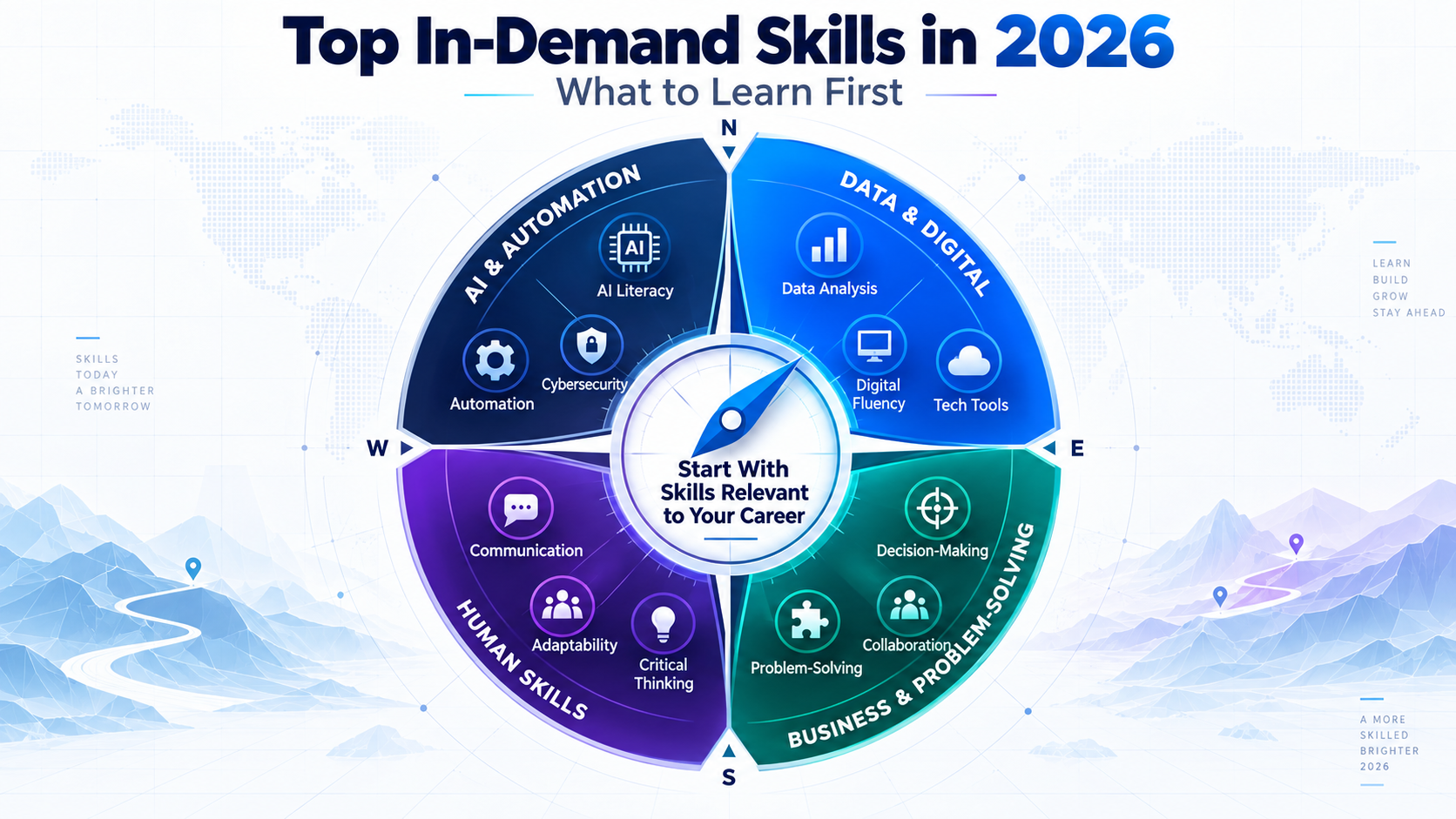
But some abilities travel across almost every career:
- Analytical thinking
- Communication
- Problem-solving
- Adaptability
- Digital and AI fluency
- Collaboration
- Continuous learning
The World Economic Forum estimates that 39% of workers’ existing skill sets will be transformed or become outdated by 2030. It also identifies analytical thinking as a leading core skill, while AI and big data are among the fastest-growing.
That means your career cannot depend only on what you know when you graduate.
You also need to know how to keep learning.
“I Know ChatGPT” Is Not an AI Skill
Almost every student can access AI today.
That doesn’t mean every student knows how to use it well.
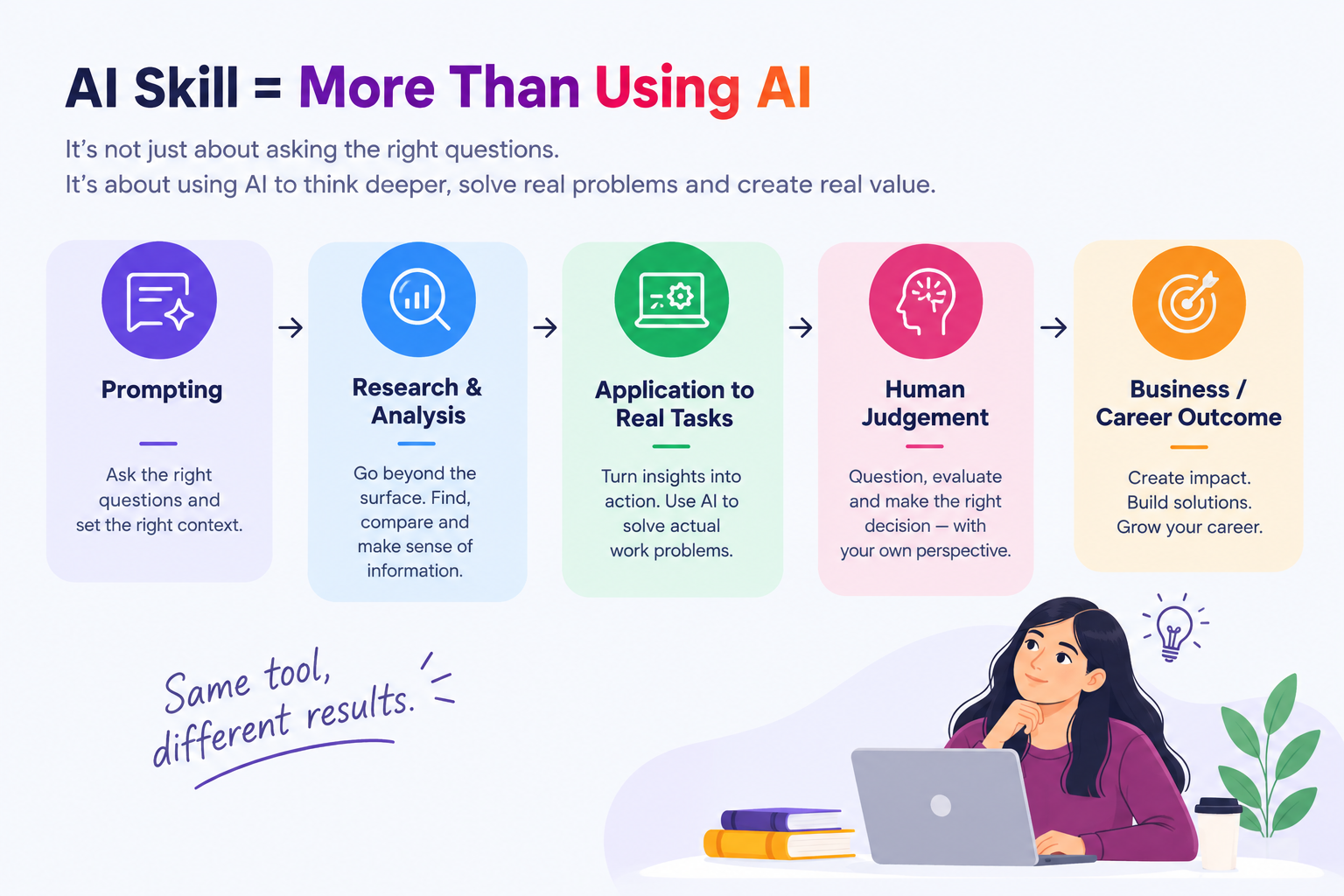
Employers are unlikely to be impressed simply because you can generate an answer using an AI tool. What matters is whether you can use AI to improve actual work.
Can you research faster?
Can you analyse information better?
Can you automate repetitive tasks?
Can you check whether an AI-generated answer is actually correct?
Can you combine AI with your own judgement?
The tools will keep changing. Your ability to use them intelligently is what matters.
Proof Beats a Long Skills List
Many fresher résumés contain something like this:
Excel — Advanced
Python — Intermediate
Digital Marketing — Advanced
Generative AI — Intermediate
The problem?
Anyone can write that.
Now compare it with:
“I analysed 10,000 customer records and built a dashboard to identify the biggest reasons for customer churn.”
Suddenly, the employer has something real to discuss.
That is proof of work.
And you don’t need a full-time job to create it.
Your proof can come from an internship, apprenticeship, college project, competition, freelance assignment, personal project or work-linked learning experience.
Don’t just collect certificates. Build things you can show and explain.
Don't Just Learn. Build Proof of What You Can Do.
Explore work-integrated degree programmes that help you connect academic learning with practical exposure.
ExploreSo, Degree First or Skills First?
There is a better question:
What do you want to be able to show an employer by the time you graduate?
Start with the career you want. Understand what an entry-level role in that field actually requires. Then look at your degree and identify what you need to add.
Ask yourself:
What knowledge will my degree give me?
What skills do I need to build?
What projects can I work on?
Where can I get real work experience?
The strongest fresher profile in 2026 may not be the one with the longest list of qualifications.
It is the one where everything connects:
Degree + Skills + Proof + Experience
Your degree tells an employer what you studied.
Your skills show what you can do.
Your experience proves that you can do it in the real world.
And that is a much better way to prepare for your first job than choosing between a degree and skills.
Find a programme aligned with your career goals
Your career starts with the right direction. Explore programmes that help you build the skills and experience you need for your chosen career path.
Learn MoreFrequently Asked Questions
Do employers still care about degrees in 2026?
Yes. Degrees still matter for many entry-level roles and career paths, but employers increasingly look at skills, projects and practical experience alongside qualifications.
What matters more for freshers: degree or skills?
Neither works best alone. A degree provides the academic foundation, while skills and practical experience show employers what you can actually do.
How can students build skills while completing a degree?
Students can build skills through internships, live projects, certifications, competitions, freelance work and personal projects related to the career they want to enter.


Comments
Be the first to share your thoughts on this article.