You are studying commerce.
Your friend is doing engineering.
Someone else in your group is studying psychology, design or law.
Do all of you really need to understand AI?
Yes. But probably not in the way you think.
You don't all need to learn machine learning. You don't need to know how to build an AI model. And you definitely don't need to switch to a career in technology.
What you do need is AI literacy.
Because whether you eventually work in finance, marketing, healthcare, HR, design, law, engineering or almost any other field, chances are AI will become part of how that work gets done.
First, What Exactly Is AI Literacy?
AI literacy is much more than knowing how to use ChatGPT.
It means understanding enough about AI to use it effectively, question its output and know when not to trust it.
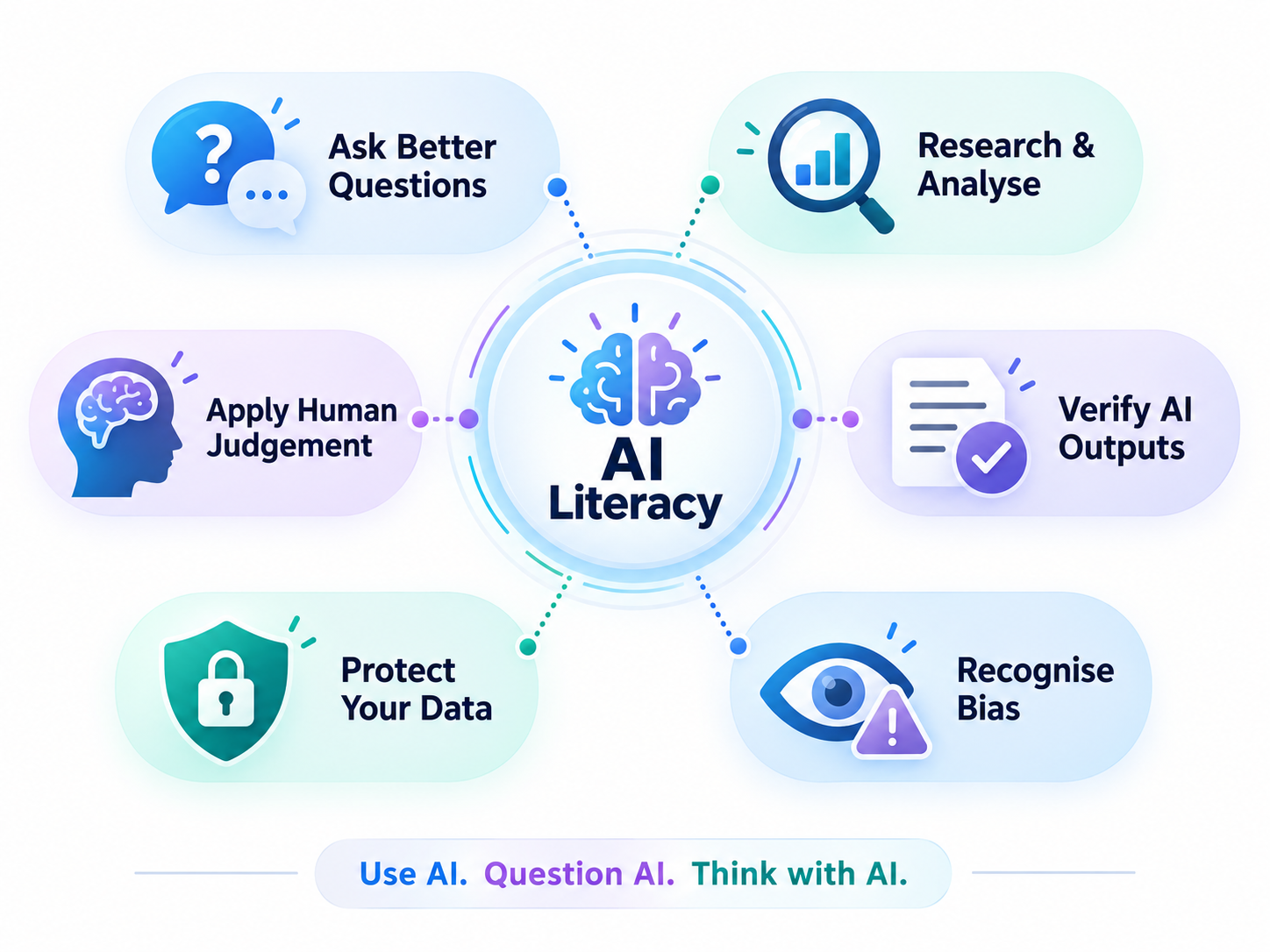
An AI-literate student should gradually learn how to:
- Ask AI better questions
- Use it to research, analyse and create
- Check whether its answers are accurate
- Recognise bias or misleading information
- Protect personal and confidential information
- Understand where human judgement is still necessary
- Apply AI to problems in their own field
UNESCO's AI Competency Framework for Students takes a similarly broad view. It covers not only AI techniques and applications, but also ethics, human-centred thinking and the ability to understand and create with AI.
That distinction matters.
Using AI is easy. Using AI intelligently is a skill.
Why Does AI Literacy Matter If You're Not a Tech Student?
Because AI isn't staying inside technology departments.
Think about what different professionals might already use it for.
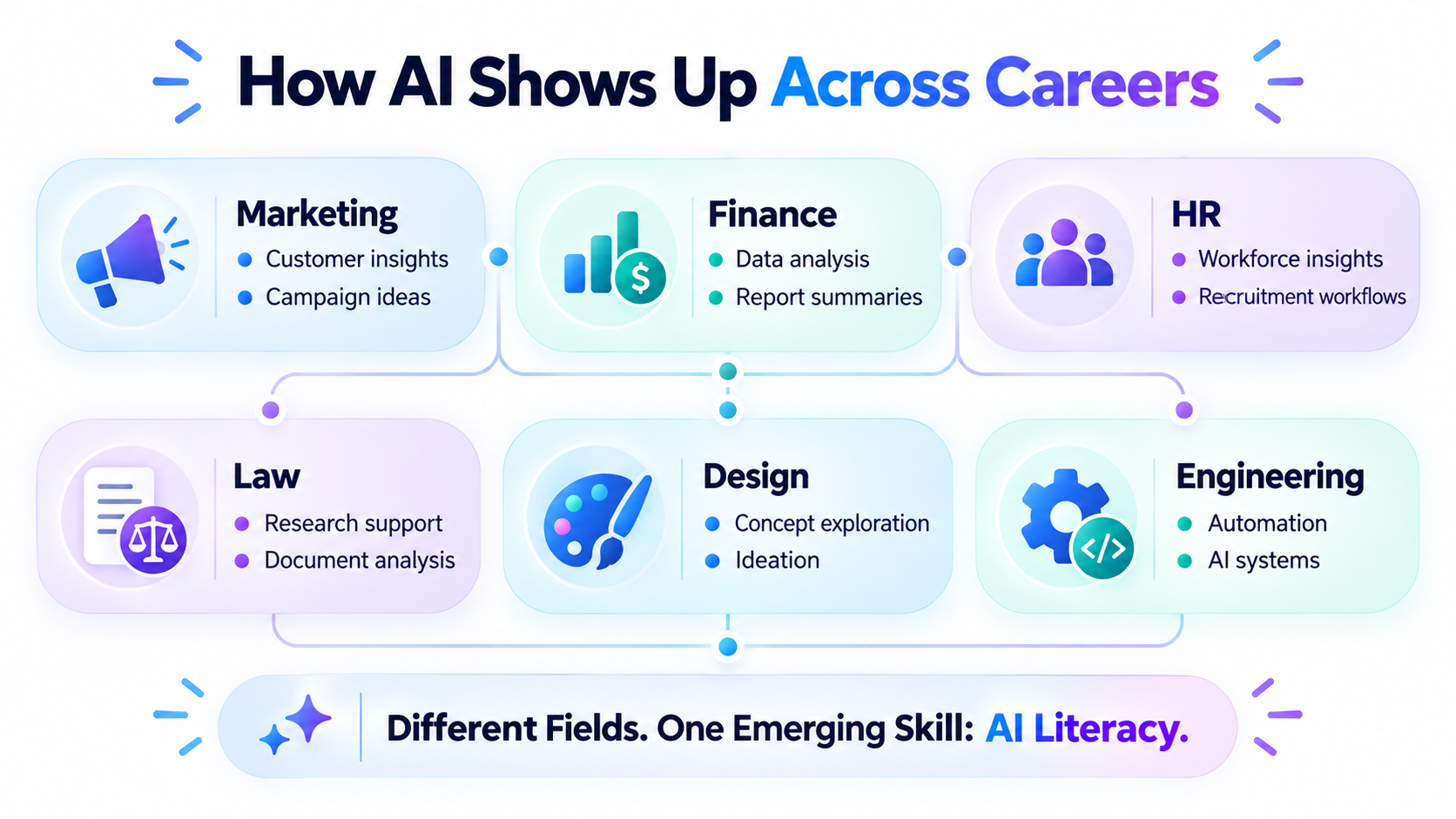
A marketing student could use AI to understand customers, develop campaign ideas or analyse performance data.
A finance student might use it to summarise reports, explore datasets or support financial research.
An HR student could use AI to analyse workforce data, improve recruitment workflows or draft employee communication.
A law student might use it to organise research or summarise lengthy documents—but would still need to verify every important fact and legal reference.
A designer could explore concepts faster while using their own judgement to decide what is original, relevant and worth developing.
And an engineer may work much more deeply with AI, automation and data.
Different careers.
Different applications.
Same underlying ability: knowing how to work effectively with AI.
This Is Already Becoming a Workplace Skill
The shift isn't theoretical.
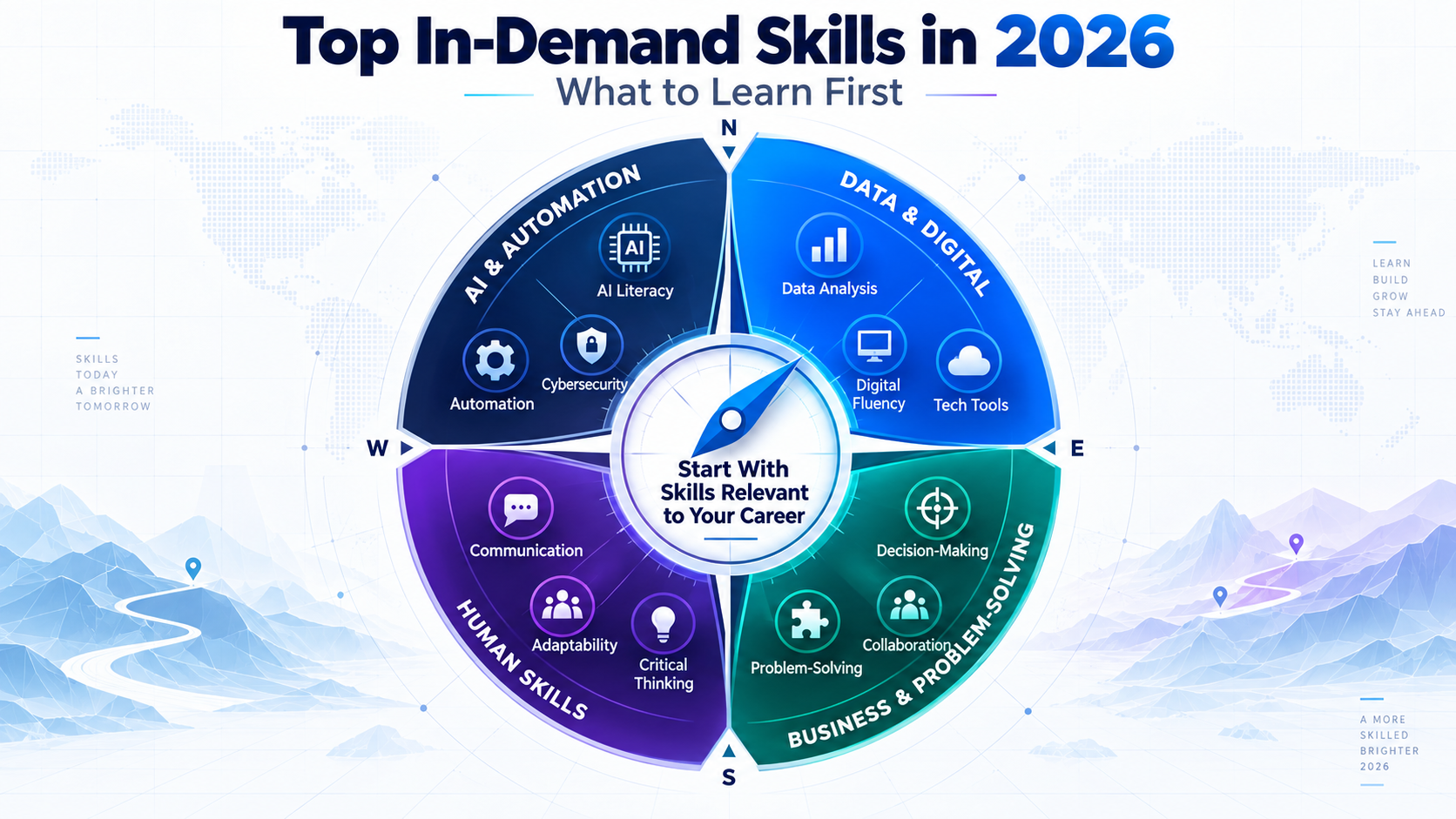
The World Economic Forum identifies AI and big data as the fastest-growing skill area through 2030, followed by networks and cybersecurity and technological literacy. At the same time, analytical thinking remains the most important core skill identified by surveyed employers.
LinkedIn's Skills on the Rise 2026 data for India tells a similar story. Fast-growing areas include prompt engineering, workflow automation and LLM operations, alongside data storytelling, collaboration and stakeholder management.
That combination is important.
Employers aren't simply looking for people who know AI.
They need people who can combine AI with thinking, communication and domain knowledge.
That is why AI literacy matters whatever your stream.
Knowing How to Prompt Is Only the Beginning
A lot of AI learning today starts and ends with:
“Here are 10 prompts you should know.”
Prompts are useful. But that is a very small part of being AI literate.
Suppose you ask an AI tool:
“Which mutual fund should a 22-year-old invest in?”
It gives you an extremely confident answer.
Do you immediately follow it?
Probably not.
You would want to know where the information came from, whether it is current, what assumptions were made and whether important information about your finances is missing.
The same principle applies to an assignment, market report, legal research or business recommendation.
AI can produce an answer. You are still responsible for deciding whether the answer makes sense.
In an AI-powered world, critical thinking may become more important, not less.
Don't Let AI Do All Your Thinking
There is another trap students need to avoid.
AI can write your assignment.
It can summarise the chapter you didn't read.
It can generate your presentation.
It can even give you answers to questions you haven't properly understood.
That makes things faster.
But faster isn't always better.
If AI does the reading, thinking, questioning and writing every single time, what exactly are you getting better at?
Use AI to accelerate learning—not replace it.
Ask it to explain something you don't understand.
Challenge its answer.
Ask for another perspective.
Use it to practise an interview.
Brainstorm with it.
Analyse information with it.
Then apply your own judgement.
The goal isn't to become good at outsourcing your thinking to AI. The goal is to become better at thinking with AI.
How Can You Start Building AI Literacy?
You don't need to begin with an expensive course.
Start with the work you're already doing.
The next time you have an assignment, don't simply ask AI to complete it.
Ask it to help you create a research plan.
Compare its answer with credible sources.
Ask it why it reached a particular conclusion.
Try the same task on two different AI tools and compare the results.
Use AI to analyse a spreadsheet, improve a presentation, practise an interview or understand a difficult concept.
Most importantly, start applying it to your own stream.
Ask yourself:
“How could AI change the career I want to enter?”
That's a far more useful question than simply asking which AI tool is trending.
Your Stream Still Matters
Your Subject Expertise Still Matters. AI can generate an answer. Your knowledge helps you judge whether it's a good one.
AI doesn't make subject knowledge irrelevant.
Quite the opposite.
A finance student who understands finance can judge an AI-generated financial analysis better.
A designer who understands design can recognise a weak AI-generated concept.
A lawyer who understands law can identify when an AI response is unreliable.
AI becomes more useful when you have the knowledge to question it.
So you don't have to choose between learning your subject and learning AI.
Learn your field deeply.
Then learn how AI can help you work differently within it.
Because the advantage in the years ahead may not belong to AI versus humans.
It may belong to people who understand their field and know how to use AI intelligently within it.
And that is why AI literacy is becoming a skill every student needs—whatever the stream.
Confused about which course adds AI to your career?
Compare programs, fees and learning modes with a counsellor who can help you choose the right fit, not just the trending one.
Learn MoreFrequently Asked Questions
Do students from non-technical streams need AI skills?
Yes. AI is increasingly being used across marketing, finance, HR, design, law, management and many other fields. The way you use AI will depend on your career.
Do I need coding to become AI literate?
No. AI literacy means understanding how to use, evaluate and apply AI responsibly. Coding is necessary only for certain technical AI roles.
How can students start learning AI?
Start by using AI for real tasks in your own subject, such as research, analysis, brainstorming or practice, while learning to verify its output and recognise its limitations.

Comments
Be the first to share your thoughts on this article.