You are already working in technology, finance, consulting, operations or another professional field.
AI is becoming more relevant to your career, and you have decided to study it seriously.
Then you encounter two very different options.
An executive AI certificate that focuses on specific capabilities over a relatively short period.
Or a formal degree in artificial intelligence, machine learning or a related discipline that requires a more substantial academic commitment.
Both may offer valuable learning.
But they are not designed to solve the same career problem.
The right choice depends on what you want to do with AI, how much technical depth you need and the qualifications your future roles require.
First, Understand What You Are Comparing
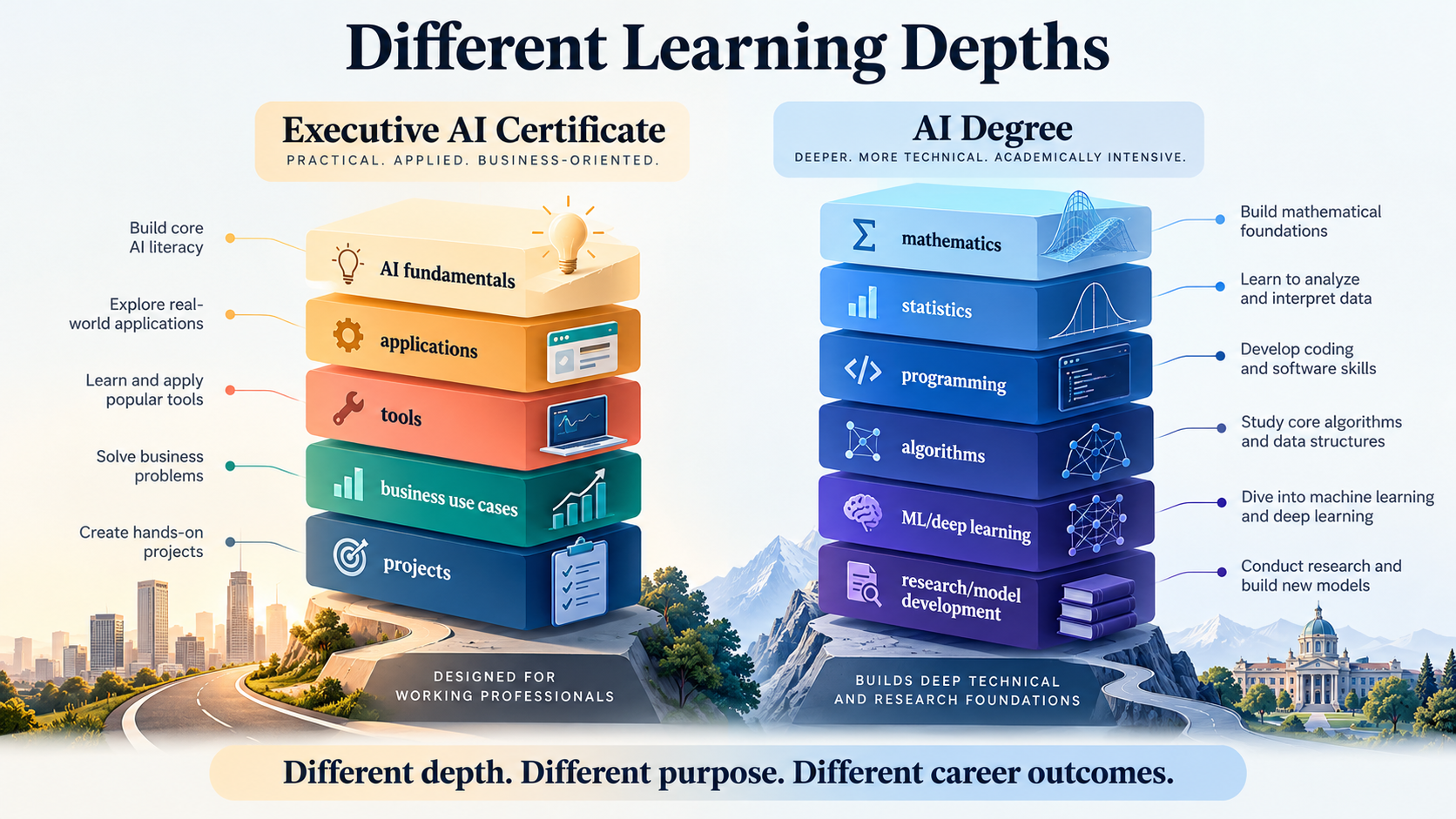
An executive AI certificate is generally a focused professional programme designed to develop particular capabilities.
Depending on its objectives, it may cover AI fundamentals, machine learning applications, generative AI, data-driven decision-making, business strategy or technical implementation.
Some programmes are created for business managers. Others are intended for software engineers, data professionals or experienced technology specialists.
An AI degree is a formal academic qualification offered through an appropriately authorised institution.
Depending on the programme, it may involve advanced mathematics, statistics, programming, algorithms, machine learning, deep learning, research methods and substantial academic assessment.
Degrees can also differ considerably. A specialist technical degree in AI is not identical to a management degree that includes AI as one subject or specialisation.
The distinction therefore goes beyond programme duration.
It is about the level, breadth, purpose and academic status of the learning.
The First Question: Do You Want to Use AI or Build AI Systems?
Consider two professionals.
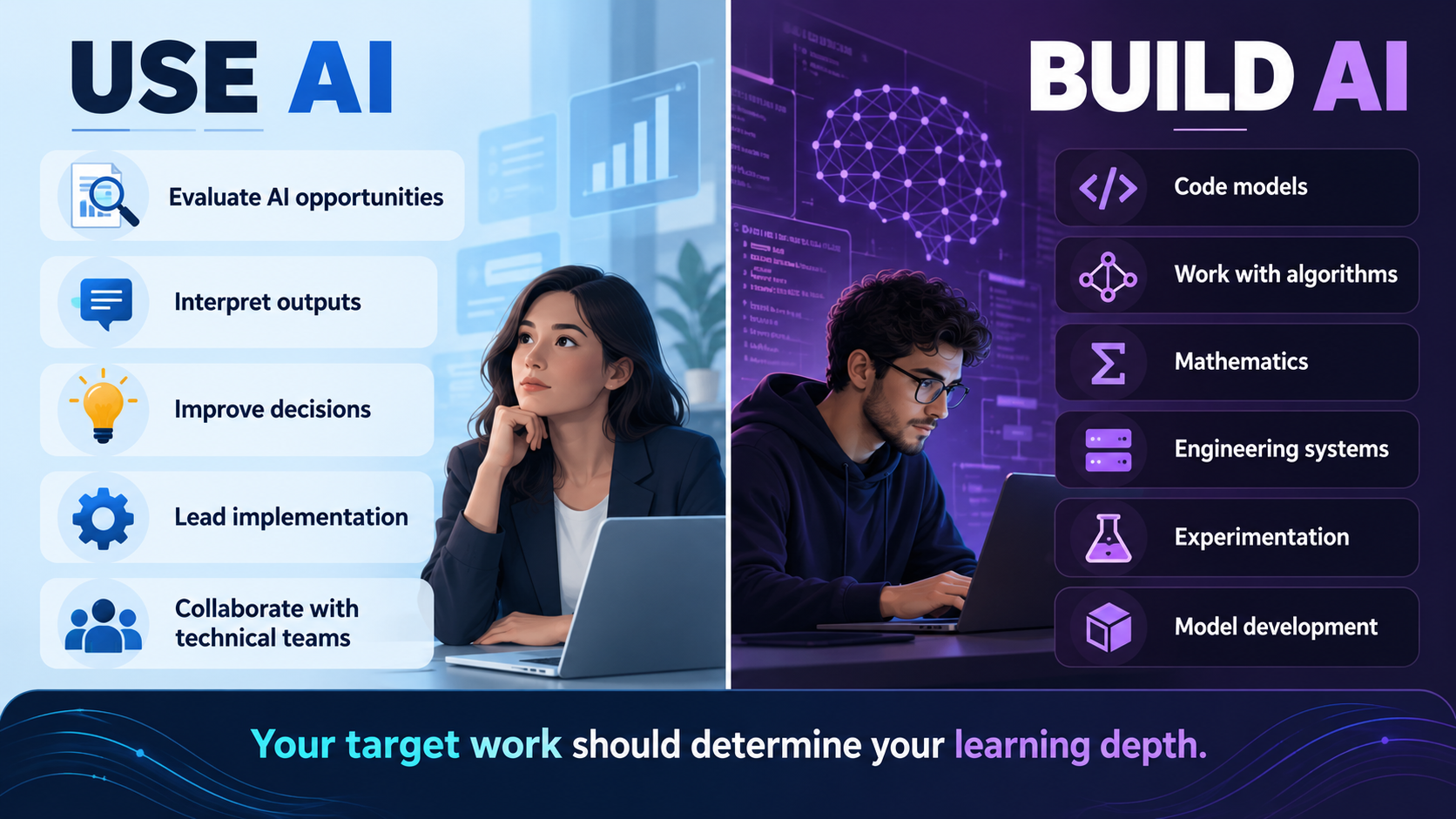
Professional A is a marketing manager with eight years of experience.
Their organisation is introducing AI-powered customer analytics. They want to understand the technology, evaluate its potential and make better marketing decisions.
They are not planning to become a machine learning engineer.
An executive AI programme focused on business applications, model interpretation, responsible AI and practical projects may address their immediate needs.
Professional B is a software engineer with five years of experience.
They want to move into a specialist role involving machine learning systems, model development and advanced AI engineering.
They may need much deeper training in mathematics, algorithms, software systems and technical experimentation.
A suitable degree programme could provide that structured academic depth. A technically rigorous executive programme may also help, particularly if they already have strong foundations.
These professionals are not choosing between a better and a worse qualification.
They need different capabilities for different jobs.
Where an Executive AI Certificate Can Make More Sense
An executive certificate may be particularly relevant when you already have professional expertise and need to add AI knowledge to it.
For example, a supply chain professional could benefit from learning about forecasting and optimisation without studying an entire computer science curriculum.
A finance manager may want to evaluate AI applications in risk assessment and reporting.
An experienced engineering professional may want focused exposure to a specific AI technique or implementation environment.
The attraction is the narrower scope.
Instead of studying a broad academic discipline, the learner concentrates on capabilities connected to a current or near-term professional requirement.
A well-designed programme should still provide meaningful assessment, practical work and an appropriate level of technical depth.
Shorter does not automatically mean superficial. But neither does the word "executive" guarantee advanced learning.
Where an AI Degree Can Make More Sense
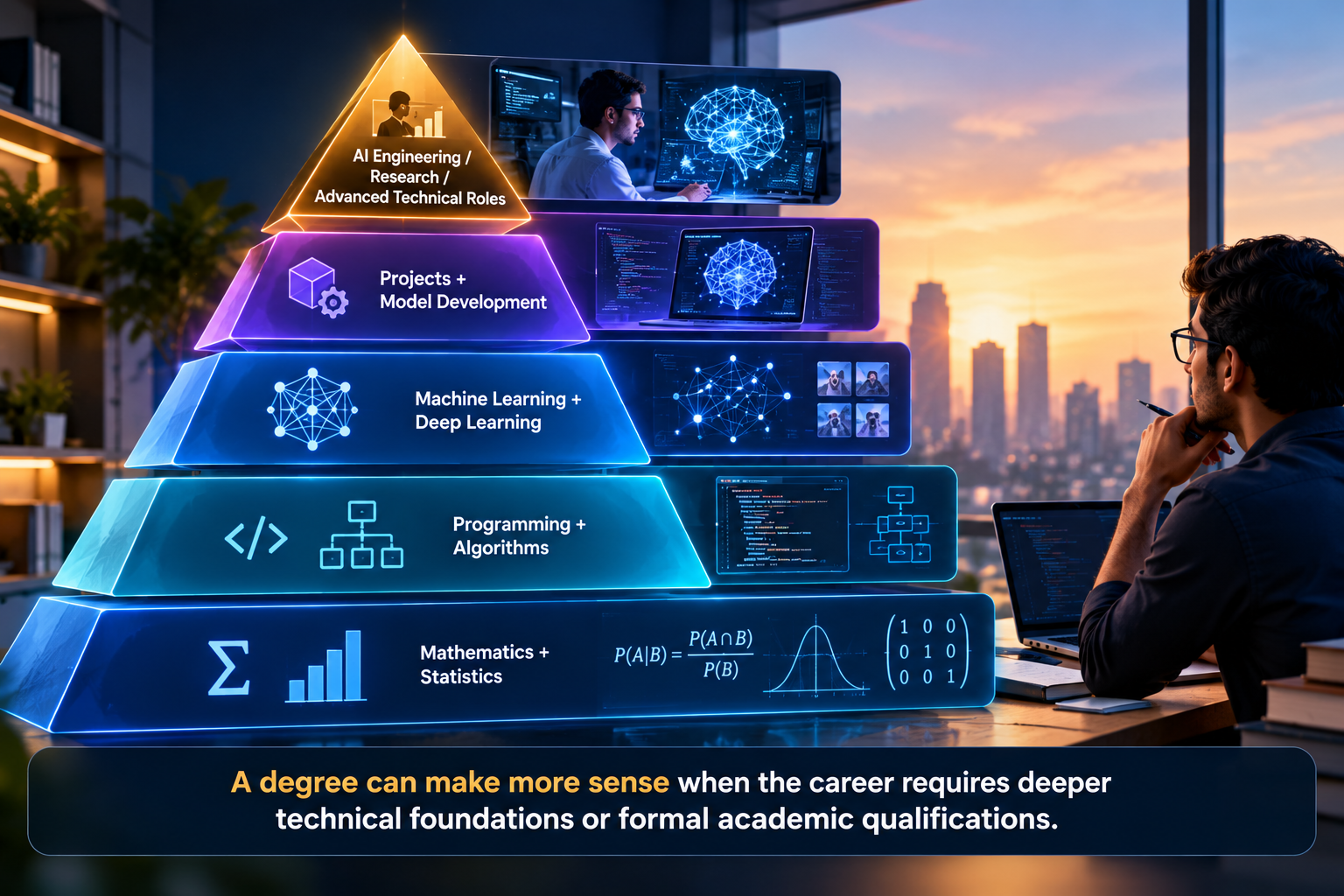
A degree becomes more relevant when your goal requires formal academic qualifications, broader foundational knowledge or sustained technical depth.
Suppose you want to move into AI research, pursue further academic study or enter roles that explicitly require a relevant undergraduate or postgraduate degree.
In those situations, the credential itself may matter alongside the curriculum.
Formal degree programmes can also provide a more systematic sequence of learning.
Rather than beginning with the latest AI application, you may study the mathematics, statistics, computing and theoretical concepts that explain how such systems work.
That foundation can be particularly useful for roles involving the development, evaluation and improvement of AI models.
However, not every degree will prepare you for the same technical roles. Review its actual modules, assessments, projects and entry requirements instead of relying on the word "AI" in the title.
Compare the Learning, Not Just the Certificate
Before selecting either route, examine these five areas.
1. Depth of Curriculum
Does the programme explain AI concepts or require you to implement them?
Will you study technical foundations such as statistics and algorithms, or primarily explore business applications?
Neither approach is automatically superior. The relevant level depends on your career objective.
2. Practical Learning
Are there meaningful assignments, datasets, projects or opportunities to apply what you learn?
For a technical role, model-development and engineering experience may be important.
For a management role, evaluating AI use cases, assessing investment decisions and understanding implementation risks could be more relevant.
3. Credential and Recognition
Check whether the outcome is a certificate of completion, an assessed professional certificate, a credit-bearing qualification or a formal degree.
These are not interchangeable.
If you are considering an online degree in India, verify the institution's authority to award the qualification and the programme's applicable recognition, permissions and delivery requirements.
Certain disciplines, including engineering, are subject to restrictions under UGC's online and ODL framework. Do not assume that every AI-related degree can be pursued fully online simply because its subject is technology.
4. Time and Financial Commitment
An executive programme may be easier to combine with employment, but it can still involve demanding assignments, live sessions and campus immersion.
A degree may require a longer period of consistent academic effort.
Compare the complete commitment, including fees, assessments, attendance expectations and time away from work.
5. Career Relevance
This is the most important consideration.
Look at actual job descriptions for the roles you want.
Do employers repeatedly require a particular degree?
Or do they emphasise practical experience, specialist skills, tools and demonstrable project work?
Use those requirements to evaluate what you need to learn.
The Decision Framework: Three Career Goals
A useful way to choose is to begin with your intended professional direction.
Goal 1: Become an AI-informed business leader.
You want to improve decisions, identify useful applications, work with specialists and lead change.
A business-oriented executive AI certificate may be a sensible starting point.
Goal 2: Move into a technical AI role.
You want to build models, develop AI systems or work as a machine learning specialist.
Prioritise technical depth, mathematical foundations, coding, engineering projects and the formal qualifications your target roles require. A relevant degree or rigorous technical pathway may be appropriate.
Goal 3: Add AI expertise to an established technical career.
You already work in software, data or engineering and need specialised capability in a particular area.
You may benefit from either route. The deciding factor is whether your gap is foundational knowledge, advanced technical practice or formal academic qualification.
Sometimes the Best Answer Is a Sequence
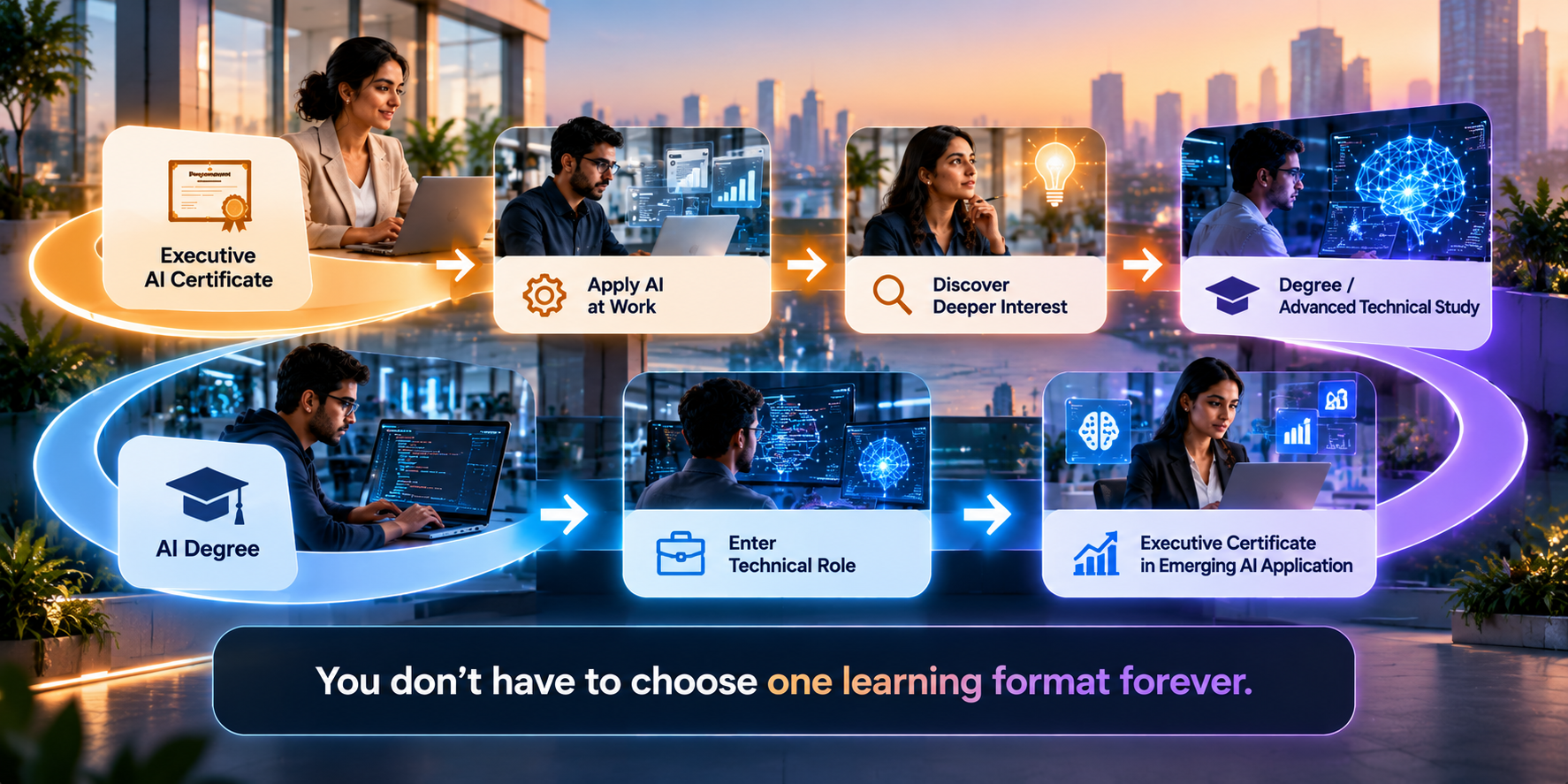
You do not always have to choose one pathway for the rest of your career.
An experienced professional might begin with focused executive learning to understand whether they want to specialise further.
A degree holder might later use an executive certificate to study an emerging application not covered deeply in their original curriculum.
Your learning pathway can evolve as your work changes.
What matters is avoiding unnecessary qualifications that do not contribute to your intended direction.
Choose the Qualification That Matches the Work You Want to Do
An executive AI certificate can be valuable for focused professional development.
An AI degree can provide a more formal academic pathway and, depending on the programme, deeper technical preparation.
Neither guarantees employment, a promotion or immediate expertise.
Before deciding, write down the roles or responsibilities you want to pursue over the next three years.
Then identify the knowledge, practical experience and credentials those roles require.
Choose the learning pathway after defining the professional capability you want to build, not before.
For working professionals exploring focused executive learning, Digivarsity offers a starting point to examine institute-led programmes and compare their intended outcomes.
Frequently Asked Questions
Is an executive AI certificate better than an AI degree for managers?
It may be more directly relevant when the goal is to understand and apply AI within an existing management role. A degree may be preferable when formal academic qualifications or broader technical foundations are necessary.
Can I become an AI engineer through an executive AI programme?
Possibly, if the programme provides sufficient technical training and you already possess relevant foundations. However, a general business-focused AI certificate alone is unlikely to cover everything required for an engineering role.
Is an AI degree necessary to work in artificial intelligence?
Not for every AI-related role. Requirements vary. Some technical and research positions demand specialised academic preparation, while other roles prioritise software experience, data skills, applied projects or business expertise.



Comments
Be the first to share your thoughts on this article.