You have spent years becoming good at your job.
You understand your customers, your industry and the decisions that make your business work.
Then AI enters the conversation.
Your organisation starts exploring automation. Teams begin using generative AI. Management wants to know which processes can be improved, what technology is worth investing in and how to manage the risks.
Suddenly, understanding AI feels less like an optional technical skill and more like part of your professional responsibility.
An executive AI certificate may seem like the obvious next step.
But what can it actually do for your career?
And just as importantly, what should you not expect from it?
Why AI Knowledge Is Becoming Relevant Beyond Technology Roles
AI is no longer something only data scientists and software engineers need to understand.
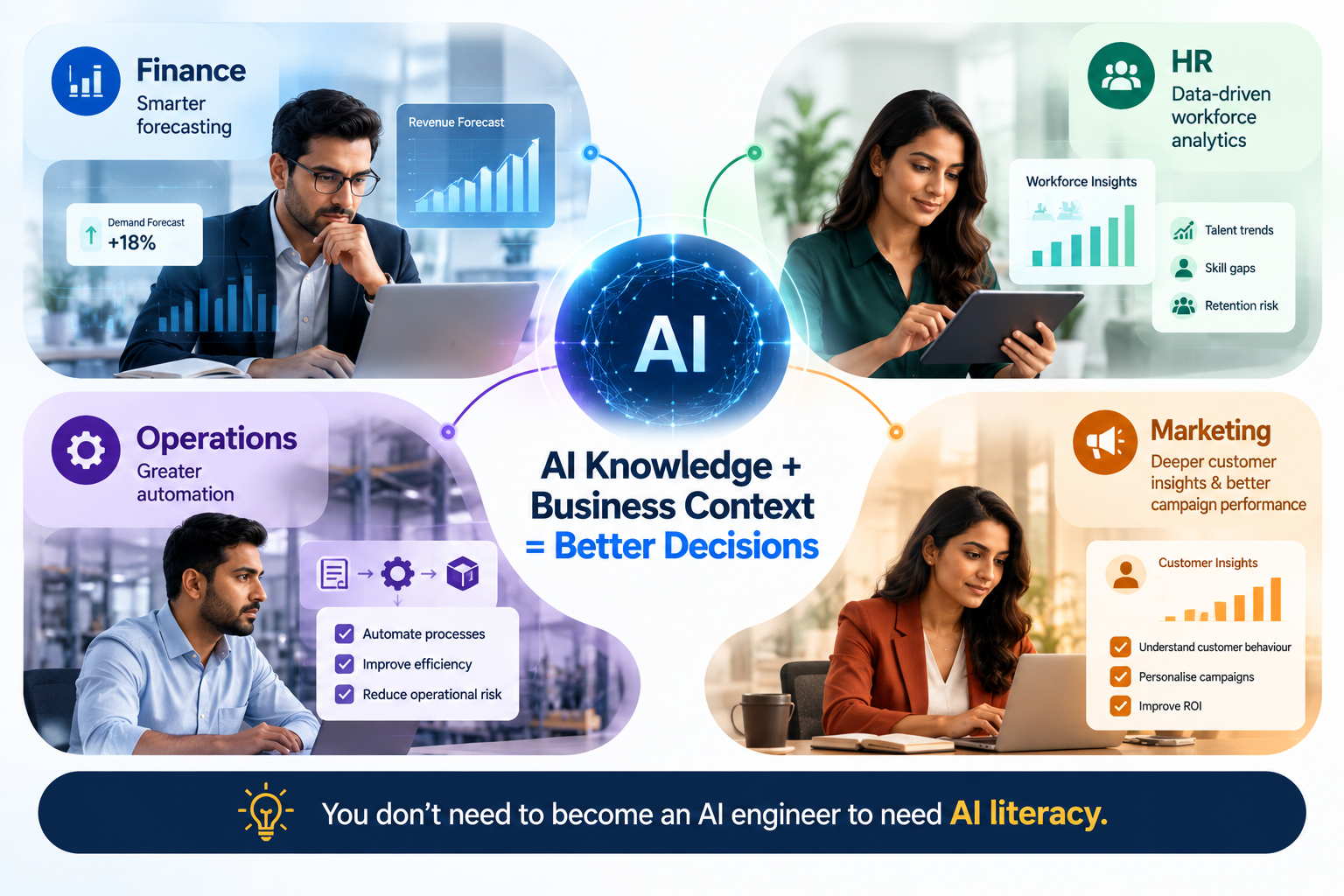
A finance manager may encounter AI-powered forecasting. An HR leader may evaluate workforce analytics. An operations professional may oversee automation initiatives. A marketing leader may need to understand how AI changes customer insights and campaign performance.
According to the World Economic Forum's Future of Jobs Report 2025, AI and big data are among the fastest-growing skill areas through 2030. The report also identifies analytical thinking, leadership and adaptability as important workplace capabilities.
This combination matters.
Organisations need people who can understand technology, connect it with business priorities and make informed decisions about its use.
That is one of the areas where an executive AI certificate can become useful.
1. It Can Help You Understand AI Beyond the Buzzwords
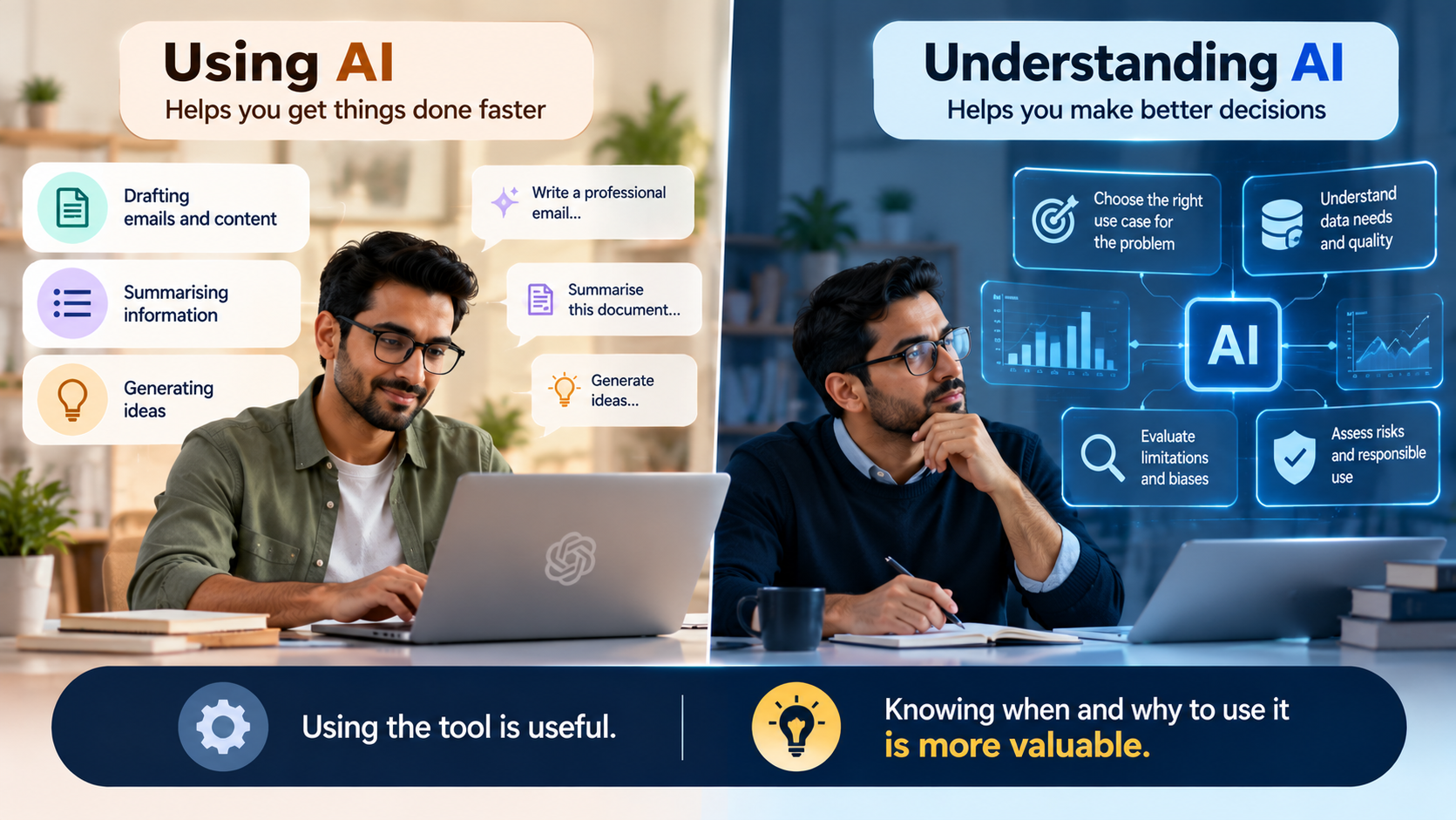
There is a difference between using an AI tool and understanding how AI creates business value.
You might already use ChatGPT to draft emails, summarise information or develop ideas.
But can you explain why a predictive model might be suitable for one business problem and generative AI for another?
Can you identify the limitations of an AI-generated recommendation?
Can you recognise when a process needs better data rather than more advanced technology?
A well-designed executive AI programme can help professionals understand concepts such as machine learning, predictive analytics, generative AI, automation and responsible AI.
The objective is not necessarily to turn every participant into a developer.
It is to strengthen the ability to understand AI applications and evaluate them intelligently.
For a business professional, that knowledge can be valuable even without advanced programming expertise.
2. It Can Strengthen Your Ability to Work With Technical Teams
Imagine you are responsible for improving customer retention.
Your analytics team proposes an AI model to identify customers who may stop buying.
You understand the business problem, but the discussion quickly becomes technical.
What data will the model use? How will its predictions be evaluated? What happens when it makes incorrect recommendations? Who is responsible for acting on the results?
Without sufficient AI knowledge, you may struggle to participate meaningfully.
With relevant training, you can ask more informed questions and evaluate the proposed solution against business requirements.
You do not necessarily need to build the model yourself.
You need to understand enough to make decisions about its usefulness, limitations and implementation.
That ability to connect technical expertise with business judgement can be particularly relevant for managers, consultants and functional leaders.
3. It Can Help You Apply AI in Your Existing Career
One of the most practical ways to benefit from an executive AI certificate is to apply the learning to a problem you already understand.
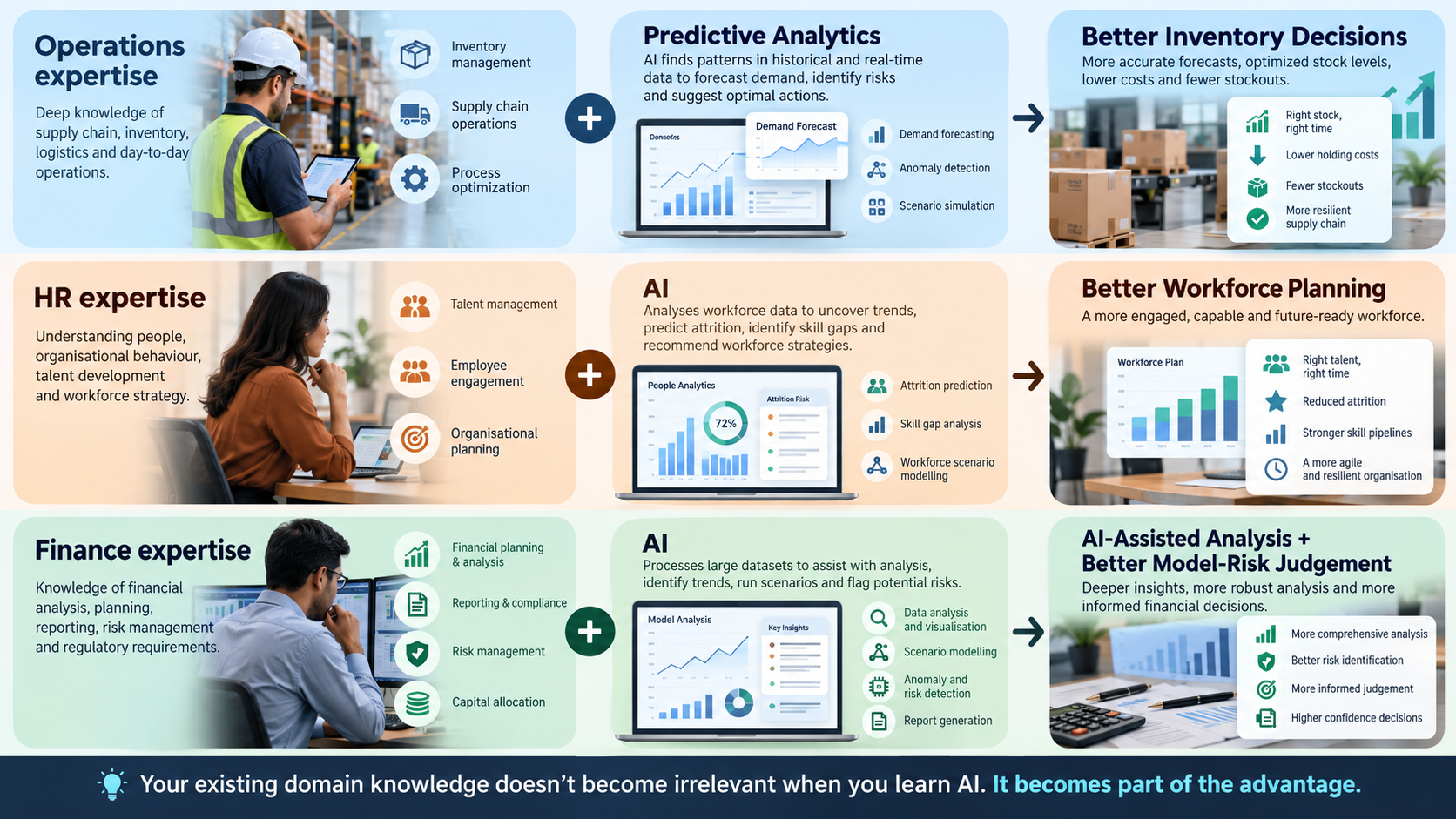
Consider an operations manager responsible for inventory planning.
Rather than changing careers to become an AI engineer, they could explore how demand forecasting and predictive analytics might improve inventory decisions.
An HR professional might examine the use of AI in workforce planning.
A finance professional could explore AI-assisted financial analysis while strengthening their understanding of model risk.
The professional's existing domain knowledge becomes part of the advantage.
This is why the curriculum matters. Programmes that include business applications, relevant tools, case studies and substantial projects can provide opportunities to connect learning with real work.
The value is greater when the participant has a meaningful opportunity to use those capabilities.
4. It Can Add Evidence of Structured Professional Learning
A certificate from a credible institution can demonstrate that you have undertaken structured learning in a particular area.
This may strengthen your professional profile, especially when the curriculum is relevant to your responsibilities or career plans.
However, the certificate becomes more persuasive when you can explain what you learnt and how you applied it.
Compare these two statements:
"I completed an executive programme in artificial intelligence."
"I studied AI applications and used the learning to evaluate an automation opportunity, including its data requirements, expected benefits and implementation risks."
The second gives an employer or manager something more meaningful to assess.
The credential provides context. Your work demonstrates capability.
What an Executive AI Certificate Does Not Do
Understanding the limitations is equally important before investing your time and money.
It Does Not Automatically Make You an AI Engineer
Learning about machine learning, generative AI or AI strategy does not necessarily prepare someone for a technical AI engineering role.
Many such roles require substantial programming, statistics, mathematics, software engineering and model-development capabilities.
If your objective is to build AI systems professionally, examine whether the programme offers the necessary technical depth.
An executive programme designed for business leaders and one designed for experienced technology professionals may have very different learning outcomes.
It Does Not Guarantee a Promotion or Salary Increase
An executive AI certificate can strengthen your knowledge and professional profile.
It cannot control the promotion decisions of your employer.
Career progression still depends on your responsibilities, performance, experience, business opportunities and ability to deliver results.
A useful question is not simply whether the certificate looks impressive on your résumé.
It is whether the learning will help you become more effective in a role you currently hold or realistically want to pursue.
It Does Not Replace a Formal Degree
An executive certificate and an academic degree are different qualifications.
Executive certificates are generally focused on specific professional capabilities. They do not automatically carry the same academic status, credits or eligibility benefits as a bachelor's or master's degree.
Before enrolling, verify the exact credential awarded, the issuing institution, assessment requirements and whether any academic credit is available.
Do not assume that a programme becomes a degree merely because it is offered by a prestigious institution.
It Does Not Make Your Knowledge Permanently Current
AI technologies will continue to change.
A particular tool or platform taught today may work differently a few years from now.
That makes underlying concepts particularly valuable.
Understanding data quality, model evaluation, business applications, risks and human oversight may remain useful even as specific tools evolve.
Treat an executive AI certificate as a structured learning milestone, not the end of your AI education.
How to Decide Whether an Executive AI Certificate Is Worth It
Before selecting a programme, evaluate four things.
Your career objective: Are you trying to become more effective in your current function, lead AI initiatives or move into a technical specialisation?
The curriculum: Does it teach the capabilities you actually need, or mainly introduce popular AI tools?
Practical application: Will you work on relevant cases, projects or problems that connect to your professional responsibilities?
The credential and commitment: Who awards the certificate? How is performance assessed? Can you realistically manage the classes, assignments, fees and any campus requirements?
The strongest programme for you is not necessarily the one that includes the largest number of AI topics.
It is the one that addresses a specific capability gap in your career.
The Real Value Is What Changes in Your Work
An executive AI certificate can help you gain knowledge, evaluate technology more confidently and participate in increasingly AI-driven business decisions.
But the certificate alone cannot make those decisions for you.
The meaningful career benefit comes when learning changes how you approach problems, work with specialists, assess opportunities or lead initiatives.
Before enrolling, ask yourself one question:
"What should I be able to do differently at work after completing this programme?"
If you can answer that clearly, you have a much stronger basis for choosing the right executive AI programme.
You can explore relevant executive education pathways through Digivarsity, comparing their curriculum, learning format and intended professional audience.
Find an AI Programme That Matches What You Want to Do Differently
Explore Executive AI Programmes, Compare Programmes
Learn MoreFrequently Asked Questions
Is an executive AI certificate useful for non-technical professionals?
Yes. Programmes focused on business applications of AI can help managers and professionals understand AI capabilities, evaluate use cases and participate in technology-related decisions without necessarily becoming programmers.
Can an executive AI certificate help me change careers?
It can support a career transition by developing relevant knowledge, but its usefulness depends on the target role. Technical AI roles may require deeper programming, mathematics and practical model-development experience.
Is an executive AI certificate equivalent to a master's degree?
No, not automatically. An executive certificate is generally a professional learning credential rather than a formal academic degree. Always verify the precise award, academic status and credit provisions with the institution.

Comments
Be the first to share your thoughts on this article.