
Tuition fees aren't the only cost of going to college.
There may be travel.
Accommodation.
A laptop.
Books.
Internet.
Examination fees.
Daily expenses.
And then there is another cost that students don't always think about:
the income you could have earned during those years.
For many families, choosing higher education is therefore not only an academic decision.
It's a financial one.
That doesn't mean students should abandon college and start working immediately.
It means we need to think more intelligently about how education and earning can sometimes happen together.
“Earn While You Learn” Doesn't Mean Paying for Everything Yourself
Let's clear up one misconception first.
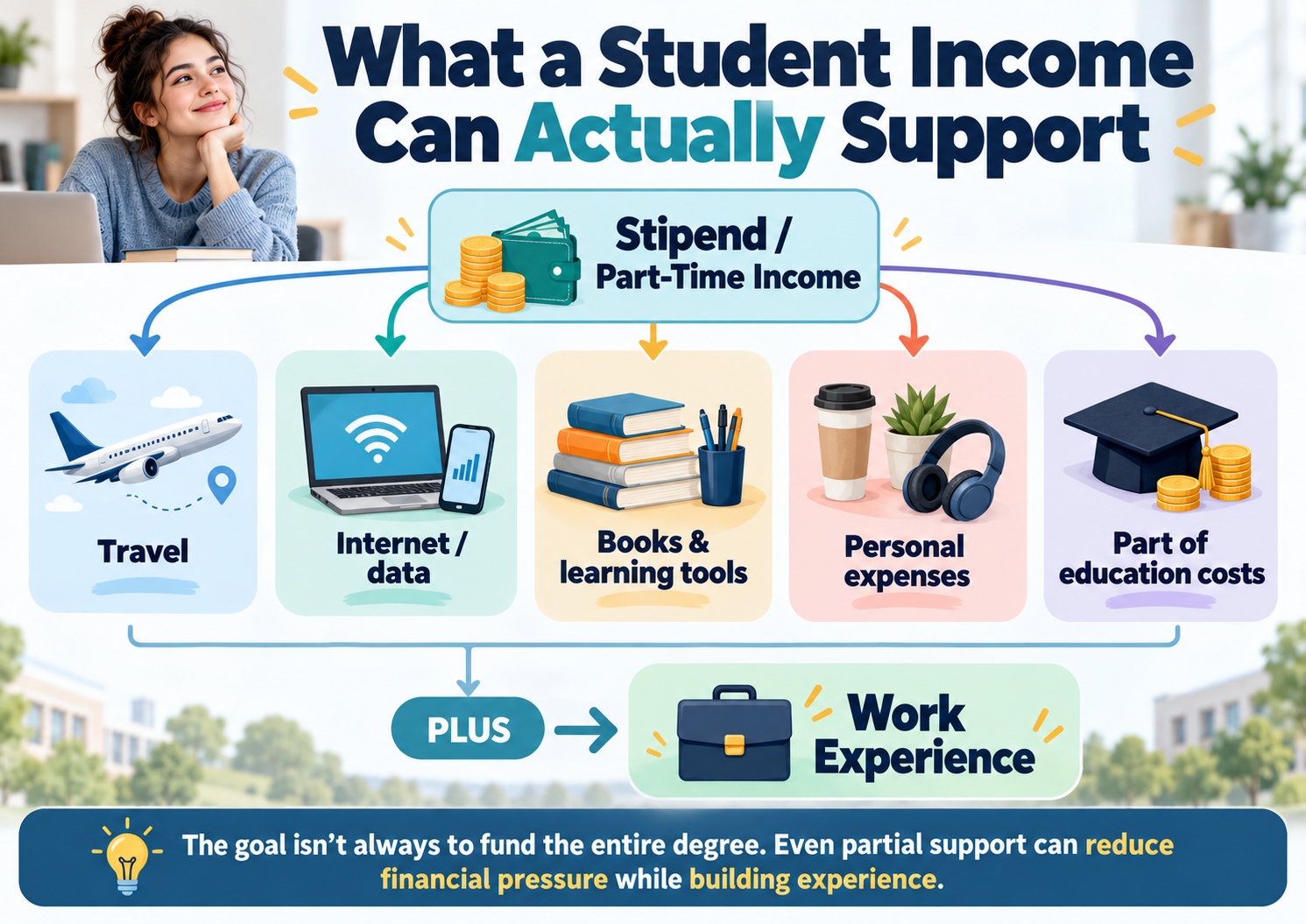
If you're 18 or 19 and earning a stipend from an internship, that income may not pay your entire college fee.
And that's okay.
The goal isn't necessarily:
“My parents should spend nothing on my education.”
Even a modest income can help cover personal expenses, travel, learning tools or part of your education costs.
More importantly, you may graduate with something else of value:
work experience.
That means earning while learning can help with both the cost of education and the transition into a career.
Start With Scholarships Before You Start With Work
Before taking on a job simply to reduce costs, check whether you're eligible for financial support.
Scholarships can reduce the amount you need to earn or borrow without adding extra hours to your week.
The Government of India's Ministry of Education maintains information on national scholarship opportunities for students.
Also check:
- University scholarships
- State government schemes
- Merit-based support
- Need-based scholarships
- Corporate or foundation scholarships
- Fee concessions
- Education financing options
Don't assume you aren't eligible.
And don't wait until the last minute.
Some scholarship deadlines arrive well before the academic year begins.
Internships Can Give You More Than a Stipend
A paid internship can help with expenses.
But the better question is:
What else am I getting from this internship?
Ideally, you should also be gaining:
- Skills
- Industry exposure
- Professional contacts
- Projects for your résumé
- A better understanding of your career
That combination is much more valuable than choosing random work only because it pays slightly more.
UGC's undergraduate internship guidelines recognise internships as part of academic learning and provide for internship credits within undergraduate programmes.
So practical experience and academic education don't necessarily have to exist in separate worlds.
Consider Programmes Where Work Is Built Into the Learning
Some programmes go further by formally integrating apprenticeship or workplace learning into the degree.
UGC has issued guidelines for apprenticeship-embedded degree programmes, building on the idea that students can gain structured workplace learning while pursuing an academic qualification.
This can change the traditional sequence from:
Study → Graduate → Look for Experience → Find a Job
to something closer to:
Study + Gain Experience → Graduate with Both
Depending on the programme and workplace arrangement, learners may also receive a stipend.
But don't choose a programme simply because it uses the words “earn while you learn.”
Ask:
Who is the university?
Is the programme recognised?
Who provides the work opportunity?
Is a stipend guaranteed or dependent on placement?
What kind of work will I actually do?
How many hours will I work?
What happens if the workplace opportunity changes?
Understand the model before you calculate the savings.
Part-Time Work Can Help—but Don't Let It Damage the Degree
Not every learner needs a formal work-linked programme.
Some students may work part-time, freelance or take short assignments alongside a conventional or online degree.
That can work well.
But there is a limit.
If you're constantly missing lectures, submitting poor assignments and sleeping five hours a night because of your part-time job, the income may be costing more than you realise.
Your education still needs enough time and attention to be useful.
Try to find work that offers at least one of these:
Money, skills or career experience.
The best opportunities may give you all three.
Use Flexibility Strategically
Online and flexible programmes can sometimes make earning alongside education easier because students have more control over their schedules.
But flexibility only helps if you use it well.
Don't turn every available hour into paid work.
Leave time for:
- Classes
- Assignments
- Projects
- Examinations
- Rest
A schedule that looks financially efficient but leaves you exhausted isn't sustainable.
Understand the Total Cost, Not Just the Tuition Fee
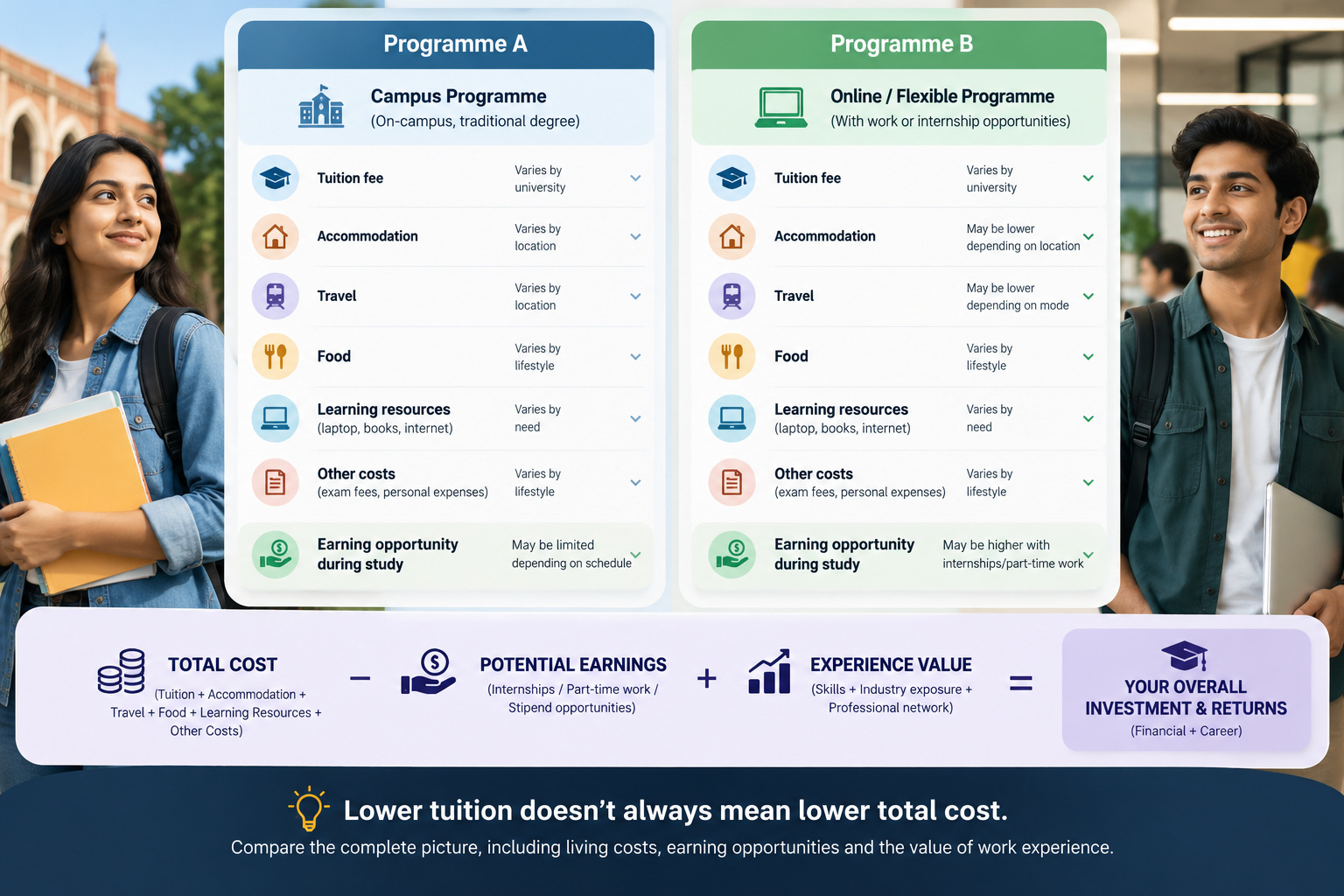
When comparing two colleges or programmes, families often look only at annual fees.
Instead, calculate:
Tuition + accommodation + travel + food + learning resources + other expenses
Then consider whether the programme allows the learner to earn or gain useful experience during the same period.
A programme with a lower tuition fee isn't automatically cheaper if it creates much higher living costs.
And a programme that costs slightly more may create additional value if it includes meaningful workplace exposure.
Compare the complete picture.
Don't Let Earning Become the Only Goal
There is something exciting about receiving your first stipend.
It feels like independence.
But your first earning opportunity doesn't need to become your permanent career decision.
At this stage, the aim is to build three things together:
Education. Skills. Experience.
Income can support that journey.
It shouldn't completely control it.
The best version of earn while you learn isn't simply about making college cheaper.
It's about using your college years more productively.
If you can graduate with a recognised qualification, useful skills, real work experience and a little less financial pressure along the way, you're starting your career from a very different position.
Make the Cost of College Work Harder for You
Look beyond tuition alone. Explore programmes that can help you combine academic learning, practical experience and flexible learning formats.
Explore ProgrammesFrequently Asked Questions
Can students earn money while pursuing a degree?
Yes. Depending on their programme and schedule, students may take paid internships, apprenticeships, part-time work, freelance assignments or other structured work opportunities.
Do all internships provide a stipend?
No. Stipends depend on the organisation, role and programme. Students should confirm compensation and other conditions before accepting an opportunity.
What is an earn-while-you-learn degree?
It generally refers to a programme where students combine academic study with structured work experience and may earn a stipend during that experience. Students should verify the programme structure and terms before enrolling.




Comments
Be the first to share your thoughts on this article.