You're 30.
You've spent the last seven or eight years building a career.
And now you're thinking:
“I don't want to do this for the next 20 years.”
Maybe data interests you more than your current job.
Maybe you want to move into technology.
Maybe you enjoy solving business problems and see yourself in management.
Then comes the uncomfortable question:
Is it too late to switch careers?
No.
But switching careers at 30 is different from choosing your first job at 21.
You have something now that you didn't have then:
experience.
The challenge is learning how to use it.
You're Not Starting From Zero
Thinking About a Career Switch but Not Sure Where You Fit?
Explore programmes across data, technology and management based on the skills you want to build next.
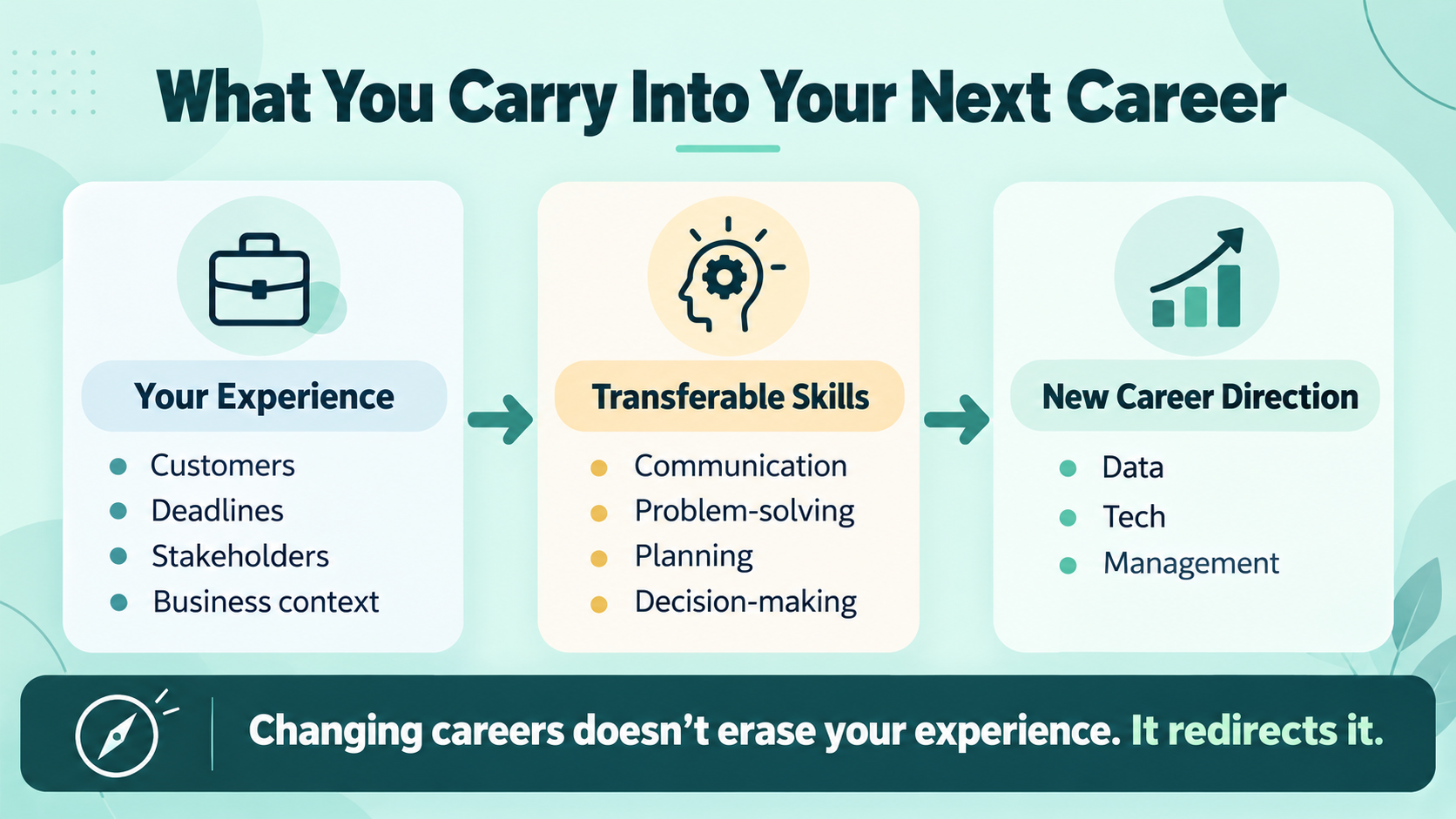
Explore Career PathwaysSuppose you've spent six years in sales and want to move into business analytics.
You may not know SQL yet.
But you probably understand customers, targets, business metrics and how decisions get made.
A teacher moving into learning and development already understands communication, facilitation and how people learn.
An operations professional moving into project management may already know how to handle deadlines, stakeholders and multiple priorities.
Changing careers doesn't erase what you've already learnt.
Your task is to identify which parts of your experience can travel with you.
That's particularly relevant in today's skills-focused job market. LinkedIn's 2026 research says employers are increasingly looking beyond degrees, job titles and linear career paths towards what candidates can actually do.
That makes transferable skills more important than they may initially appear.
Moving into Data: Start With the Problem, Not Python
Data careers can look intimidating from the outside.
SQL. Python. Power BI. Tableau. Statistics. Machine learning.
Do you need all of them before applying for a job?
Probably not.
First understand the role you're targeting.
A business analyst, data analyst and data scientist may all work with data, but they don't do the same job.
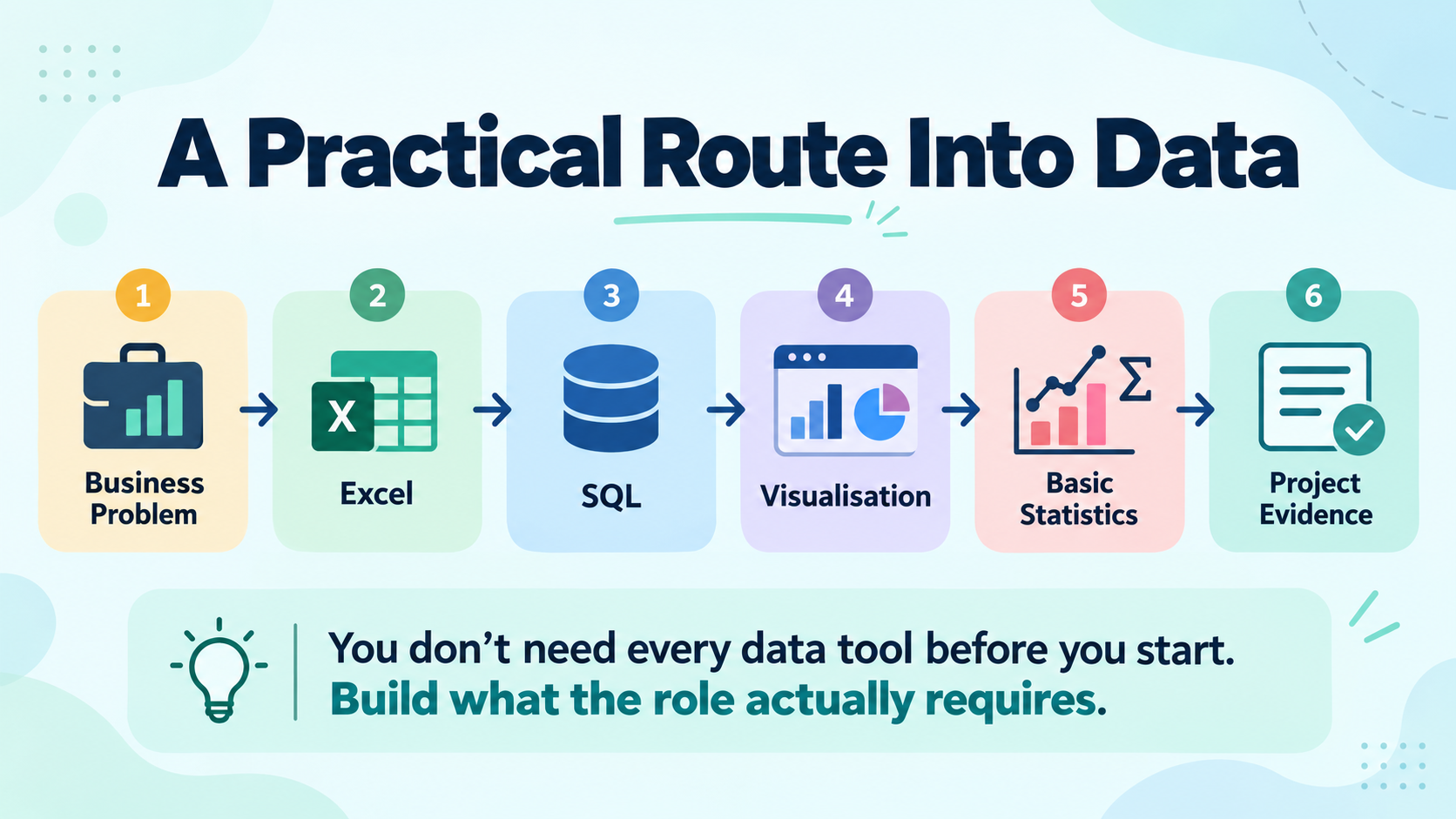
For an entry-level move into analytics, you might begin with:
Excel → SQL → data visualisation → basic statistics → projects
Python can follow if the roles you're targeting require it.
Most importantly, don't just complete courses.
Take a dataset and answer a real question with it.
What happened? Why did it happen? What should the business do next?
That begins to turn a new skill into evidence.
Moving into Tech Doesn't Always Mean Becoming a Developer
You Don’t Have to Become a Developer to Move Into Tech
Explore technology programmes aligned with different roles, from AI and cloud to digital transformation and emerging technologies.
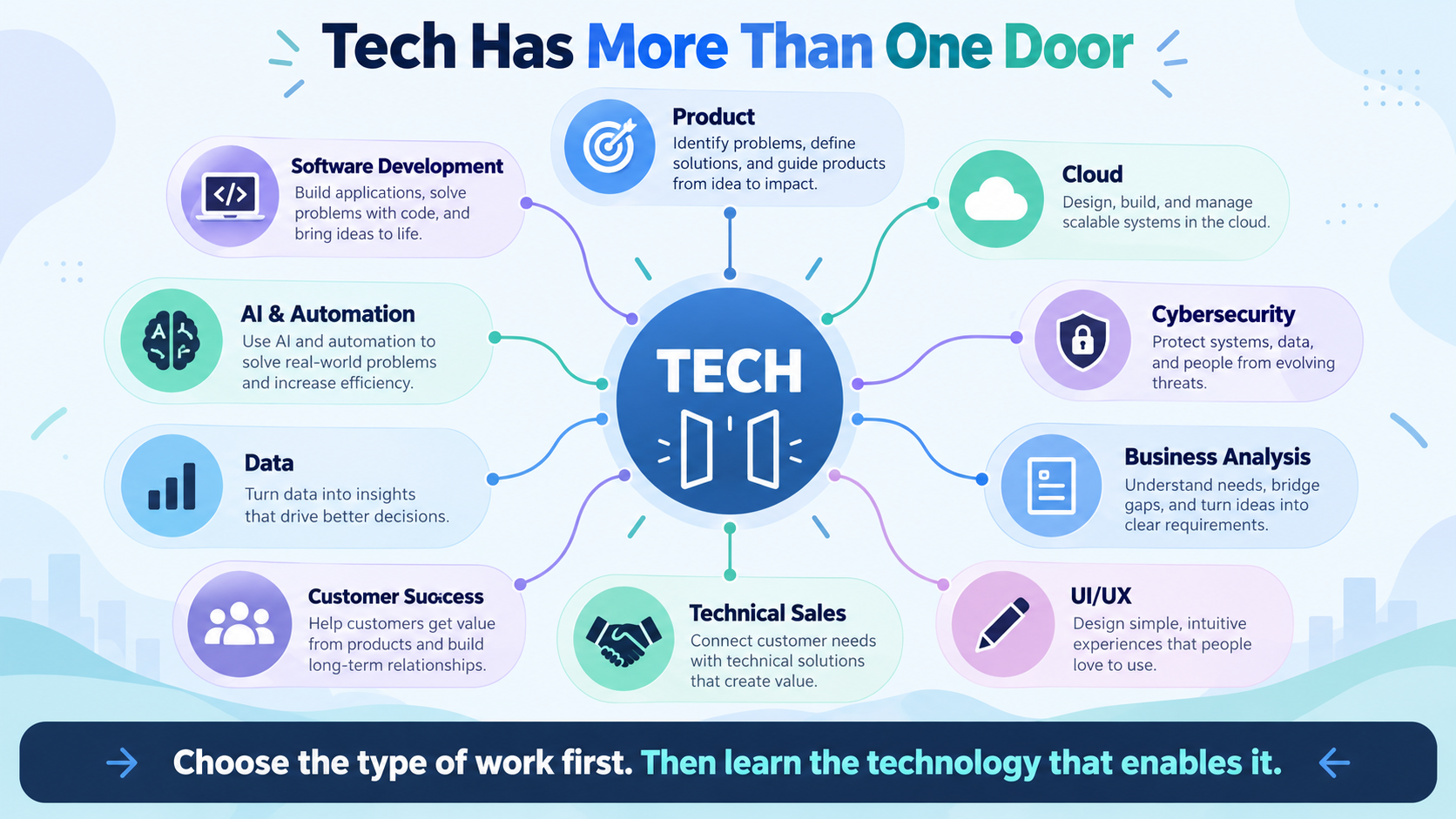
Explore Tech ProgrammesA tech career is much broader than software development.
There are careers in:
- Product
- Cybersecurity
- Cloud
- Quality assurance
- Business analysis
- UI/UX
- Technical sales
- Customer success
- Data
- AI and automation
Your existing experience can help determine where you fit.
Someone from banking may bring useful domain knowledge into fintech.
Someone from HR may move towards HR technology.
Someone from marketing may find a natural route into marketing technology or product growth.
And if coding genuinely interests you, software development may absolutely be an option.
But don't choose coding simply because “tech pays well.”
Choose the type of work first.
Then learn the technology that enables it.
What If You Want to Move into Management?
Management isn't simply the next step after spending a certain number of years at work.
The work itself changes.
You may move from doing tasks yourself to:
setting priorities, solving business problems, managing people, working across teams and making decisions with incomplete information.
That means your development may need to include areas such as:
- Business fundamentals
- Finance
- Strategy
- Data-based decision-making
- Communication
- Leadership
- Stakeholder management
LinkedIn's 2026 India skills data highlights stakeholder management, collaboration and leadership alongside AI, automation and data capabilities.
The combination matters.
Managers increasingly need to understand people, business and technology.
Don't Quit Your Job Before Testing the Career
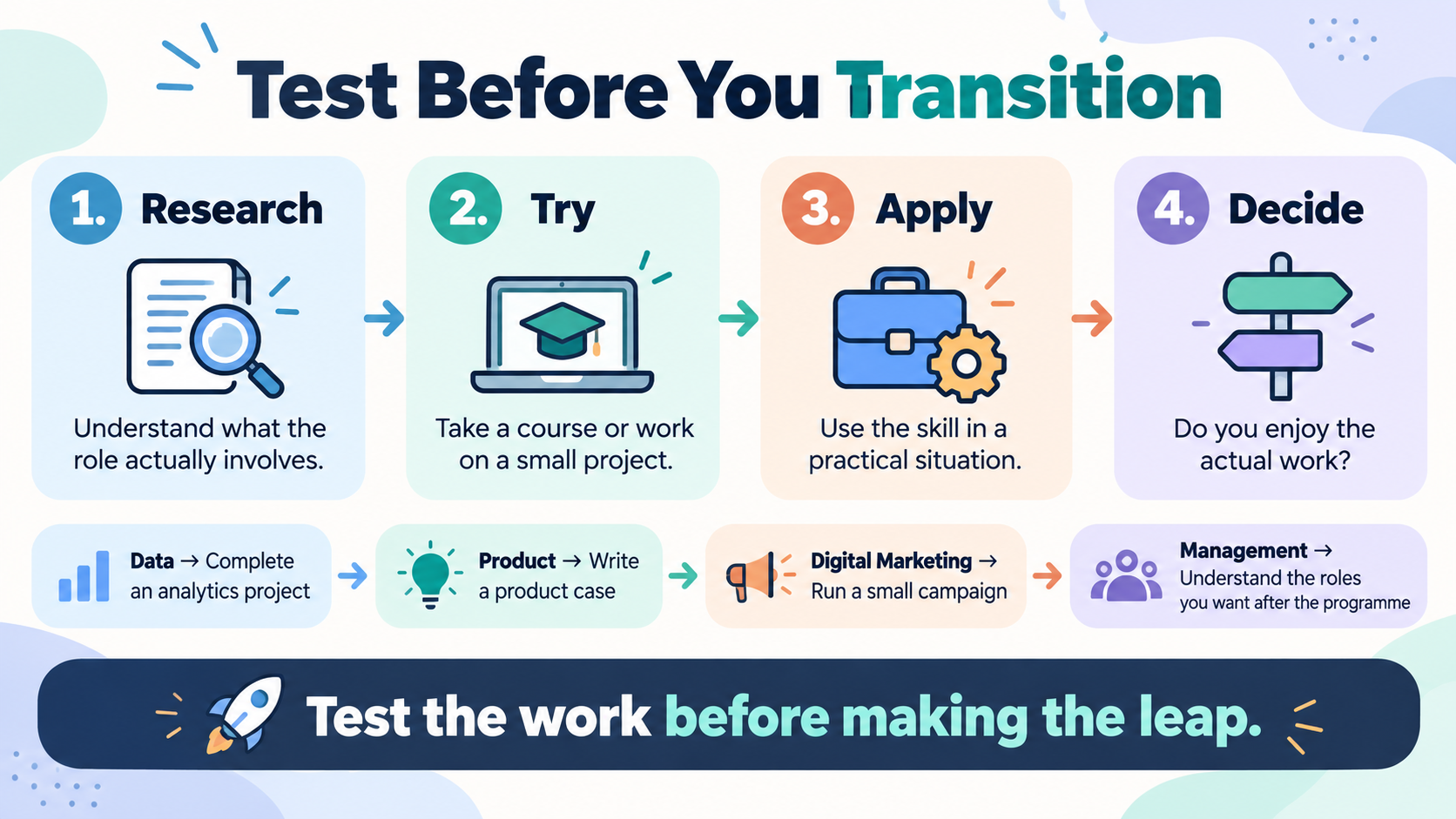
This is one of the most important things you can do.
Before making a dramatic career switch, try the new field on a smaller scale.
Thinking about data?
Complete a real analytics project.
Considering product management?
Study how a product works, write a simple product case and speak to people doing the job.
Interested in digital marketing?
Run a small campaign.
Considering an MBA or management programme?
First understand the roles you actually want after it.
Don't fall in love with the idea of a career. Test the work itself.
You may discover that you love it.
You may also discover that what looked exciting from outside isn't right for you.
Both outcomes are useful.
Build a Bridge, Not a Jump
A career switch doesn't always need to happen overnight.
Sometimes the smartest move is an adjacent one.
A salesperson may move into sales analytics before moving fully into data.
A recruiter may move into HR analytics.
A finance professional may learn automation and analytics before exploring fintech.
A customer service professional may move into customer success at a technology company before shifting towards product.
An adjacent role lets you use what you already know while building credibility in a new area.
The shortest route into a new career may pass through a role between your old career and your new one.
Give Employers Proof of the New You
The biggest challenge in career switching is simple.
Your résumé shows several years of your old career.
You need evidence of your new one.
Create it.
Build projects.
Take on relevant assignments at your current company.
Volunteer for cross-functional work.
Freelance.
Create a portfolio.
Earn a relevant qualification if the new role genuinely benefits from one.
Talk about what you've learnt publicly or professionally.
The goal is to make it easier for an employer to imagine you doing the new job.
At 30, Your Experience Can Be an Advantage
You may be competing with someone younger who has studied the subject more recently.
But you may understand workplaces better.
You know what deadlines feel like.
You've handled difficult colleagues.
You've dealt with customers.
You've made mistakes.
You've probably learnt how to communicate professionally and take responsibility for outcomes.
Don't hide that experience because you're changing direction.
Combine it with your new skills.
A career switch at 30 isn't about becoming 21 again.
It's about taking everything you've learnt so far and pointing it towards a different destination.
So don't ask:
“Am I too old to start again?”
Ask:
“What do I already know, what do I still need to learn, and what's the smartest bridge between the two?”
That's a much better place to begin.
Your Next Career Doesn’t Have to Start From Zero
Use the experience you already have. Build the capabilities you still need. Find a programme that helps connect the two.
Find My ProgrammeFrequently Asked Questions
Is 30 too late to change careers?
No. At 30, you already have professional experience and transferable skills that can help you move into a new field. The key is identifying what you can carry forward and what you still need to learn.
How long does a career change usually take?
It depends on how different the new career is from your current one. Moving into an adjacent role may be quicker, while a major shift may require more learning, projects and practical experience.
Should I quit my job before changing careers?
Not necessarily. It can be safer to test the new career through courses, projects, freelance work or internal opportunities before leaving your current role.


Comments
Be the first to share your thoughts on this article.