
Picture this.
You attend a lecture in the morning.
Work on an actual client project in the afternoon.
Complete an assignment in the evening.
By the time you graduate, you don't just have a degree.
You also have work experience.
Sounds ideal.
But there's an obvious question:
Can you realistically study for a degree and complete an internship at the same time?
Yes, you can.
But only if you understand one thing from the beginning:
flexible learning doesn't mean effortless learning.
Why Online Learning Makes the Combination Possible
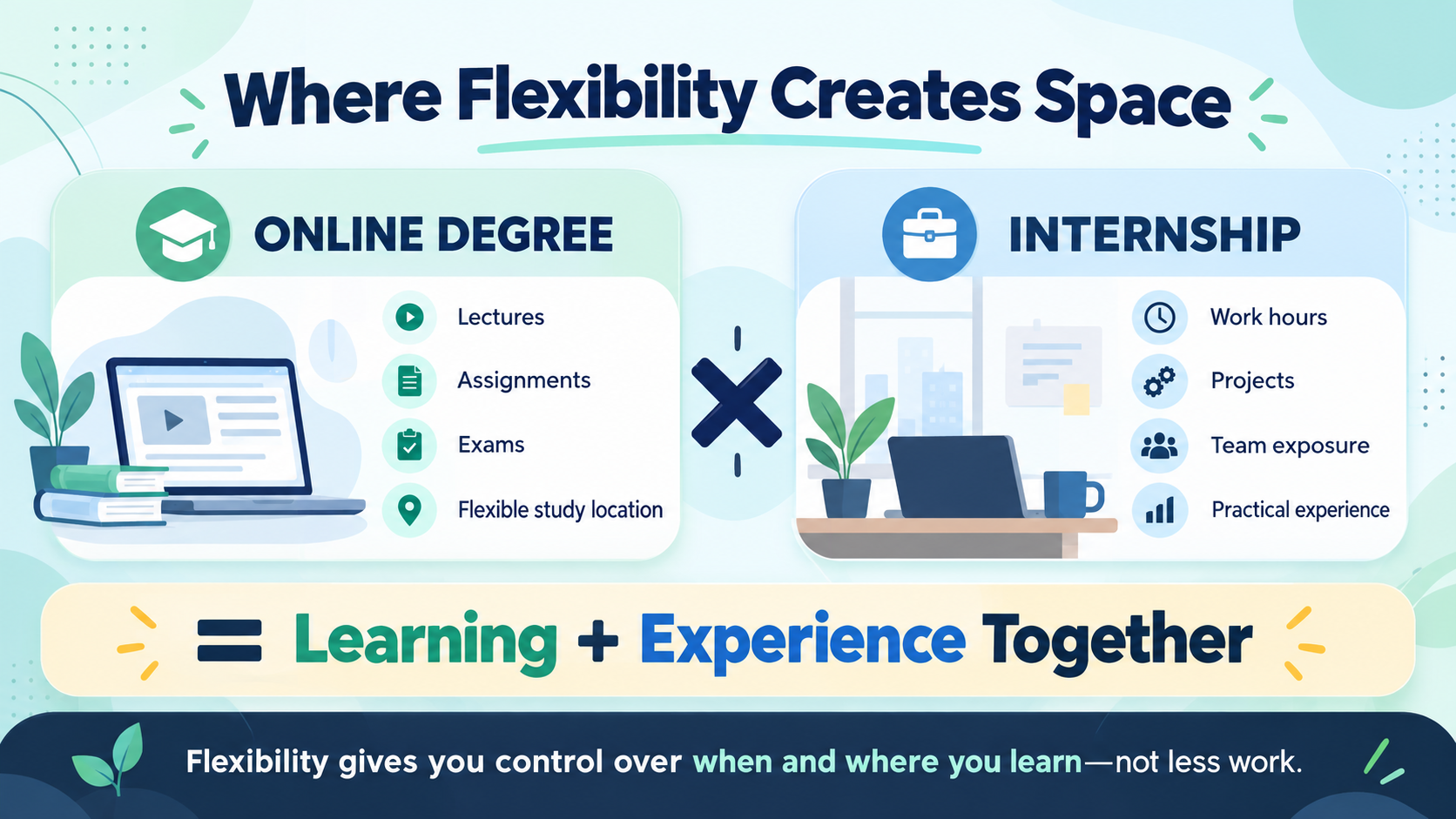
A conventional college timetable often decides where you need to be and when.
Online learning can give you more flexibility around how and where you study.
That's particularly useful if you're also interning.
UGC regulations themselves recognise that online and distance programmes can serve conventional learners as well as working professionals and others seeking academic qualifications.
But flexibility shouldn't be confused with having less work.
For recognised online programmes, UGC regulations require the total credits and minimum programme duration to align with the corresponding conventional programme in applicable institutions.
So you still need time for lectures, assignments, examinations and learning.
You simply have more control over where some of that learning happens.
Why Combine a Degree With an Internship?
Because the two give you different things.
Your degree helps you understand concepts.
Your internship shows you what happens when those concepts meet the real world.
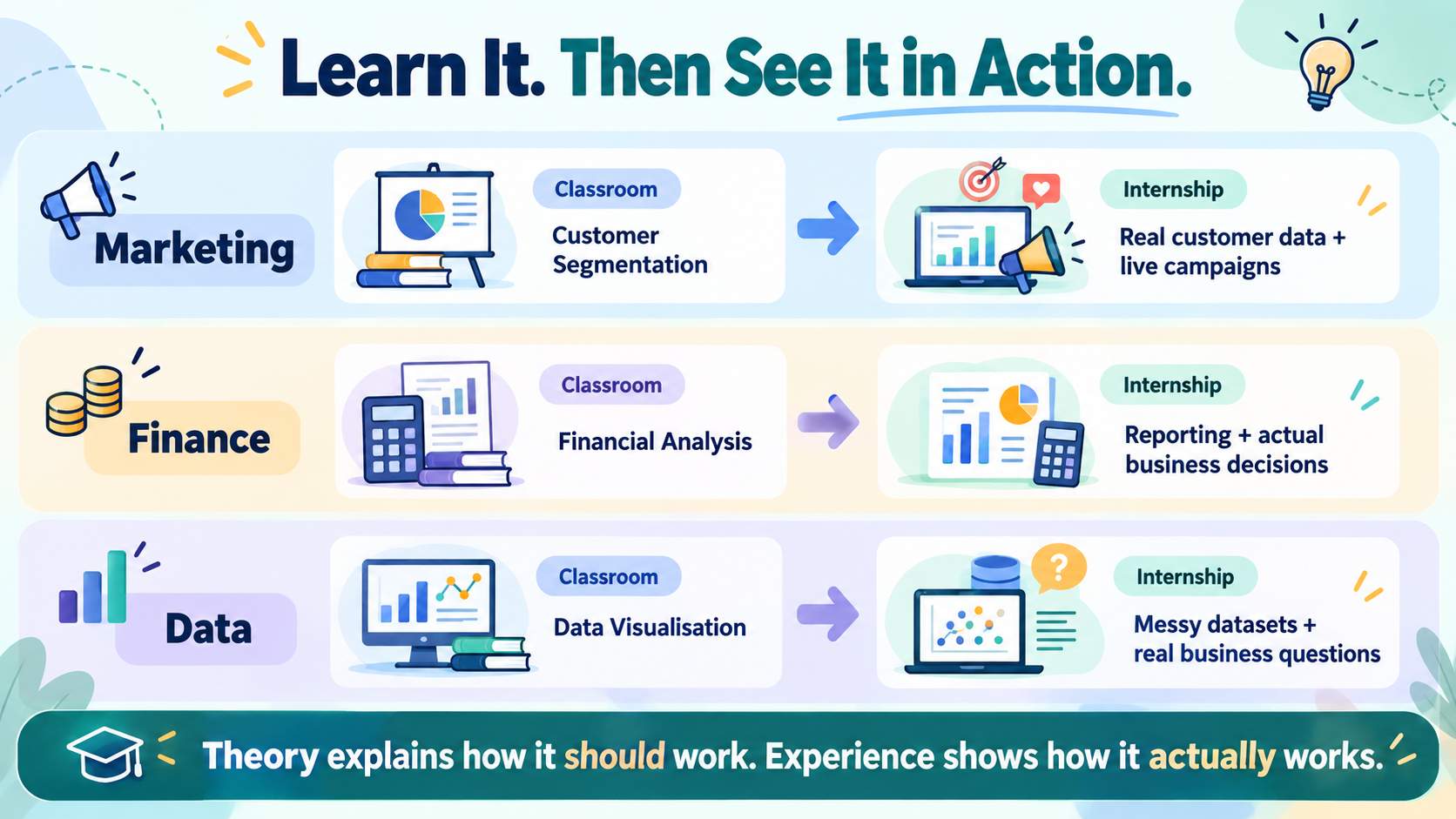
Consider a marketing student.
In class, you may learn about customer segmentation.
During an internship, you may discover that actual customer data is messy, campaigns don't always work and your manager needs an answer by 4 PM.
A finance student might study financial analysis and then see how reporting works inside a real company.
A data student might learn visualisation and then deal with an actual dataset filled with missing information.
Theory tells you how something should work. Experience shows you how it actually works.
Both matter.
But Won't It Become Too Much?
Looking for a Learning Model Built Around Work Experience?
Explore programmes where academic learning and practical exposure are designed to work together.
View Work-Linked DegreesIt can.
A degree plus internship means you're carrying two sets of responsibilities.
Your university doesn't stop giving assignments because you have an internship deadline.
And your manager doesn't necessarily know you have an examination next week.
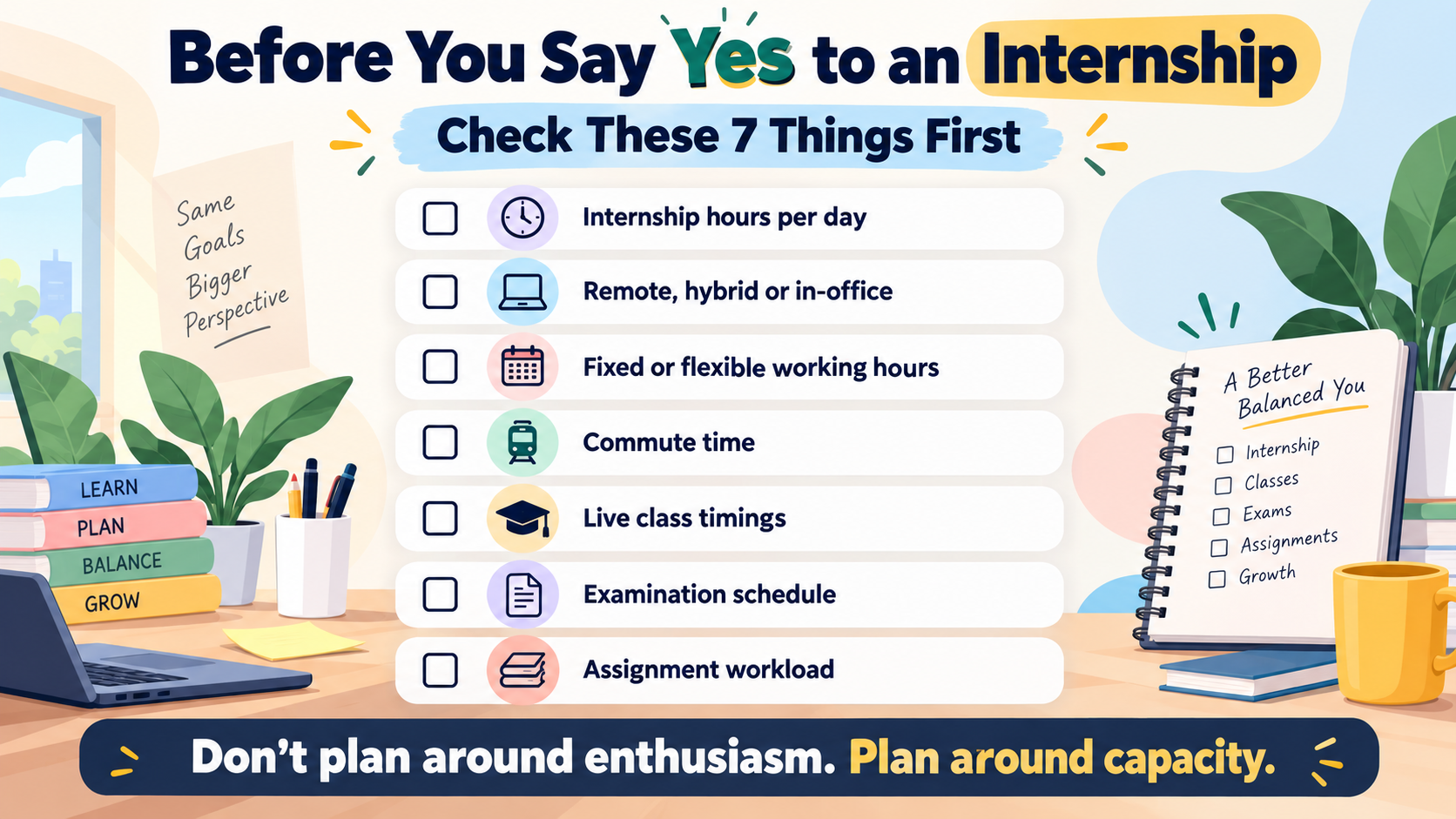
That's why the combination works best when you plan around capacity, not enthusiasm.
Before accepting an internship, understand:
- How many hours per day will it require?
- Is it remote, hybrid or in-office?
- Are the working hours fixed?
- How long is the commute?
- Does your course have live sessions?
- When are examinations held?
- How many assignments usually fall in the same period?
You don't need every hour mapped out.
But you should know whether the two schedules can realistically coexist.
Your Internship Should Ideally Connect With Your Career
Not every internship is automatically valuable.
If possible, choose one that helps you practise what you're learning or explore a career you're genuinely considering.
Studying business?
Try marketing, sales, operations, HR or finance depending on your interests.
Studying computer applications?
Look for development, testing, analytics, technology support or related opportunities.
Studying commerce?
Finance, accounting, business operations or analytics may give you useful exposure.
The closer the internship is to the career you want, the easier it becomes to connect:
Degree → Skills → Experience → Career
That's much more useful than taking an internship simply because one was available.
Build Your Week Around Fixed Commitments
When you have two major commitments, planning every day from scratch becomes exhausting.
Start with the things you cannot move.
Internship hours.
Live classes.
Examinations.
Deadlines.
Then build your study time around them.
Perhaps Monday to Friday is mainly work plus short revision sessions.
Saturday morning becomes your deeper study period.
Sunday afternoon is for assignments and the week ahead.
Your plan doesn't need to look perfect.
It needs to survive a normal week.
If your timetable requires you to be productive for 16 hours every day, the problem isn't your discipline.
It's the timetable.
Use the Internship to Make Studying Easier
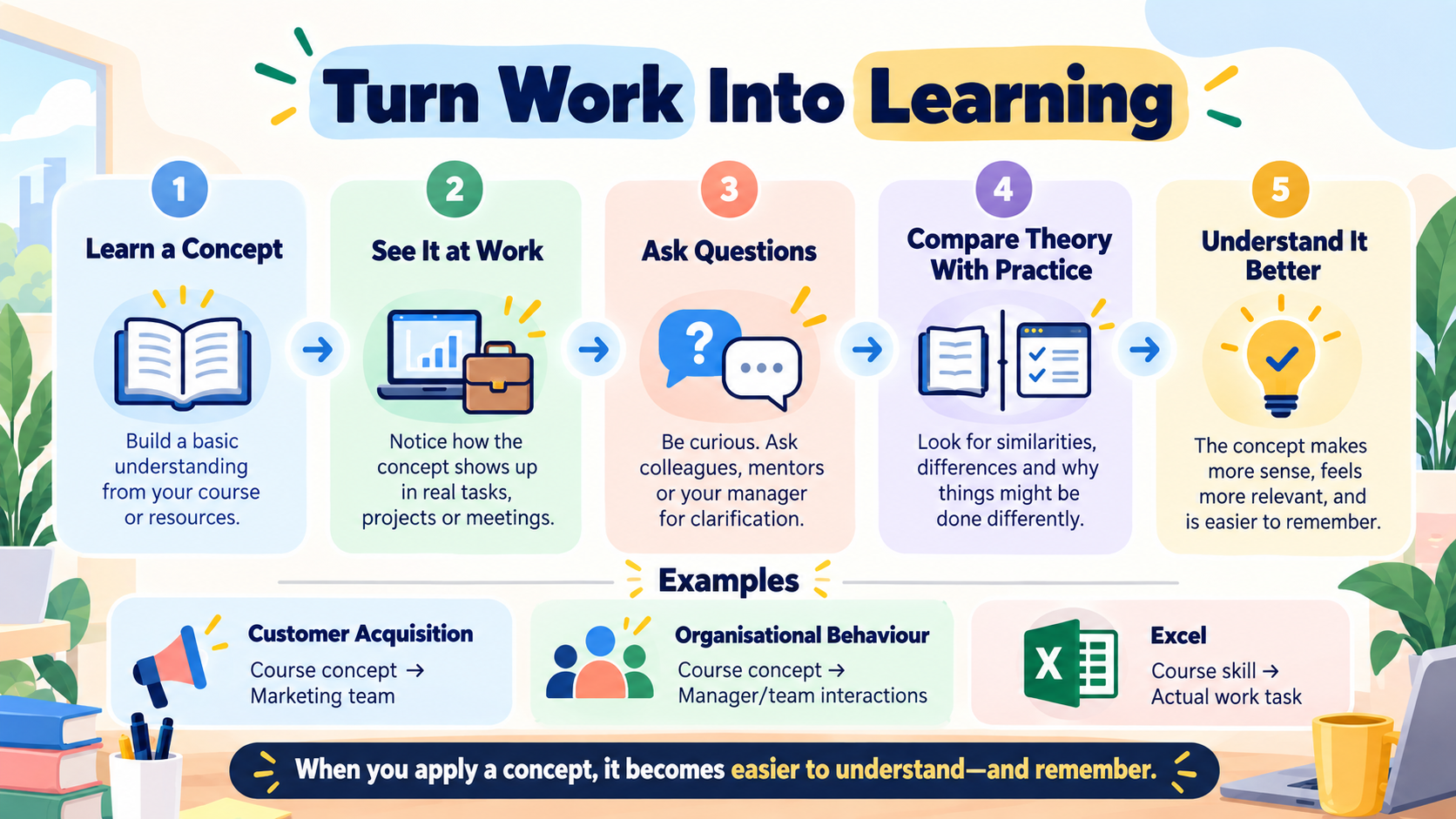
One of the biggest advantages of doing both simultaneously is that your internship can become part of how you learn.
Suppose your course discusses customer acquisition and you're working with a marketing team.
Observe what happens.
Ask questions.
Compare the textbook idea with the company's approach.
Studying organisational behaviour while working?
Watch how your manager gives feedback or handles conflict.
Learning Excel?
Find opportunities to use it.
The moment a classroom concept connects with something you've actually experienced, it often becomes much easier to understand.
Don't Let Work Completely Take Over
Internships can become exciting because the work feels real.
That can also create a problem.
You start prioritising every work request and slowly push your degree into whatever time is left.
Then examinations arrive.
Your internship should add to your education, not quietly replace it.
During particularly demanding academic periods, communicate early where possible.
If examinations are approaching, don't wait until the evening before the exam to tell your manager.
The same applies to college deadlines.
Managing both requires communication, not just time management.
Avoid the “Busy Means Productive” Trap
You attend classes.
Work five hours.
Complete an assignment.
Watch a lecture.
Answer messages.
And finish the day completely exhausted.
It feels productive.
But are you actually learning?
Leave some room to think.
Reflect on what happened during the internship.
Review what you've learnt.
Sleep properly.
A packed schedule may look impressive for two weeks.
A sustainable schedule can work for two years.
So, Can You Really Do Both?
Yes.
And when done well, the combination can be powerful.
Instead of waiting until graduation to discover what work is like, you're building experience while you're still learning.
By the time you finish your degree, you may be able to tell an employer:
“I have studied this.”
and
“I have actually done this.”
That's a meaningful difference.
The goal isn't to stay busy every hour of the day.
It's to make your education and your experience work together.
And if you can build that balance, an online degree and an internship don't have to compete for your time.
They can strengthen each other.
Frequently Asked Questions
Can I do an internship while pursuing an online degree?
Yes, provided you can manage the schedules of both your degree and internship. The flexibility of online learning can make it easier to combine study with work experience.
How many hours should an internship take while studying?
Choose an internship that leaves enough time for classes, assignments and exams. The right number of hours depends on your course workload and the flexibility of the internship.
Is an internship useful during an online degree?
Yes. An internship can help you apply what you are learning, build practical skills and gain work experience before graduation.


Comments
Be the first to share your thoughts on this article.