You want to learn artificial intelligence.
You begin exploring courses and notice something interesting.
Some are called AI courses.
Others specifically focus on generative AI.
Both promise to help you understand emerging technologies.
Some teach machine learning and predictive models. Others focus on large language models, prompt engineering, AI assistants and content generation.
So are they teaching the same thing?
Not exactly.
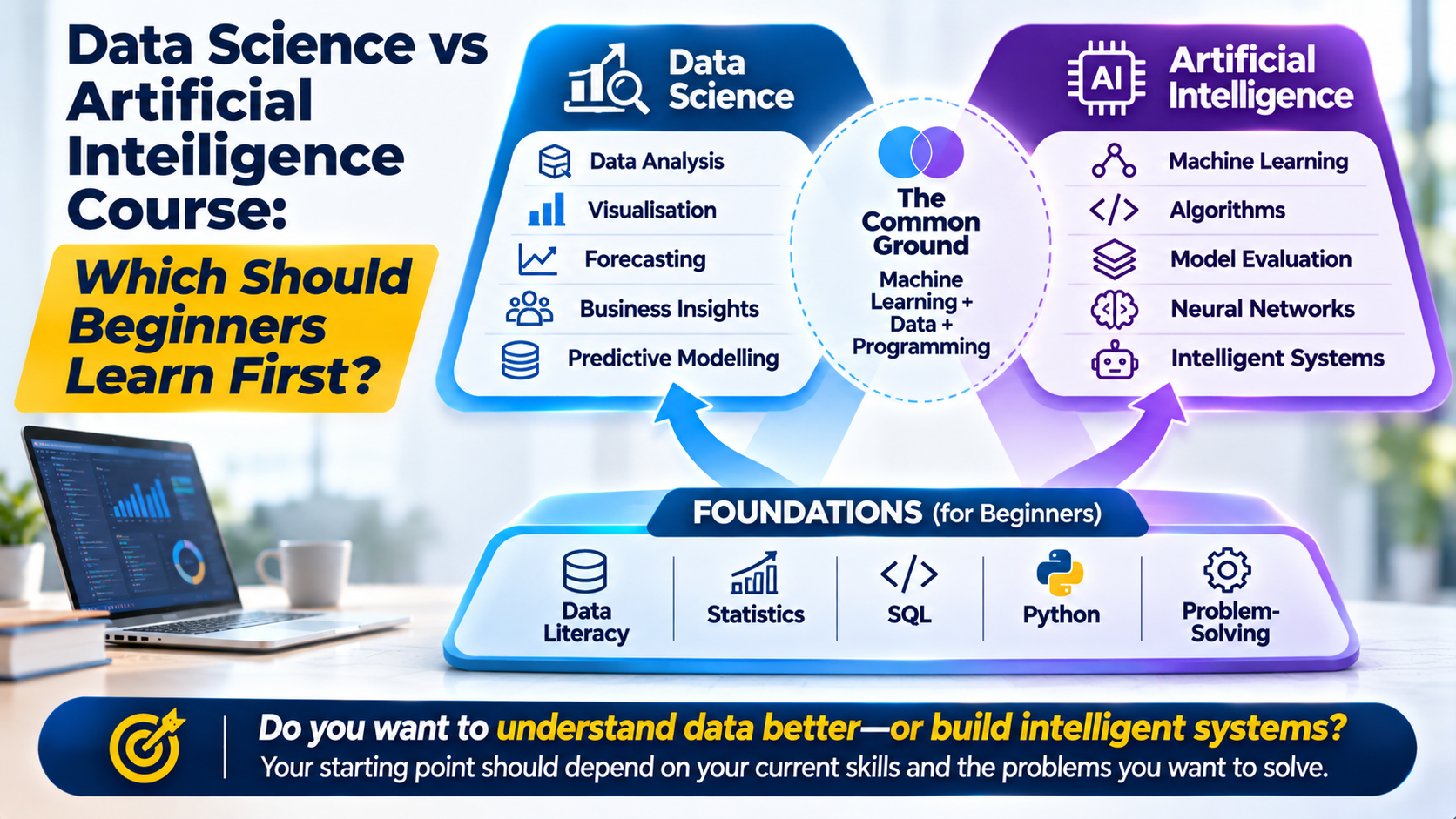
Generative AI is part of the broader field of artificial intelligence. But a course focused on generative AI may develop a different set of capabilities from one covering AI more comprehensively.
The distinction matters because learning to use AI tools and learning how intelligent systems work are not the same objective.
First, What Does an AI Course Cover?
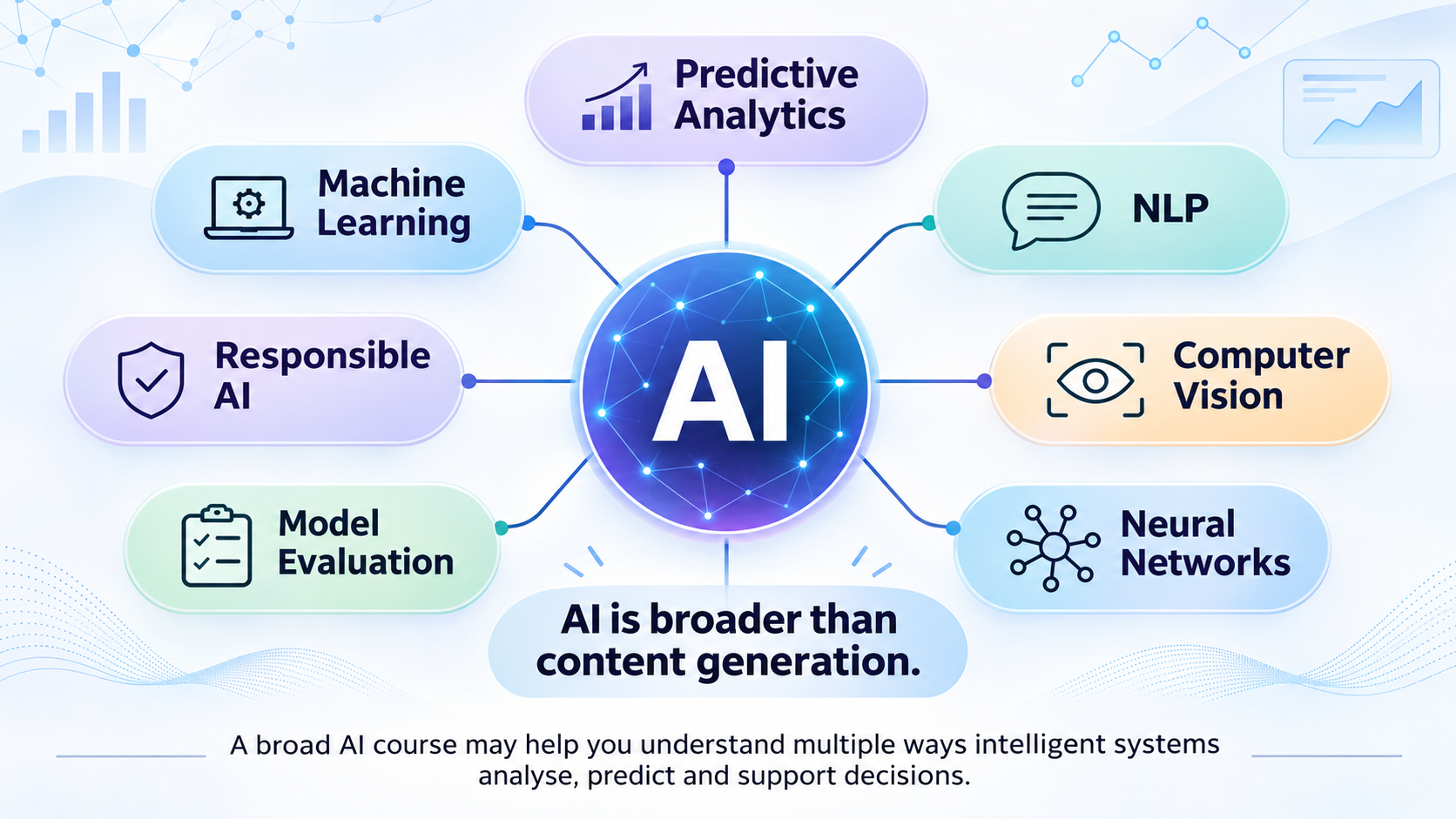
Artificial intelligence is a broad field involving systems that perform tasks such as recognising patterns, interpreting information, making predictions and supporting decisions.
Depending on its intended audience, an AI course may introduce concepts such as:
- Artificial intelligence fundamentals
- Machine learning
- Predictive analytics
- Natural language processing
- Computer vision
- Neural networks and deep learning
- AI model evaluation
- Responsible AI and governance
Not every programme covers all these subjects.
A course designed for business managers may explain how AI supports decisions without teaching advanced model development.
A technical AI course may involve substantial programming, mathematics and computational methods.
This means you should examine the learning objectives before assuming that every course carrying the term "AI" offers the same depth.
Want a Broader Understanding of AI?
Explore programmes that build foundations across machine learning, predictive models, AI applications and responsible use.
Compare AI CoursesWhat Is Generative AI?
Generative artificial intelligence is a category of AI designed to produce content or other outputs based on patterns learnt from data.
Depending on the system, it may generate text, images, computer code, audio or video.
For example, a generative AI tool might draft a customer email, summarise a long report, explain a programming concept or help create initial design ideas.
Large language models, commonly called LLMs, are widely used in text-based generative AI applications.
But generative AI is not limited to chatbots.
It includes different model architectures and applications designed to generate new outputs.
The important distinction is that generative AI concentrates on generating content or representations, while the broader field of AI includes many other capabilities.
A Simple Business Example
Imagine a retail company wants to understand and improve customer retention.
It has two objectives.
First, it wants to identify customers who may stop purchasing.
Second, it wants to prepare personalised communication for those customers.
A predictive AI model might analyse historical customer behaviour and estimate which customers are at greater risk of leaving.
A generative AI system could help draft communication tailored to different customer segments.
Both applications use AI.
But they solve different problems.
One helps estimate an outcome.
The other helps generate content.
Neither system guarantees that the company's retention strategy will work.
The business still needs reliable data, appropriate safeguards, customer understanding and a way to evaluate results.
This example shows why choosing the right technology matters more than simply choosing the latest AI tool.
AI Course vs Generative AI Course: The Main Differences
|
These are general differences.
A comprehensive AI programme may contain generative AI modules.
A technical generative AI programme may also cover machine learning, deep learning and advanced model architecture.
There is substantial overlap.
What Does a Generative AI Course Actually Teach?
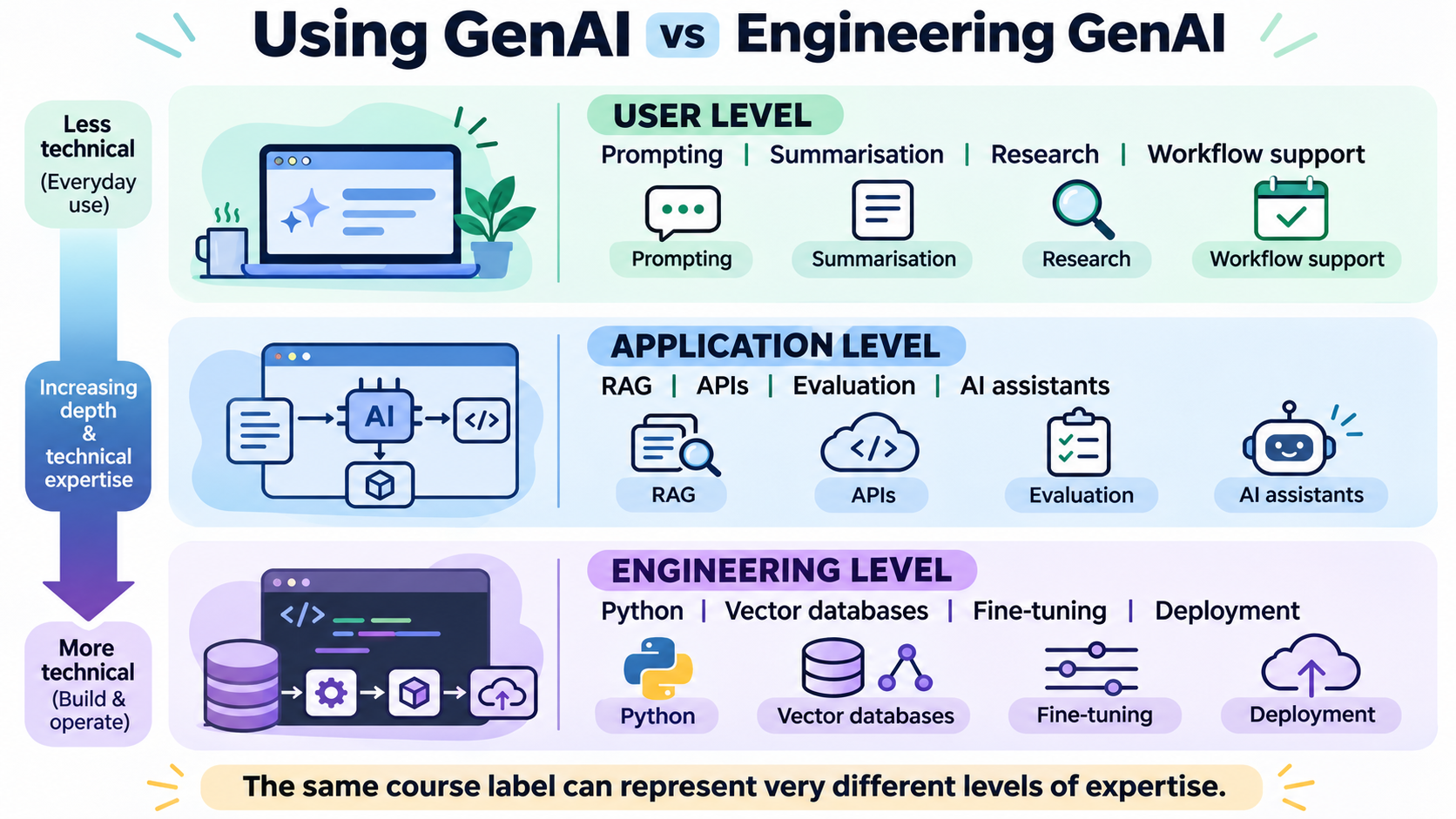
This depends on whether the programme is designed for users, developers or advanced technical professionals.
An introductory generative AI course may teach participants how to communicate effectively with AI tools, evaluate generated responses and use them for suitable work activities.
A more advanced programme might cover prompt design, model limitations, retrieval-augmented generation, model evaluation and application development.
Technical courses may involve Python, APIs, vector databases, model fine-tuning or system deployment.
These are very different levels of expertise.
Someone learning to prepare better research summaries does not necessarily need the same curriculum as an engineer building an enterprise AI assistant.
Before enrolling, establish what you should be able to do by the end of the programme.
When Does a Broad AI Course Make More Sense?
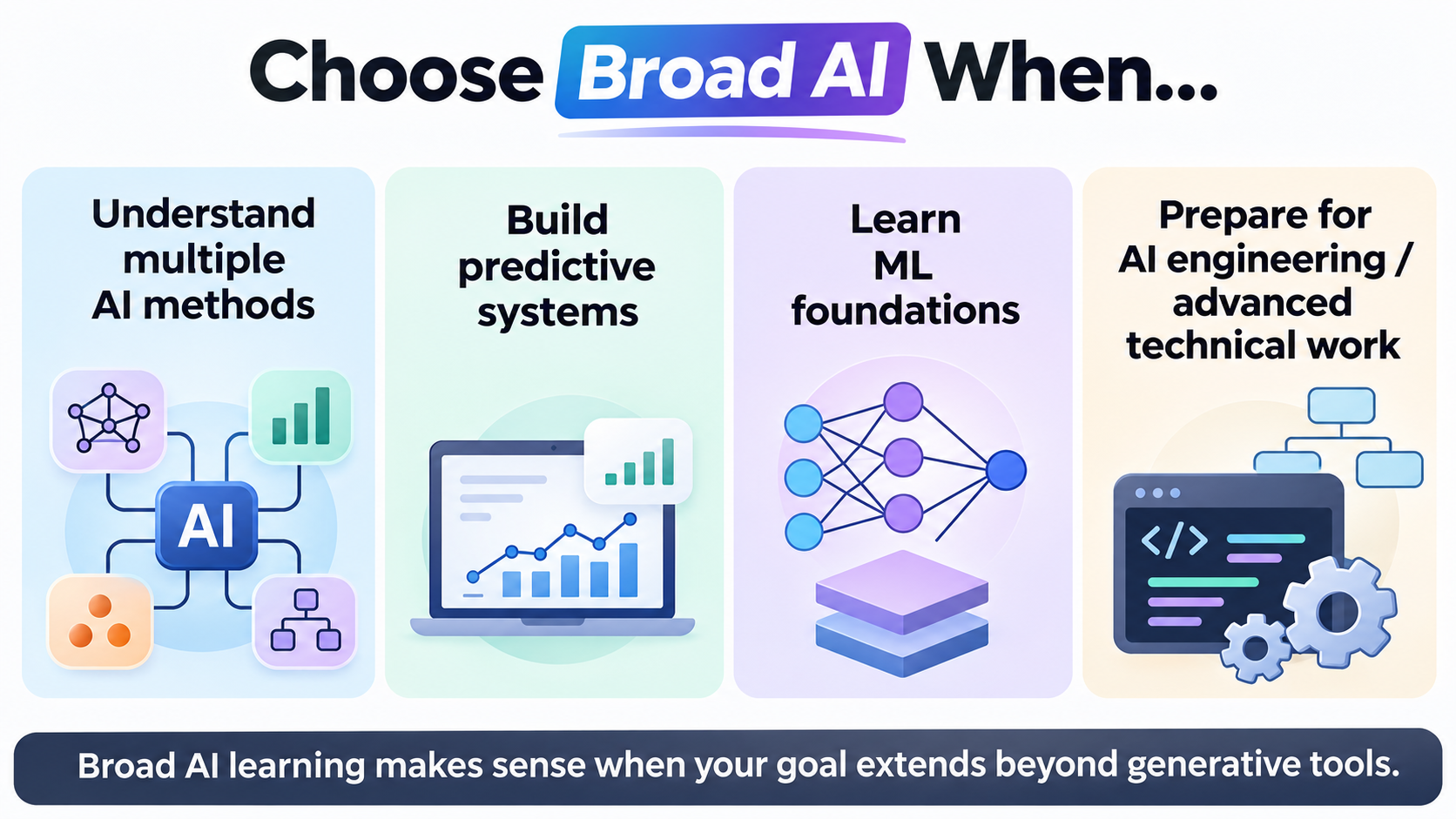
A broad AI course can be useful when you want to understand the range of AI technologies and their applications.
Suppose you're a business analyst who wants to develop deeper technical capabilities.
You may need to understand predictive models, classification, machine learning and model evaluation.
An AI programme with suitable foundations could be more useful than a course limited to generative AI tools.
The same applies to someone interested in AI engineering or advanced technical work.
Learning how models are developed, evaluated and integrated into software systems may be important.
A narrow course focused only on generating text or images may not provide sufficient preparation.
When Does a Generative AI Course Make More Sense?
A focused generative AI course may be suitable when the work you want to improve is directly related to language, knowledge, content or software generation.
Consider a marketing professional.
They may want to use generative AI to support campaign ideation, research summaries, content development or customer communication.
A legal operations professional might explore document summarisation while learning to verify important information.
A software developer may want to understand code-generation tools and how to evaluate their output.
In these situations, a relevant generative AI programme may offer a more direct route to the capabilities needed.
But the learning should go beyond collecting prompts.
Professionals need to understand how to evaluate outputs, protect information and identify where human judgement remains necessary.
Why Prompt Engineering Alone Is Not Enough
A common attraction of generative AI learning is the promise of becoming proficient through better prompts.
Prompt design is useful.
Clear instructions, relevant context and appropriate examples can improve the quality of many AI-generated outputs.
But prompting is only one part of effective AI use.
Consider a finance professional who asks a generative AI tool to analyse a company report.
The response may look convincing.
But if the tool misinterprets financial figures or overlooks an important qualification, the output could be misleading.
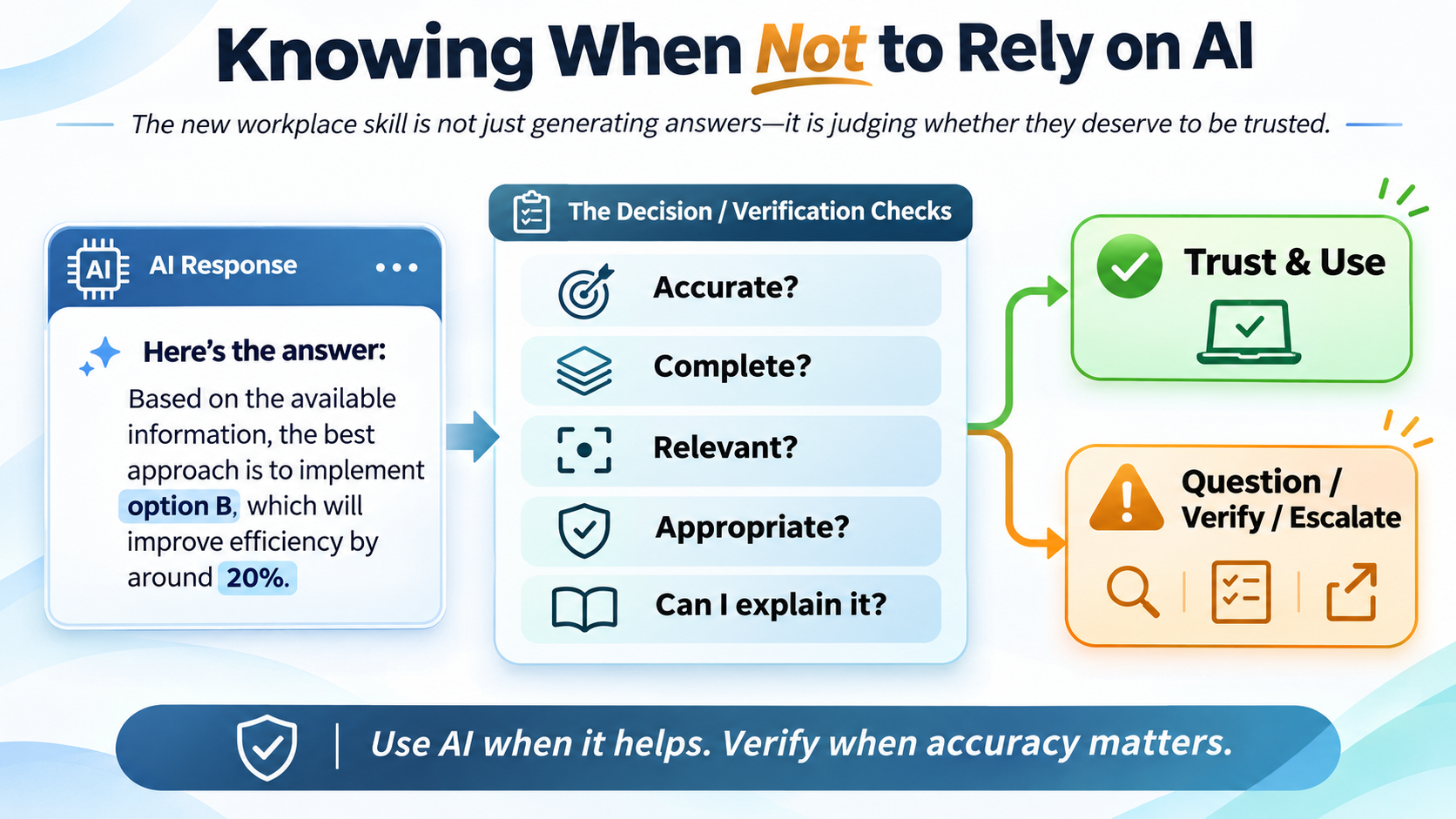
The professional still needs to verify the information.
Similarly, a developer using AI-generated code needs to test its correctness, security and compatibility with the application.
The valuable skill is not simply obtaining a response.
It is understanding whether the response is useful, accurate and appropriate.
Can You Learn Generative AI Without Coding?
Yes, depending on your learning objective.
Professionals who want to use generative AI for communication, research, summarisation or basic workflow support can begin without advanced programming knowledge.
However, developing custom applications, integrating models into business systems or building technical AI products may require programming and software engineering skills.
The distinction is between using generative AI and engineering generative AI solutions.
A programme designed for business users should not necessarily be judged by how much code it teaches.
Likewise, an advanced technical programme should not be evaluated only through the number of AI tools it introduces.
The curriculum must match the intended outcome.
How Can You Choose the Right Programme?
Before selecting an AI or generative AI course, ask four questions.
- What problem am I trying to solve?
Do you want to understand AI broadly, develop predictive systems or improve workflows involving text, content and knowledge?
- How technical do I want to become?
Are you aiming to use AI tools, manage AI projects or develop AI applications?
- What foundations do I already have?
Consider your programming, mathematics, data and professional knowledge.
- What practical work will I complete?
Look for projects, assessments and opportunities to apply learning to realistic problems.
A course that teaches the right concepts at the right level will generally be more useful than one that simply covers the largest number of trending topics.
The Best AI Course Starts With the Right Objective
Generative AI has expanded what professionals can do with intelligent systems.
But it does not represent the entire field of artificial intelligence.
Predictive modelling, computer vision, optimisation and other AI applications remain relevant across industries.
If you want a broad understanding of intelligent systems, a comprehensive AI course may be more appropriate.
If you want to develop capabilities around LLMs, AI assistants, content generation or related applications, a generative AI course may provide more focused learning.
And if your role involves broader technology decisions, you may need elements of both.
Through Digivarsity, learners can explore relevant AI and technology education pathways and compare their curriculum, technical prerequisites and intended professional audience.
Before choosing, ask:
"Am I trying to understand AI as a field, apply generative AI to my work or build AI-powered systems?"The answer will help you identify the learning pathway that makes sense.
Frequently Asked Questions
Is generative AI different from artificial intelligence?
Generative AI is a category within artificial intelligence. It focuses on generating content and related outputs, while AI also includes areas such as predictive modelling, classification, computer vision and optimisation.
Should beginners learn AI or generative AI first?
It depends on the objective. Beginners who want to use AI tools at work can start with practical AI literacy and generative AI applications. Those pursuing technical AI careers should develop programming, mathematics and machine learning foundations.
Is coding required for a generative AI course?
Not for every programme. Introductory courses focused on using generative AI may not require coding, while technical programmes involving application development, model integration or engineering usually require programming skills.


Comments
Be the first to share your thoughts on this article.