Every few weeks, there's another headline:
“AI will replace these jobs.”
Then another list appears.
Accountants.
Marketers.
Developers.
Writers.
Customer service.
Analysts.
It can leave you wondering:
“Is my job next?”
But there's a more useful way to think about AI and careers.
Instead of asking:
“Will AI replace my job?”
ask:
“Which parts of my job can AI do—and what becomes more valuable when it does?”
Because in many careers, AI is likely to change the tasks inside the job before it eliminates the entire job.
Which Jobs Are Most Likely to Change?
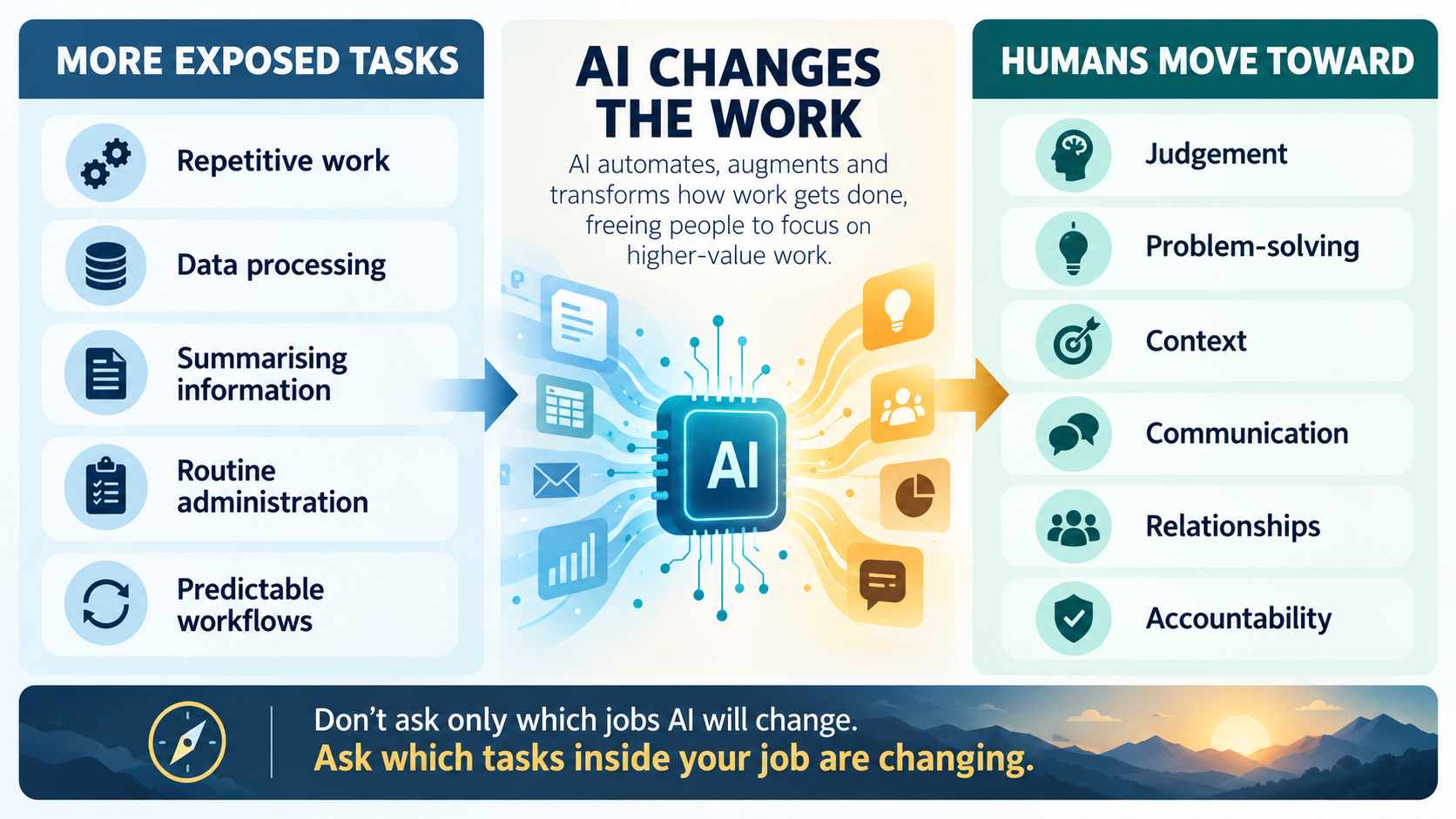
Work that contains large amounts of repetitive, predictable or information-processing activity is particularly exposed to automation.
The World Economic Forum's Future of Jobs Report identifies roles such as data entry clerks, bank tellers, administrative assistants and some clerical positions among roles employers expect to decline significantly by 2030.
But that is only half the story.
The same research expects growth in roles including software development, care, education, construction, delivery and areas connected with the green transition.
So the future of work isn't simply:
AI arrives → jobs disappear.
Some roles will decline.
New ones will emerge.
And a large number will change.
Want to Understand Where AI Fits Into Your Career?
Explore programmes in AI, analytics, technology and digital transformation.
Explore AI & Technology ProgrammesMarketing Won't Disappear. But Marketing Work Will Change.
Take marketing.
AI can already:
- Generate copy
- Suggest campaign ideas
- Analyse data
- Create images
- Summarise customer research
- Build variations of advertisements
Does that mean marketers disappear?
Not necessarily.
It means producing the first draft may become much easier.
The marketer's value may increasingly move towards:
Understanding the customer.
Choosing the right strategy.
Judging whether an idea is good.
Protecting the brand.
Connecting marketing to business results.
When execution becomes easier, judgement becomes more important.
The Same Applies to Many Knowledge Jobs
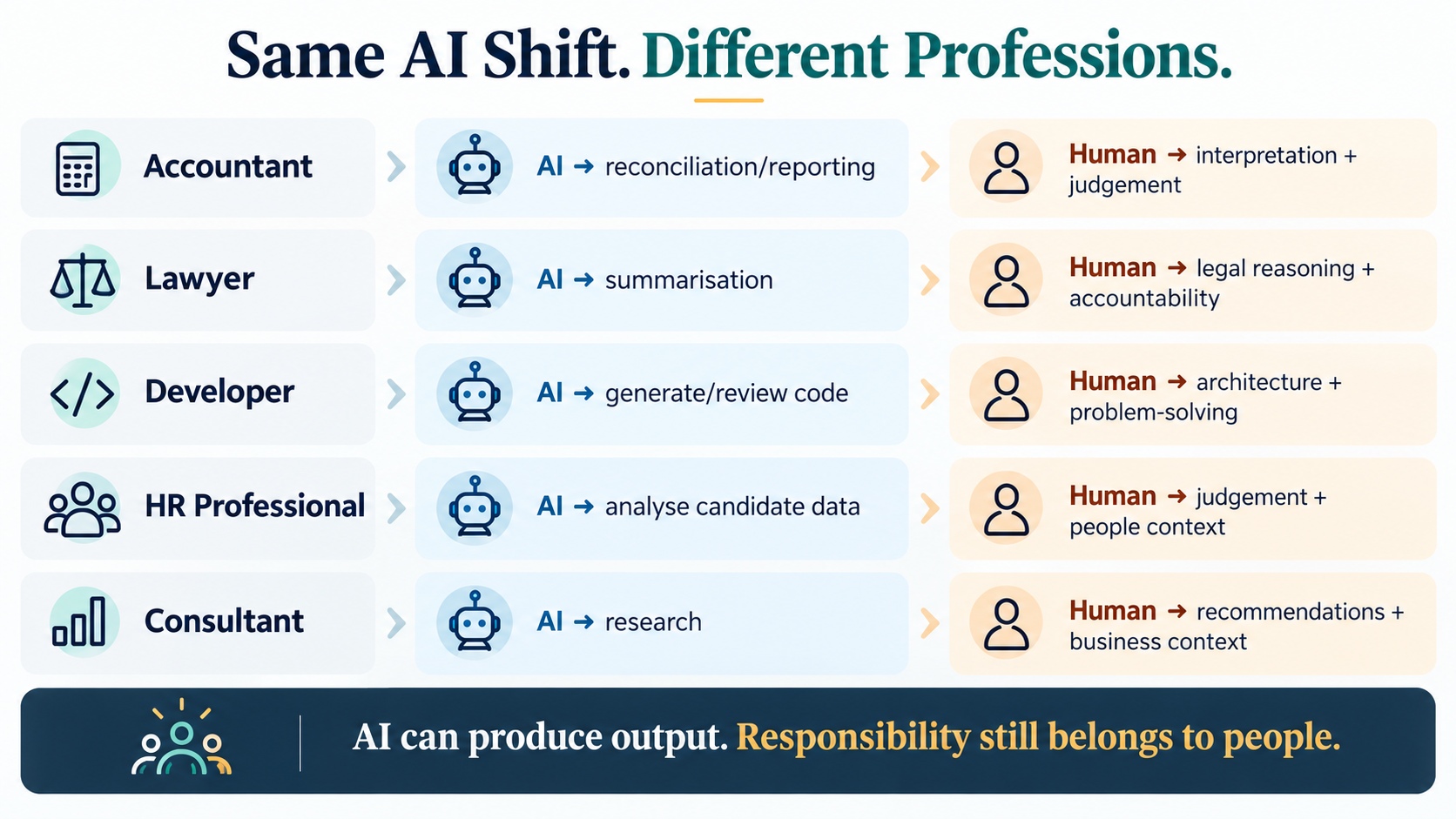
An accountant may use AI to automate repetitive reconciliation or reporting.
A lawyer may use it to summarise documents.
A software developer may use it to generate or review code.
An HR professional may use it to help analyse candidate information.
A consultant may use it to accelerate research.
In each case, some tasks become faster.
But someone still needs to ask:
Is the output correct?
Is important context missing?
Is the recommendation sensible?
What should happen next?
Who is accountable?
AI can produce output. Responsibility still belongs to people.
AI Skills Alone Aren't Enough
One response to this change is:
“Fine. I'll learn AI.”
That's useful—but incomplete.
LinkedIn's 2026 Skills on the Rise research shows growth in AI capabilities such as prompt engineering and large language models, but also highlights collaboration, stakeholder communication, leadership and business-development capabilities.
That combination matters.
Imagine two people who can both use the same AI tool.
One understands the industry, asks better questions, checks the answer and explains the recommendation clearly.
The other copies whatever the tool generates.
They don't have the same skill.
AI becomes more valuable when you combine it with expertise and judgement.
How Do You Future-Proof Your Career?
You probably can't make any career completely “future-proof.”
But you can make yourself much more adaptable.
1. Understand Which Parts of Your Job Can Be Automated
List the tasks you do every week.
Which are repetitive?
Which involve summarising or processing information?
Which require judgement?
Which depend on relationships?
Then experiment with where AI helps.
Don't wait until your employer changes the process around you.
Learn how the process might change.
2. Build Skills Around the Technology
If AI makes a task 50% faster, don't spend all your energy becoming slightly faster at the old method.
Develop the capabilities around it.
For example:
An analyst can strengthen business understanding and storytelling.
A marketer can develop strategy and consumer insight.
A developer can strengthen architecture and problem-solving.
A manager can become better at decision-making and people leadership.
Move towards the parts of your job that require context and judgement.
3. Keep Your Domain Knowledge Strong
Knowing AI without knowing anything else isn't much of a career strategy.
A finance professional who understands finance deeply can use AI better in financial work.
A lawyer can evaluate legal output better than someone who only knows prompting.
A marketer with strong customer understanding can judge AI-generated ideas more effectively.
Technology amplifies expertise.
It doesn't automatically create it.
4. Get Comfortable Learning Repeatedly
The World Economic Forum estimates that 39% of workers' existing skills will change or become outdated between 2025 and 2030.
So the goal cannot be:
“Learn one future-proof skill and I'm done.”
There probably isn't one.
Instead, get good at learning.
Short courses.
Projects.
New tools.
Reading.
Mentoring.
Stretch assignments.
Your career may depend increasingly on how quickly you can update yourself.
Don't Compete With AI at What AI Does Best
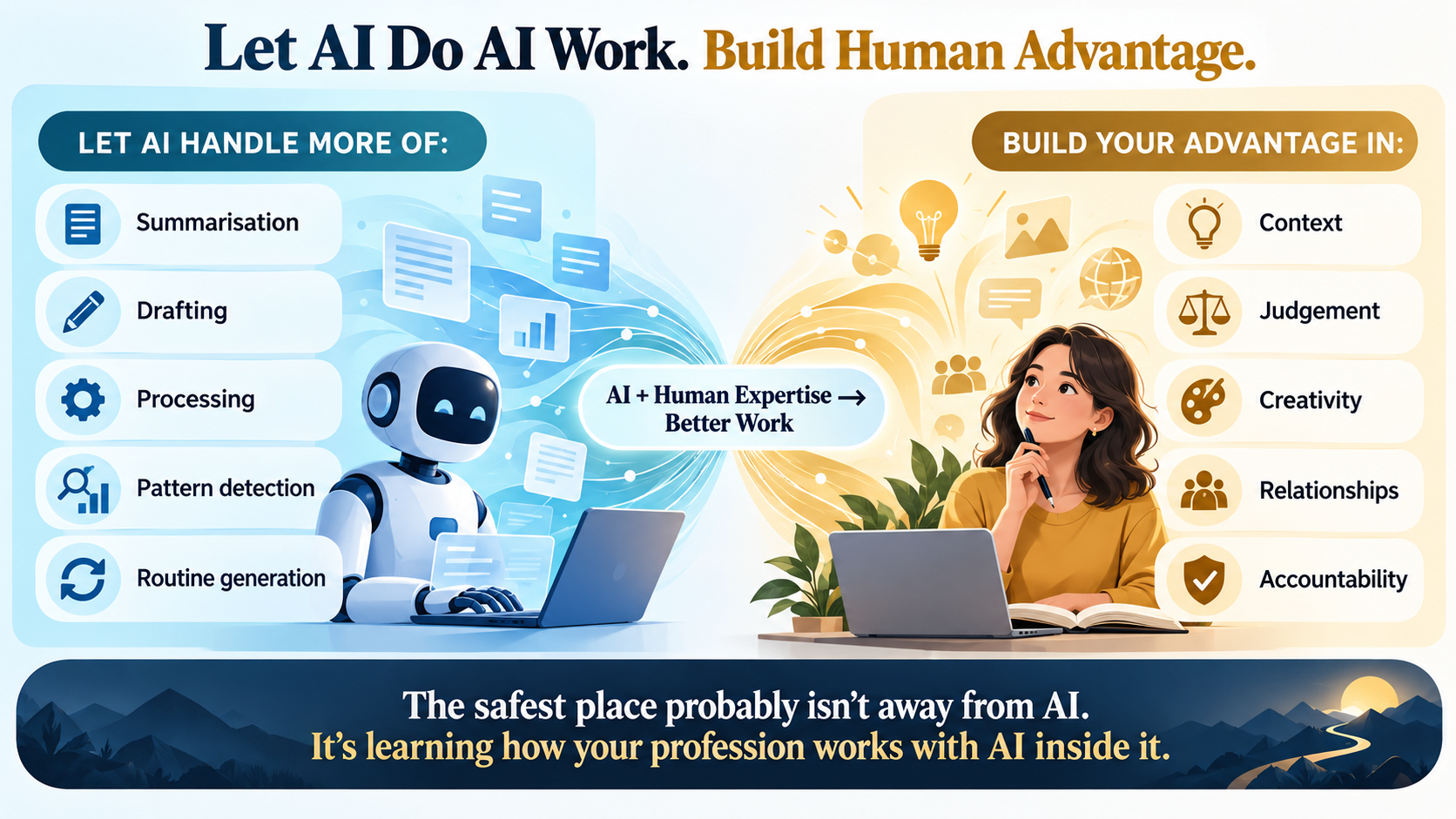
If a tool can summarise a 40-page document in seconds, building your career around being the fastest person at summarising documents may become risky.
Use the tool.
Then add something it doesn't automatically provide:
Context. Judgement. Creativity. Relationships. Accountability.
The safest place probably isn't away from AI.
It's learning how your profession works with AI inside it.
So instead of worrying about whether AI will take your job, start with something more practical:
Which part of my work is changing—and what should I become better at next?
That's a question you can actually act on.
Frequently Asked Questions
Which jobs are most at risk from AI?
Roles containing large amounts of repetitive, predictable and information-processing work are more exposed to automation. However, AI may change individual tasks without eliminating the entire occupation.
Should everyone learn AI skills?
Most professionals will benefit from basic AI literacy. The depth required depends on the role—using AI effectively in marketing is very different from developing AI systems as an engineer.
What skills are hardest for AI to replace?
Human judgement, domain expertise, complex problem-solving, relationship-building, leadership, creativity and accountability can remain especially important when combined with strong technology skills.




Comments
Be the first to share your thoughts on this article.