You're a marketing manager, finance professional, HR executive or business operations specialist.
You understand your work.
You know your customers, processes, industry requirements and the decisions involved in your role.
But artificial intelligence is becoming part of the conversation.
Your organisation is exploring automation.
Colleagues are using AI assistants.
Business teams are discussing predictive analytics, machine learning and intelligent workflows.
You want to understand these developments without necessarily becoming a programmer.
So you start exploring AI and machine learning courses.
And almost immediately, the technical language becomes overwhelming.
Python. Algorithms. Neural networks. Regression. Deep learning.
Do you really need all of this to work effectively with AI?
Not necessarily.
For non-technical professionals, the right learning pathway depends on whether you want to use AI in your existing role, manage AI-related initiatives or move towards a technical specialisation.
These are different objectives.
Why Non-Technical Professionals Need to Understand AI
AI is increasingly relevant to work outside technology departments.
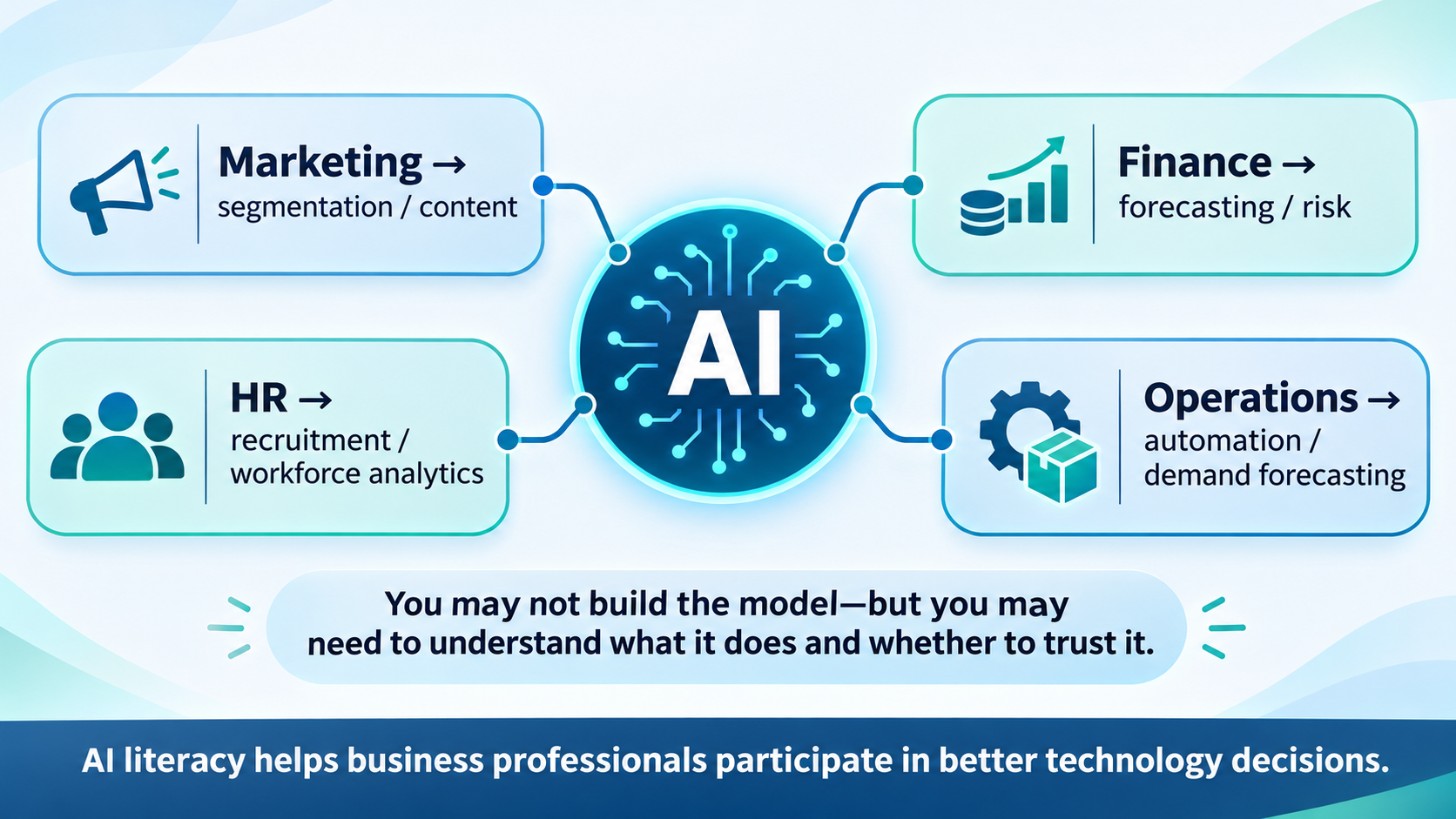
A marketing professional may encounter AI-powered customer segmentation or content tools.
A finance manager may use systems that support forecasting, reporting or risk analysis.
An HR professional may work with AI-enabled recruitment platforms or workforce analytics.
An operations manager may evaluate automation or demand forecasting.
In each case, the professional does not necessarily need to develop the underlying AI model.
But they may need to understand what the system can do, how reliable its output is and whether the application is appropriate for the business.
This is where foundational AI literacy becomes useful.
It allows professionals to participate more meaningfully in technology-related decisions.
Learn AI for the Role You Already Have.
Build practical AI understanding without assuming you need to become a programmer.
Compare ProgrammesFirst, Understand the Difference Between AI and Machine Learning
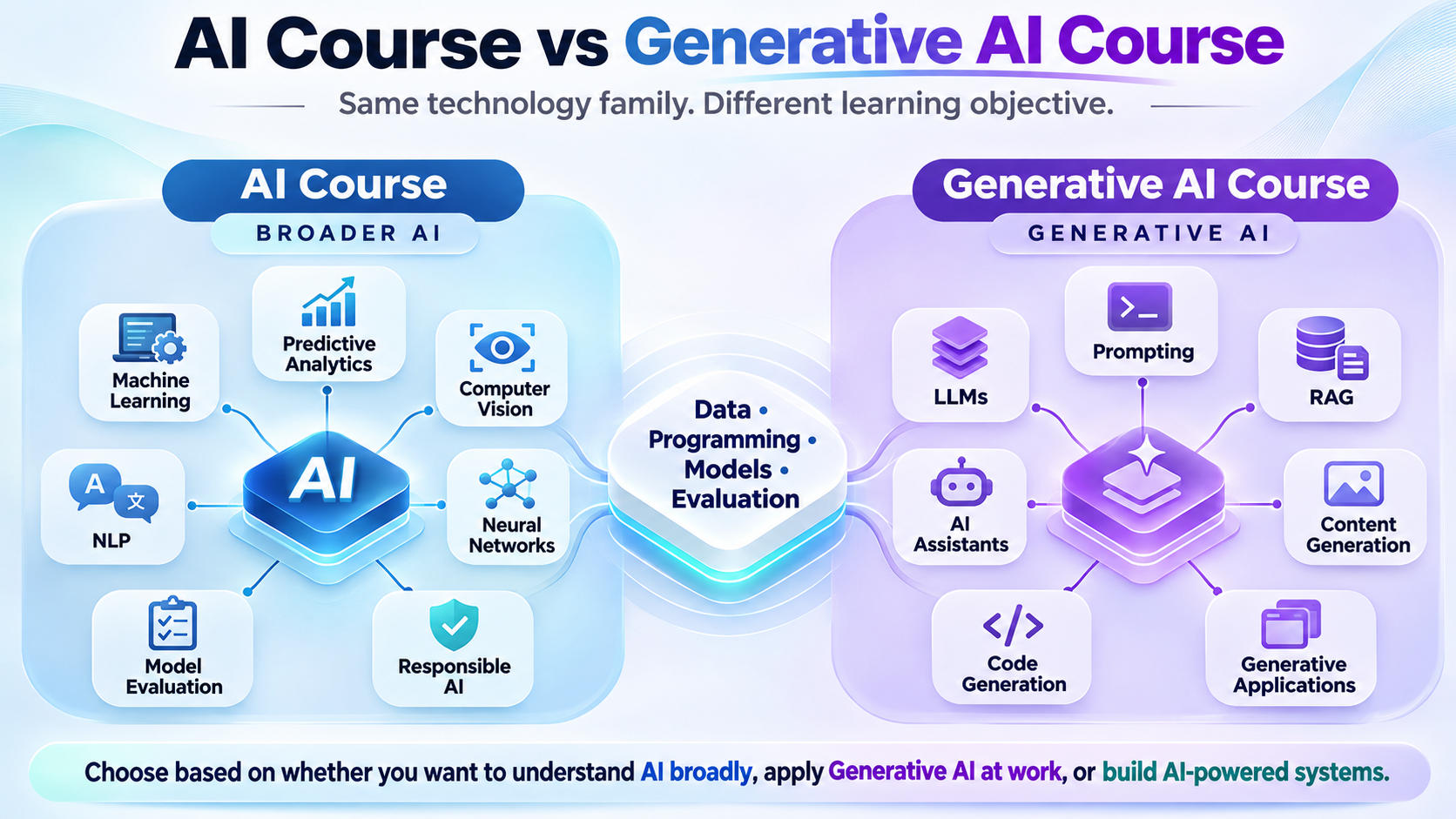
Artificial intelligence is the broader field.
It includes systems that perform tasks involving prediction, language processing, recognition, reasoning or other intelligent capabilities.
Machine learning is one important approach within AI.
It involves developing models that learn patterns from data and use those patterns to produce predictions or other outputs.
Consider a company trying to forecast customer demand.
A machine learning model may analyse historical sales, seasonal patterns and other relevant information to estimate future demand.
The operations manager may not need to build the model.
But they should understand what information it uses, how its predictions are evaluated and what might make its results unreliable.
That level of understanding can help managers make better decisions about AI applications.
Do You Need to Learn Coding?
Not always.
If your objective is to become more effective in a business role, you can begin by learning foundational AI concepts and practical applications.
You should understand what AI can do, where it may fail and how to evaluate its usefulness.
Advanced programming becomes more relevant when you want to build models, develop AI applications or move into technical AI roles.
This distinction matters because non-technical professionals sometimes assume they must become programmers before learning anything useful about AI.
That isn't the case.
But it would also be misleading to suggest that a short no-code course can prepare someone for advanced machine learning engineering.
The right level of technical learning depends on the responsibilities you're preparing for.
What Should Non-Technical Professionals Learn First?
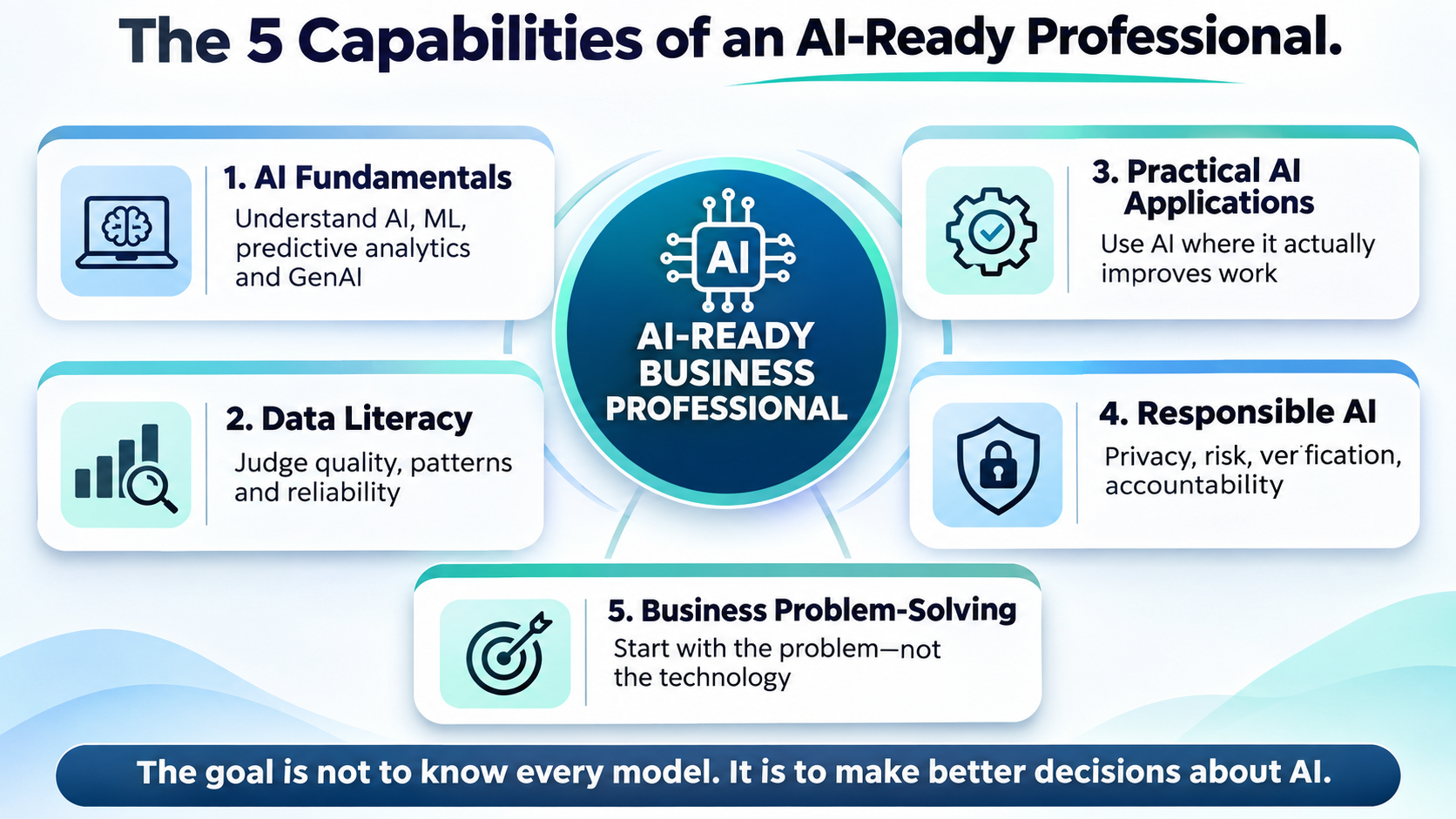
A useful starting curriculum should develop five capabilities.
1. AI Fundamentals
Understand concepts such as artificial intelligence, machine learning, predictive analytics and generative AI.
Learn how these technologies differ and what kinds of problems they are designed to address.
For example, a predictive model might estimate customer churn.
A generative AI tool might help prepare a communication draft.
Knowing the difference helps you select appropriate applications.
2. Data Literacy
AI systems depend on information.
You should understand basic data concepts such as data quality, patterns, accuracy and interpretation.
You don't necessarily need advanced statistics to begin.
But you should be able to recognise when information is incomplete or unreliable.
Suppose an AI system analyses customer feedback.
If the underlying data represents only a small or unusual group of customers, its conclusions may not reflect the broader customer base.
Understanding that limitation is part of effective AI literacy.
3. Practical AI Applications
Learn how AI can support tasks relevant to your function.
For a marketing professional, this might involve campaign analysis or content workflows.
For an HR professional, it could involve workforce reporting or employee communication.
For a finance professional, it might involve summarising reports or supporting analytical work.
The objective should be to understand when AI genuinely improves a task, not simply to use it wherever possible.
4. Responsible AI and Risk Awareness
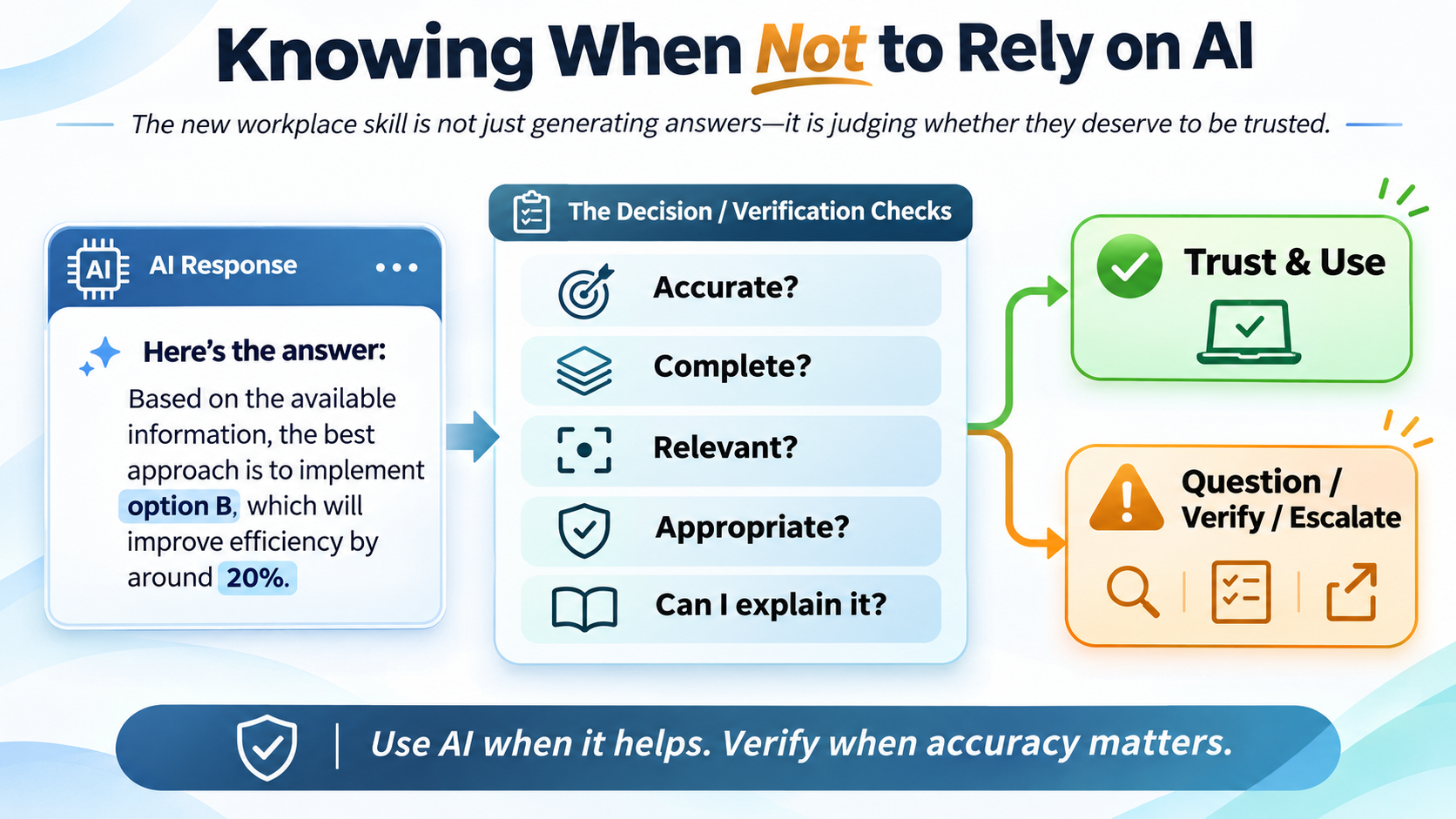
AI systems can produce incorrect, incomplete or biased outputs.
They can also create concerns involving confidential information, privacy and accountability.
Professionals should learn how to evaluate AI-generated recommendations, protect sensitive information and recognise situations requiring independent verification.
UNESCO's AI competency frameworks emphasise human-centred thinking, responsible use and critical judgement alongside technical understanding.
These principles are relevant even for people who never write a line of code.
5. Business Problem-Solving
This may be the most important capability.
Before adopting AI, you need to understand the business problem.
Is a process slow because employees repeat the same tasks?
Is customer service underperforming because information is difficult to access?
Are forecasts unreliable because the underlying data is incomplete?
Sometimes AI may help.
Sometimes a simpler process change or better information system may be more effective.
The ability to recognise the difference is valuable.
What Should Different Professionals Focus On?
AI learning becomes more useful when connected to an existing function.
|
Professional background |
Relevant AI learning areas |
|
Marketing |
Customer analytics, generative AI, campaign evaluation and content workflows |
|
Finance |
Predictive analytics, AI-assisted reporting, risk awareness and model interpretation |
|
HR |
Workforce analytics, recruitment technology, privacy and responsible AI |
|
Operations |
Forecasting, process automation and operational analytics |
|
Sales |
Customer insights, forecasting and AI-assisted sales workflows |
|
Management |
AI strategy, implementation, governance and technology investment decisions |
These are starting points, not complete curricula.
A finance manager may require more analytical depth than a general business administrator.
An operations leader responsible for implementing AI systems may need to understand technical architecture and data requirements.
Learning should reflect actual responsibilities.
What If You Want to Move Into AI Leadership?
Some professionals are not trying to become technical experts.
They want to lead AI initiatives within their organisations.
That requires a broader perspective.
Imagine you're responsible for introducing an AI-powered reporting system.
Your technical team can explain how the solution works.
But you may need to decide:
Which business problem should the project address?
What data will be required?
How will employees use the system?
What risks need to be managed?
How will the organisation measure whether the investment has been worthwhile?
These questions involve business strategy, technology understanding, organisational change and accountability.
An executive AI programme designed for managers may be useful when it develops these capabilities.
But the programme should offer more than introductory demonstrations of AI tools.
Look for business cases, implementation frameworks, responsible AI topics and meaningful applied learning.
Should You Learn Machine Learning in Detail?
That depends on how closely your role interacts with predictive models and technical teams.
For some professionals, conceptual knowledge may be sufficient.
You may need to understand why models require good data, how their performance is measured and what can make predictions unreliable.
For others, deeper learning may be valuable.
A business analyst moving towards advanced analytics might benefit from statistics, Python and introductory machine learning.
A product manager responsible for an AI-enabled application may need to understand model evaluation and technical constraints.
A professional who wants to become an AI engineer will require substantially more mathematical, programming and engineering knowledge.
These objectives should not be grouped together simply because all involve AI.
A Practical Four-Week AI Learning Plan
If you're beginning with limited technical experience, try a structured introduction before committing to an advanced programme.
Week 1: Understand the Fundamentals
Learn the differences between AI, machine learning and generative AI.
Identify examples from your own industry.
Week 2: Explore Practical Applications
Choose one routine task in your work.
Investigate whether an approved AI tool could assist with it.
Use only information you're permitted to share.
Week 3: Practise Evaluation
Examine the tool's outputs.
Check their accuracy, completeness and relevance.
Identify the situations where human judgement is essential.
Week 4: Assess Business Value
Consider whether the application saves time, improves quality or helps produce a better outcome.
Document its limitations.
Decide whether the use case is worth exploring further.
This exercise won't make you an AI specialist.
But it can help you understand how AI learning connects with your actual responsibilities.
How Should You Evaluate an AI Course?
Before enrolling, ask five questions.
- Who is the course designed for?
A programme for business leaders may differ significantly from one intended for data scientists or software engineers.
- What technical knowledge does it assume?
Check whether programming, statistics or mathematics are prerequisites.
- What will I be able to do afterwards?
Look for specific learning outcomes rather than broad promises about career transformation.
- Will I work on relevant business problems?
Case studies, practical exercises and applied projects can make the learning more meaningful.
- What credential will I receive?
Verify the awarding institution, programme requirements and whether the outcome is a professional certificate, academic credit or formal qualification.
The label "AI and Machine Learning" does not automatically establish technical depth or academic status.
What an AI Course Cannot Do for You
A short course may help you understand concepts and develop practical capabilities.
It does not automatically make you qualified to build production AI systems.
It does not guarantee a promotion or salary increase.
And it cannot replace professional judgement.
If you're an experienced finance manager, your understanding of finance remains important.
If you're a marketing leader, your customer knowledge and strategic judgement continue to matter.
AI education should strengthen those capabilities rather than suggest they are becoming irrelevant.
The greatest value may come from combining existing domain expertise with a better understanding of technology.
You Don't Have to Become a Programmer to Benefit From AI
The growing use of AI does not mean every professional needs to follow the same technical learning pathway. Some people will develop and maintain AI systems. Others will use AI-enabled applications. And many will be responsible for deciding where technology creates value, how it should be implemented and what risks need to be managed. Each role requires a different depth of knowledge. For non-technical professionals, a sensible approach is to begin with AI literacy, develop relevant data skills and explore practical applications within your own field. From there, you can decide whether deeper technical or executive education is necessary. Digivarsity offers a starting point for exploring AI, analytics and management learning pathways through partner institutions, allowing learners to compare programmes according to their professional objectives. Before choosing an AI course, ask yourself:"Do I need to build AI technology, or do I need to understand how to use it to make better decisions in my existing role?"That distinction can help you avoid unnecessary learning and focus on capabilities that matter to your career.
Frequently Asked Questions
Can non-technical professionals learn AI and machine learning?
Yes. Professionals can begin with AI fundamentals, data literacy and practical applications without advanced programming. More technical roles require additional mathematics, coding and model-development skills.
Which AI course is suitable for managers?
A course focused on AI applications, business strategy, data-driven decisions, responsible AI and implementation may be relevant. The best programme depends on the manager's responsibilities and intended outcomes.
Do I need Python to learn AI for business?
Not necessarily. Python is valuable for technical AI development and advanced analytics, but professionals focused on understanding AI applications and evaluating business use cases can begin without programming.

Comments
Be the first to share your thoughts on this article.